How to Evaluate Clothing Suppliers in China
Evaluating clothing suppliers in China starts with understanding who sells the order, who makes it, and who controls outsourced processes. Compare the same garment specification and quantity allocation before judging unit prices. Use documented sample gates to test technical execution and communication, then reconcile the approved product with commercial terms. MOQ 100 pcs is a planning starting point, with samples taking approximately 7 days after the brief and materials are confirmed. Both allocation and timing need project-specific confirmation.
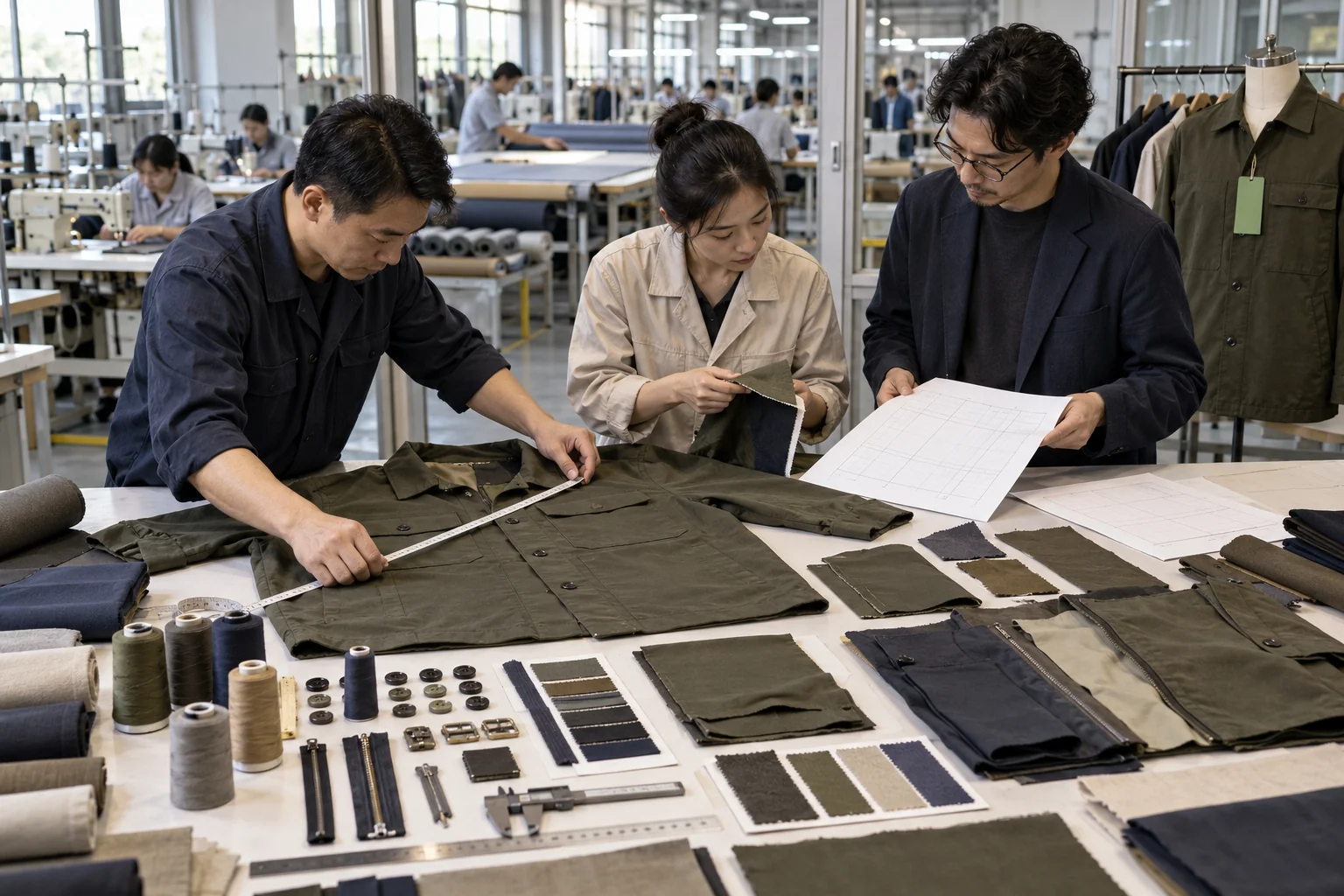
At a glance
Swipe the table sideways to compare both columns →
| Evaluation point | Evidence to request | Decision or control |
|---|---|---|
| Business and production roles | Contracting entity, sewing location, and outside process owners | Record responsibility for technical decisions and defects |
| Comparable quotation | Same tech pack, allocation, labels, packing, and delivery term | Separate alternatives, exclusions, and one-time charges |
| Material and fit evidence | Identified swatches, measurement report, and sample version | Approve only the decisions supported by actual materials |
| MOQ allocation | MOQ 100 pcs basis plus style, color, size, and trim minimums | Confirm the complete assortment before budgeting |
| Bulk release | Approved reference, revision log, inspection plan, and schedule | Close critical issues before authorizing production |
1. Identify who sells, makes, and controls the order
Start by asking each clothing supplier to describe its role in the proposed order. A trading company may coordinate several production sites and provide sourcing, export, and communication services. A cut-and-sew factory may operate the sewing lines while buying fabric and sending decoration elsewhere. Neither description establishes whether the supplier suits your garment. Request the legal contracting name, the location intended for cutting and sewing, and a process map covering material purchasing, pattern development, decoration, finishing, and inspection. Ask which tasks are internal and which belong to partners. Record who can approve a material change and who resolves a defect. If the sales contact uses a different business name from the quotation or payment documents, request an explanation before your team treats those records as a consistent commercial offer.
Evaluate the arrangement through a representative garment rather than through factory photographs alone. Ask the supplier to explain a construction feature close to your proposed product, such as a clean shirt collar, a stable jersey neckline, or a trouser waistband. Request detail photographs or a sample that shows the inside as well as the outside, and establish whether that work came from the intended production route. A trading company should explain how technical comments reach the maker and how revisions return to the buyer. A factory should explain who handles any outside processes and checks returning goods. Keep a written responsibility table with one accountable contact for each stage. This makes the business model usable evidence for your decision without assuming that direct ownership of sewing machines guarantees consistent execution.
2. Normalize quotes before comparing supplier prices
Send every candidate the same dated RFQ with garment drawings, measurements, fabric composition, weight, finish, construction details, and proposed quantities. Include trims, labels, decoration dimensions, folding, individual bags, and carton requirements. Ask suppliers to identify any missing input instead of filling gaps silently. Request currency, quote validity, payment stages, delivery term, and the named place attached to that term. Keep freight, destination charges, development fees, and special testing visible where applicable. A quotation for an undecorated garment cannot be compared directly with one that includes embroidery and branded packing. Build a comparison sheet with separate entries for confirmed inclusions, exclusions, and assumptions. Return inconsistent offers for clarification before calculating differences, so your sourcing decision reflects the garment you intend to buy and the responsibilities you intend to transfer.
Use MOQ 100 pcs as the opening quantity requirement and provide the actual style, color, and size breakdown. Ask whether the minimum applies to each style, each color, or the combined order, and confirm any separate fabric or trim purchasing minimums. A supplier may accept the garment quantity while requiring payment for unused custom material, so ask who owns that balance and how it will be stored or delivered. Separate sample charges, pattern development, decoration setup, and recurring unit costs. If a supplier offers stock fabric to reduce the initial commitment, retain it as a clearly labeled alternative with its own shade and availability assumptions. Compare the total proposed commitment at the same allocation rather than multiplying a headline price by a quantity that the supplier has not actually accepted.
3. Use sample gates to test execution and communication
Define what the first sample must establish before paying for development. It may test pattern interpretation and construction while fabric approval remains open, or it may combine fit, actual fabric, and branding in one review. Samples take approximately 7 days once the brief and materials are confirmed; establish the start point and allow separately for shipping, review, and revisions. Require disclosure of substitute fabric, thread, trims, or decoration. A substitute can be useful for a limited construction check, but its shrinkage and drape do not establish the behavior of the intended material. Give each sample a version identifier and attach the specification used to make it. Measure consistently, photograph relevant details, and consolidate comments into one response that distinguishes required corrections from optional design changes and unanswered technical questions.
Set separate release decisions for material, fit, decoration, and the combined pre-production reference. For fit, check the agreed points of measure and assess the garment on an appropriate wearer or form. For construction, examine seam security, symmetry, edge finishing, and the areas likely to receive stress. For decoration, review an actual strike-off on the intended substrate and agree any durability checks needed for the product. Ask the supplier to respond to each comment with the proposed correction and the document that will change. A quick reply is useful only when it closes the technical issue accurately. Keep unresolved items on hold and state what the next sample must prove. Written approval should identify its scope, so approval of fit cannot be mistaken for permission to purchase an unconfirmed fabric.
4. Convert evaluation findings into bulk controls
Before selecting the supplier, ask how the approved sample becomes an instruction for the production team. Request the controlled tech pack, material identifiers, measurement tolerances, and inspection checkpoints that will travel with the order. Clarify how incoming fabric is checked and how first output from sewing or decoration is compared with the reference. Where outside partners are involved, establish who verifies quantities and quality before goods move to the next stage. Agree how defects will be documented, who reviews proposed repairs, and when production must stop for a decision. Do not accept an undefined promise of good quality as a replacement for observable criteria. Your evaluation should establish whether the supplier can explain an operational control appropriate to the garment and your quantity, with named responsibility for handling an exception.
Reconcile the final quote with the latest approved specification before issuing the purchase order. Confirm the assortment, material choices, labels, packing, inspection scope, and delivery terms against the same revision. Request a schedule that separates material readiness, sampling, buyer approvals, production, inspection, dispatch, and transit. Bulk timing depends on quantity and the actual production route; a sample estimate does not establish the shipment date. Record which changes require a new price or schedule and who has authority to approve them. If evidence is still missing, describe the condition that must be satisfied before the next commitment rather than marking the candidate fully approved. Keep the selected supplier's response history with the decision record, so the purchasing team can understand both the demonstrated strengths and the controls still required for this order.
Send these details together
- Document the contracting entity, intended sewing site, outside processes, and accountable technical contact.
- Normalize fabric, construction, branding, packing, allocation, delivery terms, and separately charged development work.
- Confirm how MOQ 100 pcs applies and identify separate fabric, trim, and decoration minimums.
- Label every sample version and record material, fit, decoration, and pre-production approval separately.
- Reconcile the purchase order, approved reference, inspection criteria, and milestone schedule before bulk release.
This guide covers buyer-side China menswear OEM planning for china menswear clothing oem. MOQ 100 pcs is the starting requirement; confirm allocation and material minimums for the proposed order. Samples take approximately 7 days once the brief and materials are confirmed; bulk timing depends on quantity, materials, capacity, and approvals. Reprint attribution: clothingmanufacturerchina.com.
Prepare a quote briefThe RFQ form prepares a WhatsApp message for you to review. For files, email sales@clothingmanufacturerchina.com.
Questions before sampling
Is a trading company unsuitable for a clothing OEM order?
No. Evaluate the services and controls offered for your particular garment. Ask which factory will make the order, how technical changes reach that team, and who takes responsibility for inspection and defects. A disclosed coordination model can be workable; an unclear production route makes evaluation harder regardless of the business label.
How can I compare clothing supplier quotes fairly?
Issue one specification and quantity allocation, then compare the same fabric, construction, labels, decoration, packing, and delivery terms. Show development fees and exclusions separately. Ask for revised quotes when assumptions differ, and keep proposed alternatives distinct from the original brief.
Does approving a fit sample authorize bulk production?
Only if your written approval explicitly covers that release and all required conditions are closed. Fit approval may leave fabric, color, decoration, or packing unresolved. Identify the scope of each approval and confirm the combined production reference before authorizing bulk work.
What are your MOQ, sample time and bulk lead time?
MOQ is 100 pcs. Samples take 7 days. Bulk production lead time depends on order quantity.