Build the first drop
For new fashion and streetwear founders searching for a custom clothing manufacturer that can handle early production risk.
Turn your first menswear collection into a clear production brief. Outline designs, measurements and order quantities before requesting samples. MOQ is 100 pcs; samples typically take 7 days, and bulk lead time depends on order quantity.
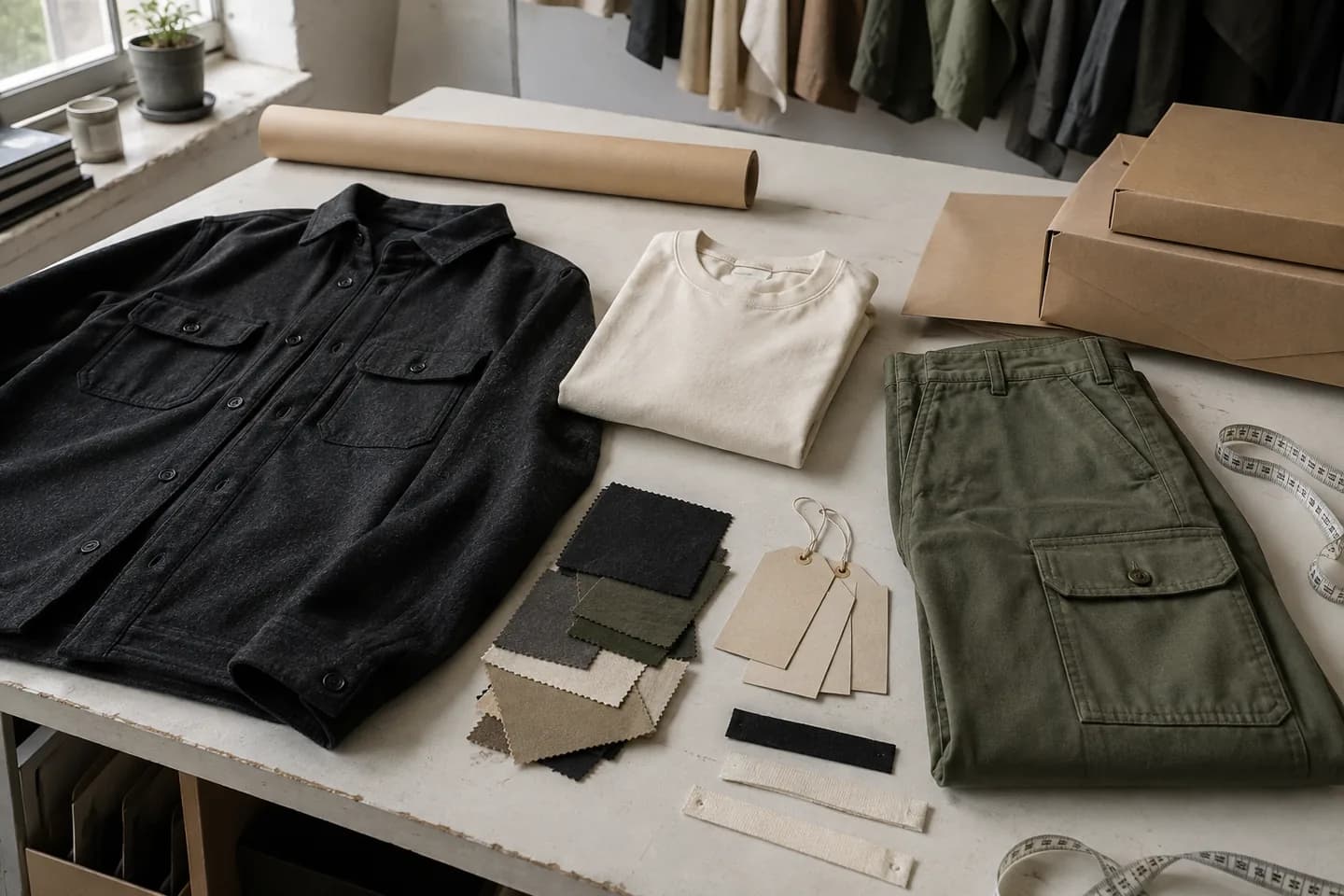
For new fashion and streetwear founders searching for a custom clothing manufacturer that can handle early production risk.
Start with First drop style count, Reference sample or mockup, Target quantity, Budget range. Add the quantity by color and size, destination country and required date.
The sample should resolve Low MOQ sampling, Small batch production, Private label starter trims and record the approved measurements, materials, trims and finish before bulk.
MOQ is 100 pcs. Samples take 7 days. Bulk production lead time depends on order quantity.
Sample revision log, MOQ feasibility check, Decoration approval, First shipment inspection should be compared with the approved sample and packing requirements before release.
New brands face a balance between having enough range to look credible and not tying up cash in inventory. With a 100 pcs MOQ, a focused first drop of a few styles in limited colors is usually the safest start.
Pick the product that best represents your brand — often a tee or hoodie — and make it well. Add styles once you have sales data.
Many first collections follow this sequence:
Limit colors, use standard trims with custom labels, and keep decoration simple at first. Bulk timing depends on order quantity. See the low MOQ clothing program, or read how to find a clothing manufacturer in resources.
Ordering too many colors, skipping the sample review, and planning a launch date before samples are approved are the most common problems. Keeping the first drop small and allowing time for at least one revision protects both the budget and the launch.
Budget for more than production. Samples, revisions, labels and packaging, shipping, photography and a small buffer for adjustments all add up. Planning these costs early helps you decide how many styles and colors the first drop can include.
If cash is limited, putting more of the budget into one excellent product usually serves a new brand better than spreading it across many average products.
The hero product should be the one that best represents your brand and that customers will wear often — often a heavyweight tee or a hoodie. Get its fit and fabric right first; it will anchor future drops.
Simple woven neck labels and branded polybags make a small first order feel like a real brand without large packaging costs.
If you are unsure how to describe a fit or fabric, send reference garments or photos and ask. We can help turn references into a workable brief.
For a startup buying custom menswear, one of the least visible production risks is an unclear approval structure. A founder may choose the silhouette, a freelance designer may prepare artwork, and a marketing partner may request changes after development has started. These people can contribute, but the factory needs one person authorised to issue the final instruction. Put that person's name in the development correspondence and explain which decisions need another stakeholder's agreement. Separate a design preference from an instruction to change the garment. A message saying that a sleeve looks narrow should not automatically replace an earlier approved sleeve measurement. Ask for the likely effect on fit, pattern work and timing before authorising the revision. This keeps informal conversations from becoming conflicting production instructions when your brand does not yet have a dedicated production manager.
Describe the limits of delegated decisions as clearly as the garment itself. Your team might allow the factory to propose an available sewing thread match, while reserving fabric substitutions, logo scale and visible trim changes for written approval. The distinction matters when a new brand is still discovering what its signature product should look like. We can make all kinds of custom designs, but a visual idea still needs an agreed interpretation before it becomes a production instruction. Identify which features carry the brand identity and which are open to practical recommendations. For example, a specific shoulder silhouette may be essential while an internal seam finish remains open for discussion. Avoid describing every detail as equally critical. That gives the development team no useful basis for proposing a solution when appearance, construction and material availability conflict.
Use a short decision record alongside your garment documents rather than scattering approvals across voice notes and screenshots. Each entry should identify the question, the agreed answer, the person approving it and the document version affected. This is especially useful when the business changes direction during development, such as switching from a fitted look to a relaxed fit after an early customer presentation. Before requesting the change, ask what completed work becomes unusable and whether materials have already been committed. A startup should be able to pause an unresolved design without accidentally pausing every approved item. Mark decisions as proposed, approved or superseded, and explicitly identify the version that replaces an earlier instruction. The objective is not more administration. It is to prevent a small team from paying for avoidable redevelopment or receiving garments based on an outdated conversation.
Consider an illustrative first custom menswear order for a brand selling a relaxed short-sleeve tee. The brief identifies style ST01, an adult men's fit, black and washed-grey colour references, and a proposed 200-piece order. Allocate 100 pieces to each colour because MOQ is 100 pcs per colour per design, not 100 pieces spread across the entire collection. For black, an example allocation is S 10, M 25, L 35, XL 20 and XXL 10. For grey, an example is S 15, M 30, L 30, XL 20 and XXL 5. These are planning examples to confirm, not a recommended sales curve. The brief should explain whether the different allocations reflect actual customer evidence or an untested assumption. Treat washed grey as a visual target requiring clarification, not as an automatically agreed dyeing or finishing method.
For the base size M, example finished measurements could be half chest 58 cm, body length from high shoulder point 72 cm, shoulder width 54 cm, sleeve length from shoulder seam 23 cm and half sleeve opening 20 cm. Include a marked drawing showing every measurement location, especially whether body length includes the neck rib and where the chest line sits below the armhole. State that these numbers are proposed sample targets to confirm, not an established factory size standard. Add neck opening width, front neck drop and finished collar width if the neckline is part of the intended identity. Request point-specific measurement tolerances for agreement rather than assigning one allowance to every dimension. Confirm whether measurements apply before or after washing, and provide the intended care method so that the sample assessment uses the same basis.
The review sequence should test this brief without combining unrelated changes. First, check the sample against the proposed measurements and identify any construction departures. Second, assess it on the intended size-M wearer, recording whether an issue concerns shoulder position, chest ease, body balance or sleeve shape. Third, assess the agreed washing response and decoration appearance, keeping pre-wash and post-wash findings separate. Consolidate the comments into one revision instruction and identify anything requiring another sample. Before bulk approval, resolve the final material, colour, artwork and size specifications rather than approving only the silhouette. Samples typically take about 7 days once the brief and materials are confirmed; any additional review round must be discussed separately. Bulk timing depends on quantity and is confirmed after sample approval. Reserve launch photography decisions until the photographed garment accurately represents what customers will receive.
The startup program fits a buyer whose main challenge is establishing a reliable way to make product decisions without an experienced internal production team. It is not a separate construction method or an exemption from production requirements. Choose this route when your brand needs to distinguish a product intention from a confirmed specification, assign approval responsibility and understand what remains unresolved before committing. The low-MOQ clothing program addresses a different primary question: whether an order can work within the required minimums and quantity structure. A startup may need both conversations, but business age does not change the minimum of 100 pcs per colour per design. An established label testing a small order may belong in the low-MOQ discussion without needing startup-focused coordination. Conversely, a new brand with substantial quantities may still need the startup program because its decision process is not yet established.
Choose the OEM clothing program when your main requirement is execution of a buyer-defined product with established specifications and a clear approval route. Choose the cut-and-sew program when the central question concerns developing garments from fabric through pattern, cutting and assembly rather than using an existing garment base. Those manufacturing requirements can exist inside a startup project, but they do not answer who on your team will resolve an incomplete fit instruction or authorise a revision. The clothing manufacturers and suppliers page is more appropriate when you are still identifying the kind of supply relationship your business needs. This startup page assumes that you want to discuss an actual custom menswear project and need a practical buyer-side framework for advancing it. Route the enquiry according to the main unresolved decision, not simply the search phrase that first brought you to a manufacturer.
Streetwear collection planning is the better fit when the unresolved issue is how several products work together as a range. The startup program instead concerns how an inexperienced buying team turns its own decisions into accountable manufacturing instructions, whether the aesthetic is streetwear or casual menswear. The custom shorts program is appropriate when the main questions are specific to shorts development and construction. A new brand ordering shorts can use that product route while identifying itself as a first-time buyer who needs clarification of approval responsibilities. There is no need to create parallel enquiries containing slightly different requirements. Tell us your product, your stage of readiness and the decision you need help resolving. If you are unsure which route fits, send that information by WhatsApp to +86 15920568771 for details, keeping one consistent project reference across subsequent discussions.
A new brand often starts building its storefront before the garment is fully resolved. This creates a second specification outside the production documents: the product customers believe they are buying. Treat storefront copy, campaign images and preorder descriptions as controlled outputs of development, not as independent creative decisions. If the sample fabric is provisional, do not publish its composition or weight as final. If the photographed sample has a longer sleeve than the approved revision, arrange accurate replacement imagery or make the difference clear before taking orders. Claims such as preshrunk, colourfast or sustainable require suitable evidence and should not be inferred from appearance or a routine finish description. For your destination market, confirm applicable labelling and product requirements with a qualified adviser. Factory approval of a garment does not by itself validate every claim your brand might put on its website.
Create a clear boundary between internal targets and external promises. An internal date can remain provisional while an open issue is resolved; a date communicated to paying customers creates a commercial obligation for your brand. If you plan preorders, identify who will update customers when approvals or delivery arrangements change, and avoid presenting an unconfirmed schedule as a guaranteed dispatch date. Also reconcile the purchase quantity with the number of units available for sale. Campaign garments, press allocations, retained references and customer exchanges may draw from the same stock unless separately arranged. For example, a 200-piece order with 12 pieces reserved for non-sale uses leaves 188 pieces before any other stock adjustments. Make those deductions by size and colour, since reserving several medium samples can distort the sellable assortment even when the total deduction looks small.
After delivery, structure feedback so your second buying decision is based on product evidence rather than a handful of impressions. Record the style, colour, size, customer-reported issue and whether the garment was worn or washed. Separate preference feedback, such as wanting a shorter body, from possible nonconformity, such as a measured length outside the agreed tolerance. A return marked too small does not establish which measurement needs changing; the customer may have chosen the wrong size or expected a different silhouette. Compare returned garments with the approved specification before revising the product. Retain an identifiable production reference and connect any corrective discussion to the relevant order. This closes the startup learning loop without automatically rebuilding a successful garment around one complaint. It also gives the next development discussion a factual starting point instead of another set of conflicting opinions.
Clothing manufacturing cost is easier to assess when every supplier quotes the same garment specification, order breakdown and delivery scope. This guide explains which decisions change a quote and what menswear sourcing teams should request before comparing totals.
Read the guide Production planningSend a concise, version-controlled brief that lets a China clothing manufacturer assess feasibility, clarify the order minimum, quote against consistent specifications, and plan sampling. Include product references, construction details, material requirements, quantities, sizing, delivery expectations, and the questions that still need answering.
Read the guide Production planningFinding factories is easy; choosing the right clothing manufacturer in China is a filtering problem. This consolidated checklist turns scattered advice into a decision table you can reuse across shortlisted suppliers before you pay for samples.
Read the guideInclude references, quantity, fabric target, color count, logo files, packaging notes and the delivery window.