How to Work With a Private Label T-Shirt Manufacturer
Working with a private label t shirt manufacturer starts with deciding whether your brand needs a decorated blank or a body developed from its own specifications. Define fabric GSM, yarn, neck rib, fit, labels, and decoration before requesting comparable quotations. Confirm MOQ 100 pcs per color per design, with the size allocation stated separately. Samples take approximately 7 days once the brief and materials are confirmed; allow additional time for sourcing, shipping, testing, and revisions. Bulk timing depends on quantity, material readiness, decoration capacity, and approvals. Connect each production release to a documented sample, measurement sheet, and bill of materials.
At a glance
Swipe the table sideways to compare both columns →
| Evaluation point | Evidence to request | Decision or control |
|---|---|---|
| Blank or cut-and-sew route | Blank article and stock record, or pattern and construction proposal | Confirm which body details can change before approving development |
| Fabric and neck rib | GSM, yarn specification, usable width, rib composition, and actual swatches | Approve body and collar behavior together after laundering |
| Fit and shrinkage | Measurement chart, graded sizes, and before-and-after wash records | Define the measurement condition and correction owner |
| Branding and decoration | Label artwork, placement drawings, print strike-off, or embroidery sew-out | Check appearance, comfort, and durability on the intended fabric |
| Quotation and release | Itemized assumptions, approved sample, size allocation, and production schedule | Release bulk only against the agreed specification and approval record |
1. Define the private label t shirt manufacturer scope
Start by defining what private label means for this order. A blank-body program uses an existing T-shirt article, then adds approved labels, decoration, and packaging. A cut-and-sew program develops or adapts a pattern and makes the body from selected fabric. Neither description alone establishes who controls knitting, dyeing, sewing, printing, or inspection. Ask the supplier to identify its own operations and any subcontracted work, then name the party responsible for coordinating defects across those stages. Request a blank article number if an existing body is proposed, or a pattern-development scope if the garment will be made to your measurements. Specify whether the quotation includes removal of existing branding, replacement neck identification, size marking, and individual packing. This separates a straightforward relabeling order from a development project with different material commitments and approval requirements.
Choose the route according to the changes your brand actually needs. An available blank can reduce development work, but its silhouette, seam positions, collar construction, and color assortment may be fixed. Request stock confirmation by color and size, and ask whether repeat purchases will use the same body specification. If you need a different shoulder drop, body length, sleeve opening, or neck shape, have the supplier assess cut-and-sew rather than promise to alter a finished blank without consequences. For cut-and-sew, identify whether you are supplying a pattern, adapting a factory block, or commissioning a new block. Record ownership and access to the approved pattern and graded measurement chart. Keep both routes separate in the comparison sheet: a stock-body offer and a custom-body offer are alternatives, not equivalent quotations merely because their fabric weights appear similar.
2. Specify fabric GSM, yarn, and neck rib together
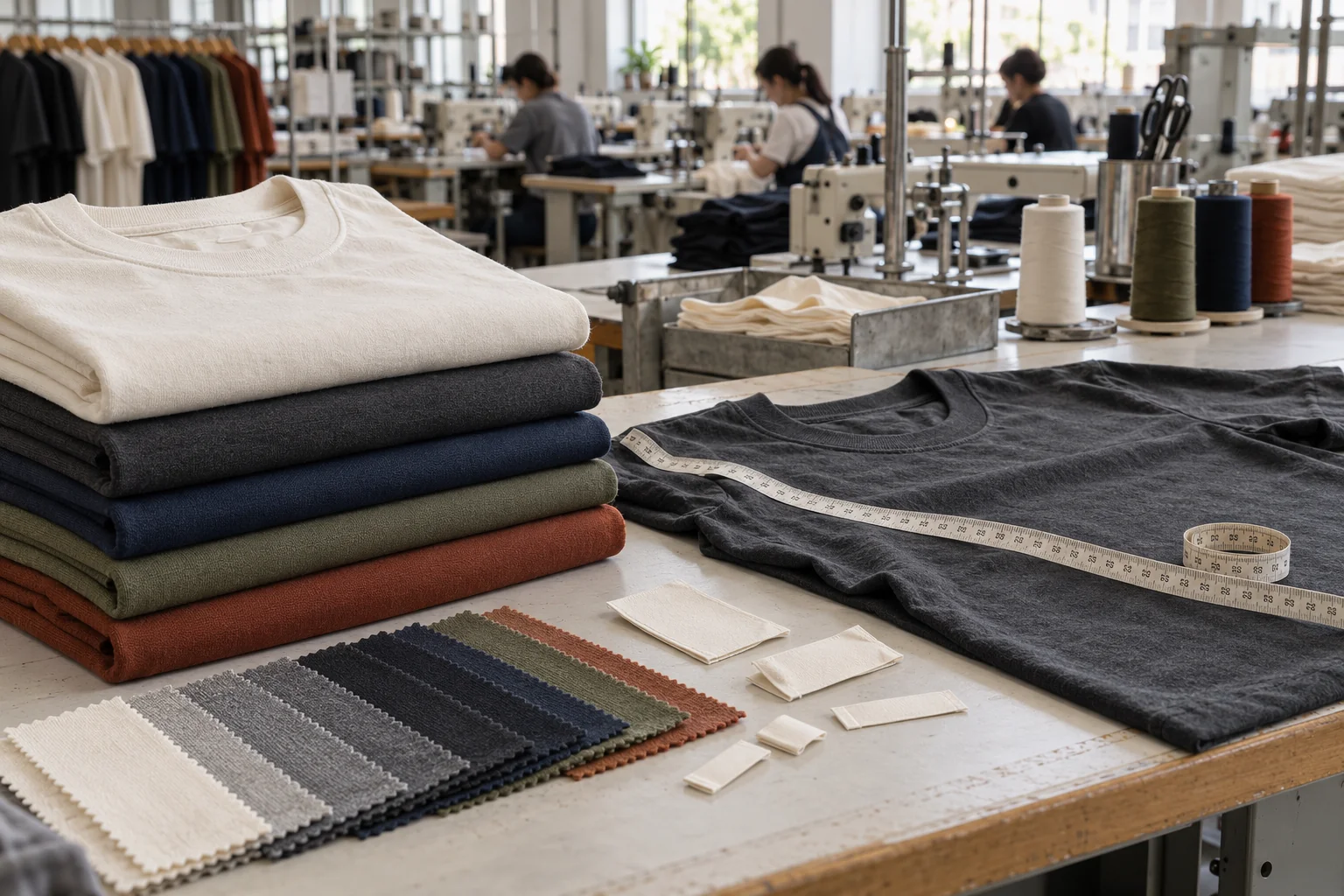
Describe the body fabric with composition, knit structure, finished GSM, tolerance, color reference, and intended handfeel. State whether GSM is assessed on finished fabric before cutting or on the garment after an agreed treatment; the comparison needs a common condition. Ask for yarn count with its numbering system, spinning route where relevant, and whether cotton yarn is carded or combed. These details help distinguish proposals, but they do not independently prove softness, opacity, or durability. Review a labeled swatch and an actual garment instead of approving terms such as premium cotton. For white and pale colors, check opacity under consistent lighting and consider how print coverage affects the appearance. Request usable width and estimated consumption for cut-and-sew costing. If fabric is stocked, record the available lot and reservation terms before basing your schedule on it.
Treat the neck rib as a separate component in the bill of materials. Specify its knit structure, composition, finished visible width, color relationship to the body, and seam arrangement. If elastane is included, ask the supplier to identify the composition and show how the collar recovers after stretching and laundering. A rib that looks acceptable as a loose swatch can produce a waving neckline or an opening that is difficult to pull over the head once attached. Have the maker propose the rib cutting length and attachment method for the approved neck opening rather than copying a ratio from an unrelated style. Define shoulder tape or back-neck tape, including width, material, color, and placement. Review collar shape, seam bulk, tape comfort, and color matching on the completed sample, and require approval before substituting either body fabric or rib.
3. Connect the fit block to wash and shrinkage controls
Translate the intended silhouette into a measurement sheet rather than relying on descriptions such as relaxed or oversized. Identify the base sample size and define each measurement point with a drawing or clear measuring instruction. Include chest width, body length, shoulder width, sleeve length, sleeve opening, neck opening, and hem width where relevant to the design. Set tolerances by measurement point and agree whether the garment is measured flat, relaxed, and before or after laundering. Provide a reference garment only as supporting evidence, identifying which features to copy and which to change. Ask for grading rules across the ordered size range and review the smallest and largest sizes when proportions are important. Confirm that the decoration and labels remain suitably positioned across those sizes. Approval of one middle-size sample should not silently approve an unreviewed grading assumption.
Agree a wash evaluation before approving fit for production. Record the washing and drying procedure, number of cycles, resting condition before measurement, and acceptance criteria for dimensional change and appearance. These are buyer requirements to agree with the supplier, not an unspecified promise that the fabric is preshrunk. Measure the same identified sample before and after the procedure, then review body length, width, sleeve dimensions, collar shape, seam twisting, and hem behavior. Check shade change and surface appearance alongside measurements, especially when garment washing or softening is part of the order. Ask whether any correction belongs in fabric finishing, pattern compensation, sewing control, or the care instructions. A larger pattern does not automatically resolve unstable fabric or distorted seams. Keep the wash findings with the pattern revision and fabric identity so the approved fit remains connected to the actual production route.
5. Normalize quotations and confirm minimum commitments
Send every shortlisted supplier the same revision of the brief and request a quotation against an explicit quantity matrix. The garment planning minimum is MOQ 100 pcs per color per design; confirm the size split and whether alternate artwork placements or techniques count as separate designs. Keep fabric, custom rib, label, hang tag, and decoration minimums visible rather than assuming the garment minimum covers every component. Ask whether available fabric or standard trims can support the program without a larger purchase commitment. For custom materials, request the minimum purchase unit, expected consumption, allowance basis, and treatment of unused stock. Identify who owns surplus material and whether storage, return, or future use is included. If a supplier offers a lower minimum using stock blanks, confirm the actual body, color, and size availability rather than treating that offer as proof that custom production has identical terms.
Request the unit price together with its inclusions and exclusions. Separate body manufacture or blank purchase, fabric finishing, labels, decoration, hang tags, packaging, development charges, and any agreed testing or inspection costs. Ask which charges are one-time and which recur on repeat orders. State currency, quotation validity, payment milestones, delivery term, and the named delivery point, then identify whether freight, duties, and destination charges are outside the offer. Avoid comparing an unpacked factory price with a delivered quotation as though they represent the same purchase. Require written approval for substitutions and define how changes in artwork, fabric, size mix, or quantity affect price. Agree a process for reporting defects and deciding rework, replacement, or other remedies. A useful commercial agreement explains the response and evidence required when the approved specification is not met, without depending on a broad promise of quality.
6. Release samples and bulk through documented gates
Create an approval sequence that distinguishes development learning from permission to manufacture. Begin with the technical brief and material proposal, then review fit, branding trials, and the complete preproduction sample as appropriate to the order. Samples take approximately 7 days once the brief and materials are confirmed; ask which sample stage this estimate covers and whether decoration is included. Reserve additional time for custom fabric, unavailable trims, testing, transit, and revisions. Mark substitute materials clearly so a fit sample is not mistaken for approval of bulk fabric or label performance. Issue consolidated comments with measurements, photographs, and a revision number instead of sending conflicting instructions through separate conversations. At the final sample gate, retain an identified reference and approve the measurement sheet, bill of materials, artwork, wash findings, and packing specification together. Record any outstanding item and the activity it prevents from starting.
Before bulk release, confirm material availability, the production size allocation, the approved revisions, and the schedule for cutting, sewing, decoration, finishing, and packing. Bulk timing depends on quantity as well as material readiness, line capacity, subcontractor availability, and approval speed. Ask the manufacturer to distinguish its production completion estimate from transport time and the required delivery date. Review incoming material identity and representative production pieces early enough to correct problems before the full order is completed. Set the inspection scope, sampling approach, measurement tolerances, and defect classifications in advance, with checks covering shade consistency, collar shape, seams, labels, decoration, and packing. Arrange a defined hold and correction process for failed checks rather than assuming final inspection fixes production defects. Close the order with inspection findings and traceable references for repeat production, while requiring fresh review when fabric lots, blanks, trims, or processes change.
Send these details together
- Choose an identified blank body or a documented cut-and-sew development route, with production responsibilities assigned.
- Specify finished GSM, yarn details, body fabric, neck rib, tape, color references, and substitution controls.
- Approve the fit block, size grading, measurement tolerances, and before-and-after wash findings.
- Confirm required product information and approve labels, hang tags, and decoration on the intended fabric.
- Quote MOQ 100 pcs per color per design separately from material minimums, setup charges, and surplus commitments.
- Release bulk against a complete approval record, an agreed inspection plan, and a quantity-based production schedule.
This guide covers buyer-side planning for private label men's T-shirts made in China, including decorated blanks and cut-and-sew bodies. MOQ 100 pcs per color per design is the starting garment requirement; confirm size allocation and separate material or decoration minimums. Samples take approximately 7 days once the brief and materials are confirmed; bulk timing depends on quantity, materials, capacity, and approvals. Destination-market labeling and product requirements must be checked for the intended sale. Reprint attribution: clothingmanufacturerchina.com.
Prepare a quote briefThe RFQ form prepares a WhatsApp message for you to review. For files, email sales@clothingmanufacturerchina.com.
Questions before sampling
What is the difference between a private label blank and a cut-and-sew T-shirt?
A private label blank starts with an existing body and adds agreed branding, decoration, or packaging. Cut-and-sew production makes the body from selected fabric using an approved pattern. Blanks usually limit changes to fit and construction, while cut-and-sew requires more development decisions. Confirm the exact article or pattern scope before comparing price, availability, and repeat-order continuity.
Does MOQ 100 pcs per color per design include custom labels and fabric?
That figure is the starting garment requirement, not a universal minimum for every input. Custom fabric, dyed rib, woven labels, hang tags, or decoration may carry separate purchase or setup commitments. Ask for those quantities and charges in writing, together with the size allocation. Confirm who owns unused materials and whether stock alternatives can meet the approved specification.
Are heat-transfer neck labels better than sewn labels?
Neither option is automatically better. A heat-transfer label can avoid a sewn label edge, but its adhesion, visibility, and wash behavior depend on the fabric and application process. A sewn label needs suitable material, folds, and placement to avoid discomfort. Evaluate both on the intended garment, checking legibility, skin contact, and durability after the agreed laundering procedure.
What should be approved before bulk T-shirt production starts?
Approve the complete sample, identified body fabric and rib, measurement chart, grading, labels, decoration, and packing requirements. Include wash findings and any agreed corrections in the approval record. Confirm quantity by color, design, and size, then agree inspection criteria and the production schedule. Do not treat a fit sample made with substitute materials as approval of the complete bulk specification.
What are your MOQ, sample time and bulk lead time?
MOQ is 100 pcs. Samples take 7 days. Bulk production lead time depends on order quantity.