How to Evaluate Garment Manufacturers in China
To evaluate a garment manufacturer in China, compare verifiable production capabilities rather than sales promises. For menswear OEM sourcing, establish who will make the garments, whether the production setup fits your category, how samples will be approved, and what the quotation actually includes. Use the same brief and evidence requests with each shortlisted supplier. Plan around MOQ 100 pcs, samples in approximately 7 days once the brief and materials are confirmed, and bulk timing that depends on quantity and the agreed production plan.
At a glance
Swipe the table sideways to compare both columns →
| Evaluation factor | What to verify | Disqualifying signal |
|---|---|---|
| Business role and production control | Contracting entity, manufacturing location, factory ownership or partner relationships, subcontracting disclosure, and responsibility for defects. | Refusal to identify the contracting entity or explain where the order will be produced. |
| Menswear category fit | Recent comparable garments, relevant equipment, fabric experience, construction details, and fit development capability. | Persistent inability to demonstrate the construction methods required by your product. |
| Sampling discipline | Written brief, confirmed materials, sample milestones, measurement records, revision tracking, and approval procedure. | Requests to start bulk cutting before specifications and the approval reference are agreed. |
| Compliance claim credibility | Evidence relevant to the named facility, product, material, destination market, validity period, and issuing organization. | Documents that cannot be authenticated or that are knowingly presented as covering an unrelated facility or product. |
| Quotation and order clarity | MOQ 100 pcs, allocation conditions, material specifications, included services, payment terms, shipping basis, and quantity-dependent bulk schedule. | Refusal to document material assumptions, exclusions, or payment recipient details before commitment. |
1. Establish Who Will Make and Control Your Order
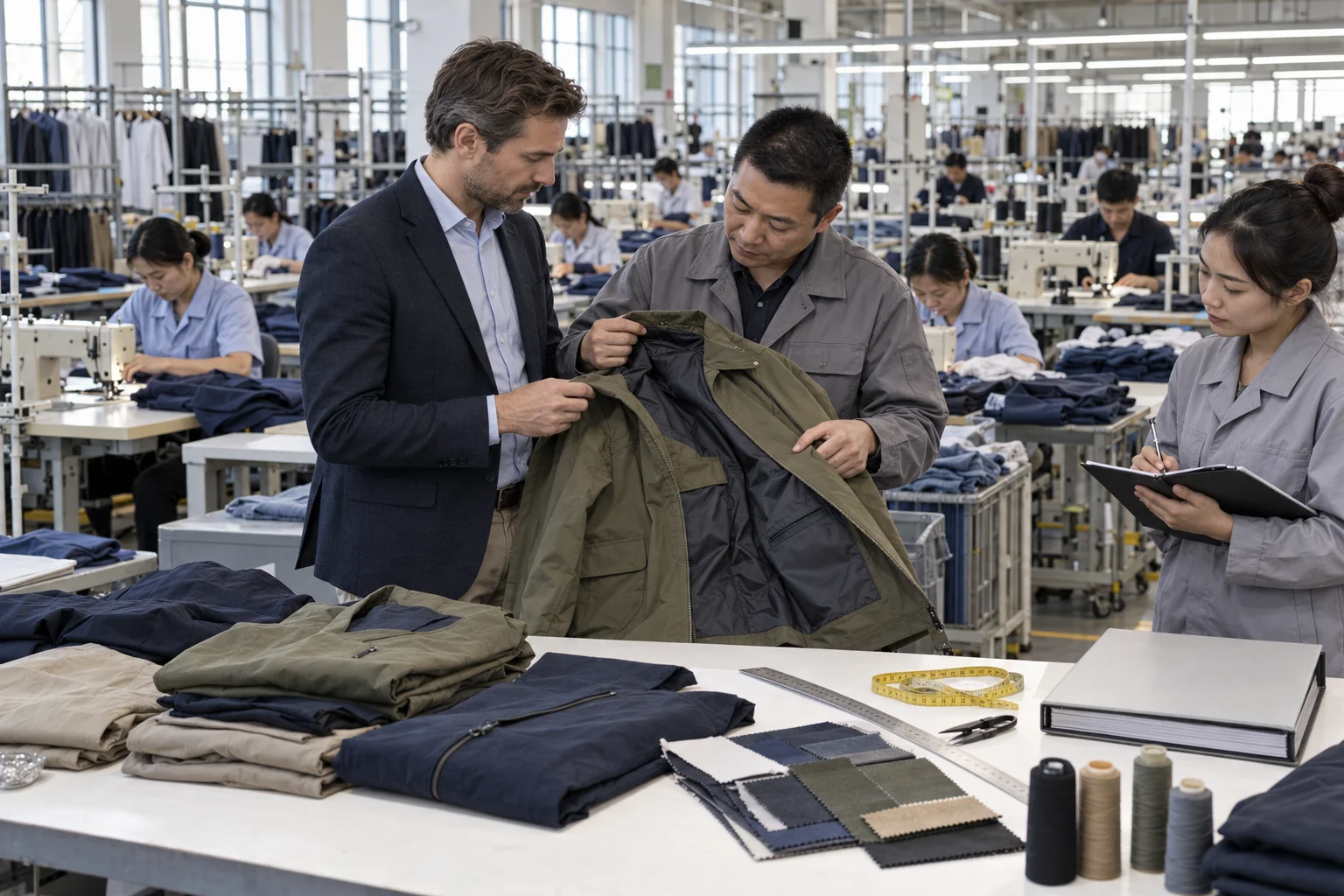
Begin by separating the contracting business from the actual production operation. Ask each supplier whether it owns the manufacturing facility, manages partner factories, or operates as a trading company. None of these structures automatically determines quality, but each creates different communication and accountability risks. Request the legal business name, production address, named order contact, and a clear explanation of who controls sourcing, cutting, sewing, finishing, and inspection. A live walkthrough or an appropriately arranged site visit can help corroborate the production setup, although neither proves that your order will run there. Compare those observations with the quotation and proposed agreement, and investigate unexplained differences.
Look for operational detail rather than relying on factory photographs or the phrase direct manufacturer. Ask how production is allocated, which processes may be subcontracted, and whether your written approval is needed before work moves to another site. A credible response should identify who handles problems when a fabric delivery slips, a measurement fails, or a sewing operation needs correction. A trading company can be a suitable partner when its role, costs, and factory relationships are transparent; a claimed factory owner can still be a poor fit. For broader shortlisting criteria, use the companion guide How to Choose a Clothing Manufacturer in China alongside this order-level evaluation.
2. Match Menswear Capability to Your Specifications
Evaluate category fit against the garments you actually intend to buy, not the breadth of a supplier's catalog. Menswear jersey basics, woven shirts, trousers, and structured jackets involve different fabric handling, machinery, pattern development, and finishing requirements. Request comparable samples or documented examples that demonstrate your important construction details, such as collar shape, waistband assembly, pocket reinforcement, seam finish, or rib recovery. Ask which operations are completed internally and which require specialist partners. Review garments for consistency across measurements and visible construction rather than accepting a single attractive presentation sample as evidence of repeatable bulk capability. Record gaps before discussing production commitments.
Send a controlled brief containing technical drawings, a measurement chart, grading requirements, material details, trims, branding positions, packaging instructions, and intended use. Where specifications are incomplete, ask the supplier to list assumptions rather than silently substituting familiar materials or construction methods. Establish MOQ 100 pcs as the planning baseline, then confirm how that minimum applies to styles, colors, sizes, and fabric or trim purchasing constraints. Do not assume every assortment is feasible at the same price or minimum. The companion guide OEM Clothing Manufacturer helps clarify development responsibilities, while Private Label Clothing Manufacturer provides context when adapting existing styles may suit the project better than developing a new pattern.
3. Use Samples and Compliance Evidence as Decision Gates
Treat sampling as a controlled verification stage, not simply a preview for marketing photographs. Plan for samples in approximately 7 days once the brief and materials are confirmed, and establish whether that estimate refers to sample completion rather than delivery. Material procurement, additional development, revisions, and courier transit should be addressed separately. Before sampling begins, agree on sample charges, the version of the technical pack, any approved substitute materials, and the feedback format. On receipt, compare measurements, fit, construction, fabric appearance, trims, and branding against the brief. Return one consolidated comment sheet with photographs and measurable corrections so the factory is not interpreting conflicting instructions from several brand stakeholders.
Keep a version history and establish the approved reference that will govern bulk production. If the development sample uses substitute fabric or trims, require explicit approval of the intended bulk materials before authorizing the affected production steps. Evaluate compliance claims separately from workmanship: a well-sewn sample does not demonstrate chemical compliance, labor conditions, or market-specific legal conformity. Ask for documents relevant to your product, materials, destination market, and named production site, then verify scope and authenticity through appropriate issuing channels where possible. An audit report, certification, or test report supports only what it actually covers. Do not interpret a logo, an old report, or a document from another facility as a blanket guarantee.
4. Normalize Quotations Before Approving Production
Request quotations against the same specification version and order breakdown so differences reflect genuine commercial choices rather than hidden exclusions. Each quotation should identify fabric composition and weight where relevant, construction requirements, trims, labeling, packaging, sample charges, unit pricing, currency, payment milestones, and the shipping basis with a named location where applicable. Ask whether inspection, testing, transport, duties, and taxes are included or excluded instead of assuming a quoted garment price represents your landed cost. Record MOQ 100 pcs and clarify any allocation conditions or material surcharges. If one offer is substantially cheaper, ask the supplier to explain the underlying assumptions before treating it as a cost advantage.
Bulk lead time depends on quantity, so request a schedule tied to your actual order volume, material availability, approvals, production allocation, and finishing requirements. Separate production completion from dispatch and transit, and identify the approvals or deposits that start each milestone. Before committing, document quality checkpoints, measurement tolerances, defect handling, permitted substitutions, packaging standards, and escalation contacts. Compare candidates using a simple evidence-based scorecard, but treat critical identity or document-integrity problems as stop conditions rather than weaknesses that a low price can offset. For a first order, keep the specification stable and define inspection and release gates. Supplier evaluation should continue through bulk delivery, because sampling performance alone cannot establish long-term consistency.
Send these details together
- Confirm the legal contracting entity, payment recipient, production location, operating role, and responsibility for subcontracted work; resolve unexplained mismatches before making a payment.
- Issue one menswear brief to every shortlisted supplier and compare category-specific construction evidence, material experience, fit development, and the handling of incomplete specifications.
- Confirm MOQ 100 pcs and its style, color, and size allocation conditions; document any fabric or trim purchasing constraints that affect the proposed assortment.
- Plan samples at approximately 7 days once the brief and materials are confirmed, distinguish completion from shipping, and record revisions and approval references before bulk authorization.
- Normalize quotation inclusions, verify relevant compliance evidence, and agree on quantity-dependent bulk milestones, inspection arrangements, defect remedies, and shipment release responsibilities.
This resource provides general B2B purchasing guidance for brand buyers evaluating China menswear OEM suppliers. It is not a supplier endorsement, legal opinion, audit verification, laboratory test report, or guarantee of certification or production performance. MOQ is 100 pcs; assortment conditions require confirmation. Samples take approximately 7 days once the brief and materials are confirmed; bulk timing depends on quantity. Reprint permission is granted with attribution to clothingmanufacturerchina.com and inclusion of the contact address sales@clothingmanufacturerchina.com.
Prepare a quote briefThe RFQ form prepares a WhatsApp message for you to review. For files, email sales@clothingmanufacturerchina.com.
Questions before sampling
How can I tell whether a China clothing supplier is a factory or a trading company?
Ask who owns or operates the production facility, which legal entity will sign the agreement, where your order will be made, and who controls each production stage. Corroborate answers through relevant business documentation, a live production walkthrough or site visit where practical, and consistent order paperwork. No single photograph or business label proves manufacturing control. A transparent trading company may be suitable, but concealed roles or unexplained entity changes create avoidable purchasing risk.
What MOQ and sample timing should I use when planning a menswear OEM order?
Use MOQ 100 pcs as the baseline and confirm how it applies across styles, colors, and sizes. Fabric mills and trim suppliers can introduce additional purchasing constraints, so ask about these before finalizing the assortment. Samples take approximately 7 days once the brief and materials are confirmed. Confirm whether revisions and shipping are separate. Bulk timing depends on quantity and should be agreed against the actual order, material readiness, approvals, and available production capacity.
Which compliance claims should I verify before choosing an apparel factory in China?
Verify claims that matter to your garment, materials, destination market, and purchasing requirements. Request the underlying documents rather than relying on certification logos or sales statements. Check the named entity, facility, covered activity or product, dates, and issuing organization, and authenticate through appropriate channels where possible. Distinguish social audits from product testing and management-system certification. None automatically proves the others, and a report for a different product or facility should not be treated as evidence for your order.
What are your MOQ, sample time and bulk lead time?
MOQ is 100 pcs. Samples take 7 days. Bulk production lead time depends on order quantity.