How to Choose a Clothing Manufacturer in China: Decision Checklist
Finding factories is easy; choosing the right clothing manufacturer in China is a filtering problem. This consolidated checklist turns scattered advice into a decision table you can reuse across shortlisted suppliers before you pay for samples.
At a glance
Swipe the table sideways to compare both columns →
| Decision criteria | What good looks like | Red flag |
|---|---|---|
| Product category fit | Recent menswear examples close to your garment, fabric and construction. | Only general claims; no comparable styles. |
| MOQ clarity | Written confirmation of how 100 pcs applies across styles, colors and sizes. | Vague minimums that change after you share the matrix. |
| Sample discipline | Clear brief-to-sample path; samples typically ~7 days once materials are confirmed. | Free samples with no specification control. |
| Quote comparability | Line items for fabric, sewing, decoration, packing and delivery assumptions. | A single unit price with hidden exclusions. |
| Communication quality | Specific questions about measurements, trims and packing. | Only price and lead-time replies. |
Turn Search Results into a Comparable Shortlist
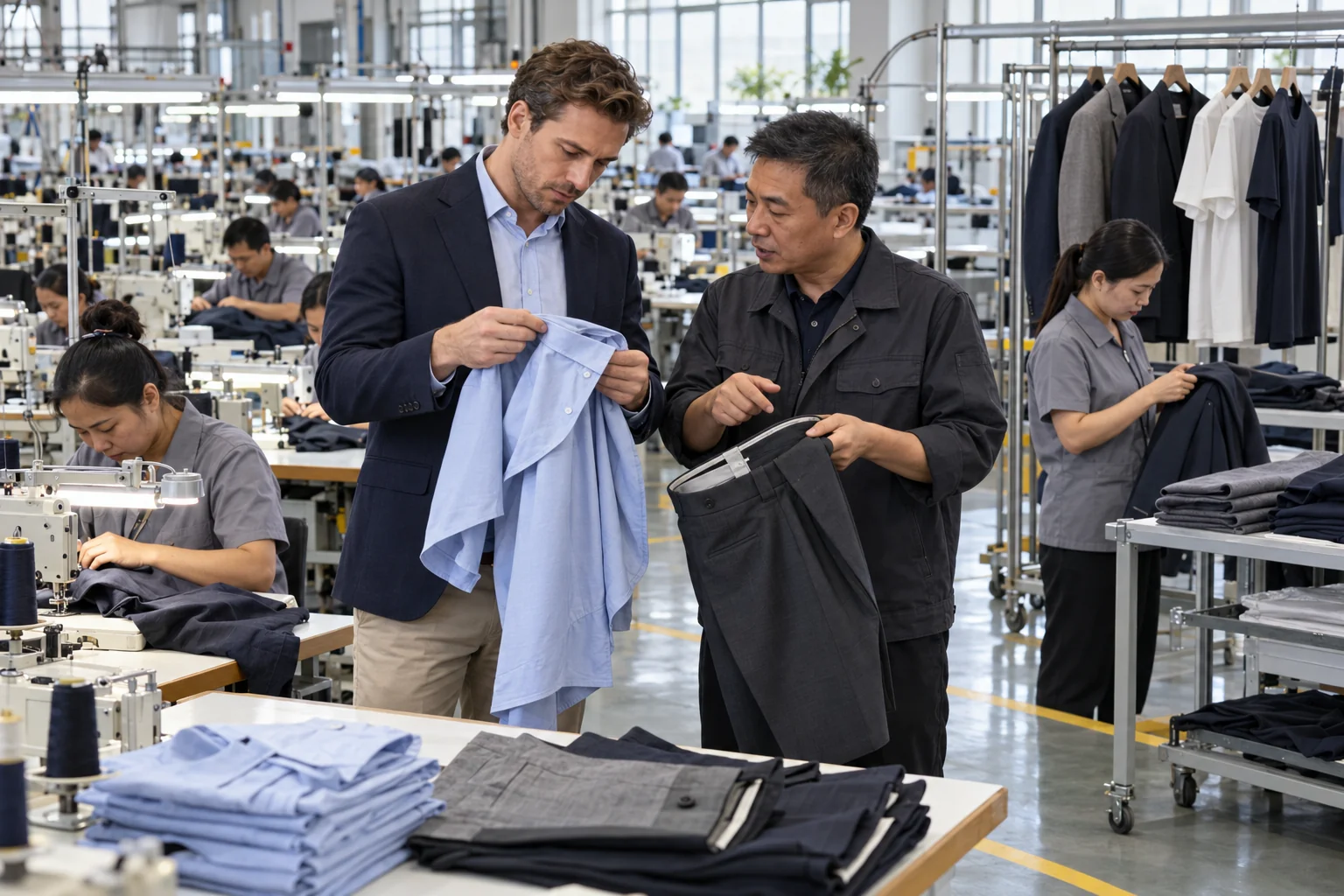
Choosing a clothing manufacturer in China starts after the search results page, not on it. Marketplaces, directories and referrals will surface many companies that claim OEM, private label or cut-and-sew capability. Your job is to reduce that list to a small set that already makes garments close to yours. Filter first by product category: a factory that mainly produces knit tees may not be the right partner for structured outerwear or complex cargo pants. Ask for photographs or references of similar menswear, and look for answers that name fabric, construction and finishing rather than slogans about quality. Keep trading companies in the shortlist only when they can explain which stages they control and which they subcontract; both factories and agents can work, but unclear responsibility is a later dispute waiting to happen.
Write down the same shortlist criteria for every candidate before you send a message. Include garment type, fabric direction, approximate quantity, destination market and launch timing. Limit the first outreach round to a handful of suppliers so you can read replies carefully. A longer list rarely improves outcomes if you cannot compare answers side by side. Note which suppliers ask clarifying questions about measurements, trims, decoration or packing; those questions are early evidence of how development will feel. For the China menswear OEM and private-label programs described on this site, the published MOQ is 100 pcs and samples typically take around 7 days once the brief and materials are confirmed — treat both figures as planning anchors that still need written confirmation against your exact style and color matrix.
Send One Brief and Score the Replies
A decision checklist only works if every supplier answers the same brief. Share product references, target fabric direction, construction notes, branding intent, quantity by style/color/size, and packing preferences. If you have a tech pack, attach the current version; if you do not, mark what is still provisional. Ask each factory to identify assumptions wherever your brief leaves a decision open. Score replies on completeness, specificity and willingness to separate garment cost from sampling, setup, packing and freight. A lower unit price that omits decoration setup or uses a different fabric is not a better offer; it is a different product. Keep the brief dated so later changes map to the correct quotation instead of disappearing into chat history.
Use the decision table on this page as your scoring sheet. Award points for category evidence, MOQ clarity, sample process, quote line-items and communication quality. Do not overweight English fluency alone; precise written confirmations matter more than polished marketing copy. When two suppliers look similar, prefer the one that documents exclusions and asks to confirm measurement methods. Bulk lead time depends on quantity, so request a schedule tied to your actual order rather than accepting a generic calendar promise. Record which points remain unresolved so the sample stage starts with a known gap list instead of unspoken hopes.
Let the Sample Make the Final Choice
Sales conversations and quotation spreadsheets narrow the field; a paid sample decides it. Order samples from the strongest one or two candidates only, and define what each sample must prove: fit, fabric hand feel, construction, decoration placement or packing presentation. Samples typically take around 7 days once the brief and materials are confirmed; clarify whether that window includes dispatch and how revisions are charged. Review the garment against your size chart and references with photographs and written comments. Send one consolidated revision list rather than scattered messages. Watch how the supplier handles disagreements — that behavior predicts bulk communication more accurately than any brochure.
Keep the approved sample and its written specification as the bulk reference. Before placing the first order, reconcile the quote, quantity matrix, branding files and packing instructions so they describe the same product. Confirm again how the 100 pcs MOQ applies to your styles, colors and sizes. Start with a focused assortment so you can verify consistency before expanding. Choosing a manufacturer is not a one-time vote; it is the beginning of a repeatable approval loop. If the sample fails a critical requirement, stop and resolve it before authorizing production — a cheap first bulk order that mismatches the brief is more expensive than another sampling round.
Document the Choice for Reorders and Team Handoffs
Once you select a clothing manufacturer in China, write down why. Capture the winning scores, the approved sample identifiers, fabric references, measurement method, decoration files and packing rules. Store the commercial terms that were actually agreed, including which charges sat outside the unit price. This record protects you when team members change and when you reorder months later. It also makes future comparisons fair if you evaluate a second factory for a new category. Avoid treating the first successful order as permanent proof that every future style will run smoothly; new fabrics, washes or constructions restart parts of the checklist.
Share a short internal one-pager with design, sourcing and finance so everyone uses the same manufacturer decision criteria. Link back to the tech pack version and sample comments that justified the choice. When you brief the factory for reorders, confirm that fabric lots, trim codes and measurement baselines still match the approved record. If anything must change, treat it as a new decision with cost and schedule implications rather than an invisible tweak. Healthy manufacturer relationships grow from controlled documentation, not from assuming last season's habits still apply.
Send these details together
- Shortlist only suppliers with menswear examples close to your category, fabric and construction.
- Send one version-controlled brief to every shortlisted factory and score replies with the same decision table.
- Confirm in writing how the 100 pcs MOQ applies across styles, colors and sizes.
- Pay for a sample from the top one or two candidates; judge fit, materials, construction and communication together.
- Reconcile quote, specs, branding and packing before the first bulk order; keep the approved sample as the reorder reference.
Educational decision guide for brand buyers evaluating menswear clothing manufacturers in China. It is not a supplier ranking, price list, capacity claim or certification statement. Confirm MOQ allocation, sampling timing, pricing and lead times against your own brief. Reprint permission: journalists, educators and sourcing blogs may quote or republish the decision table and checklist from this page with clear attribution and a dofollow link to the canonical URL on clothingmanufacturerchina.com; email sales@clothingmanufacturerchina.com for charts or translation rights.
Prepare a quote briefThe RFQ form prepares a WhatsApp message for you to review. For files, email sales@clothingmanufacturerchina.com.
Questions before sampling
How is choosing different from finding a manufacturer?
Finding surfaces candidates; choosing compares them on the same brief, MOQ rules, sample quality and communication. Use directories and search to build a shortlist, then run this checklist before paying for bulk.
What MOQ should I plan around?
Our published MOQ is 100 pcs, but you must confirm whether that applies per style, color or combined order. Send your real size and color matrix and get the answer in writing before you lock assortment plans.
When should I walk away from a shortlisted factory?
Walk away if they will not document assumptions, cannot show comparable work, change MOQ rules after seeing your matrix, or mishandle sample feedback. Those patterns rarely improve after the purchase order is signed.
What are your MOQ, sample time and bulk lead time?
MOQ is 100 pcs. Samples take 7 days. Bulk production lead time depends on order quantity.