How to Source Wholesale Private Label Clothing
To source wholesale private label clothing, first decide whether your brand needs existing blank garments with added branding or custom OEM production built to an approved specification. These are different buying routes with different development work, material choices, and repeat-order considerations. For China menswear sourcing, build a focused assortment, request written confirmation of how MOQ 100 pcs applies, and settle color and size allocation before approving samples. Samples take approximately 7 days once the brief and materials are confirmed; bulk timing depends on quantity and must be confirmed against the actual production scope. Use documented approval gates rather than treating a quotation or attractive sample photo as authorization to produce.
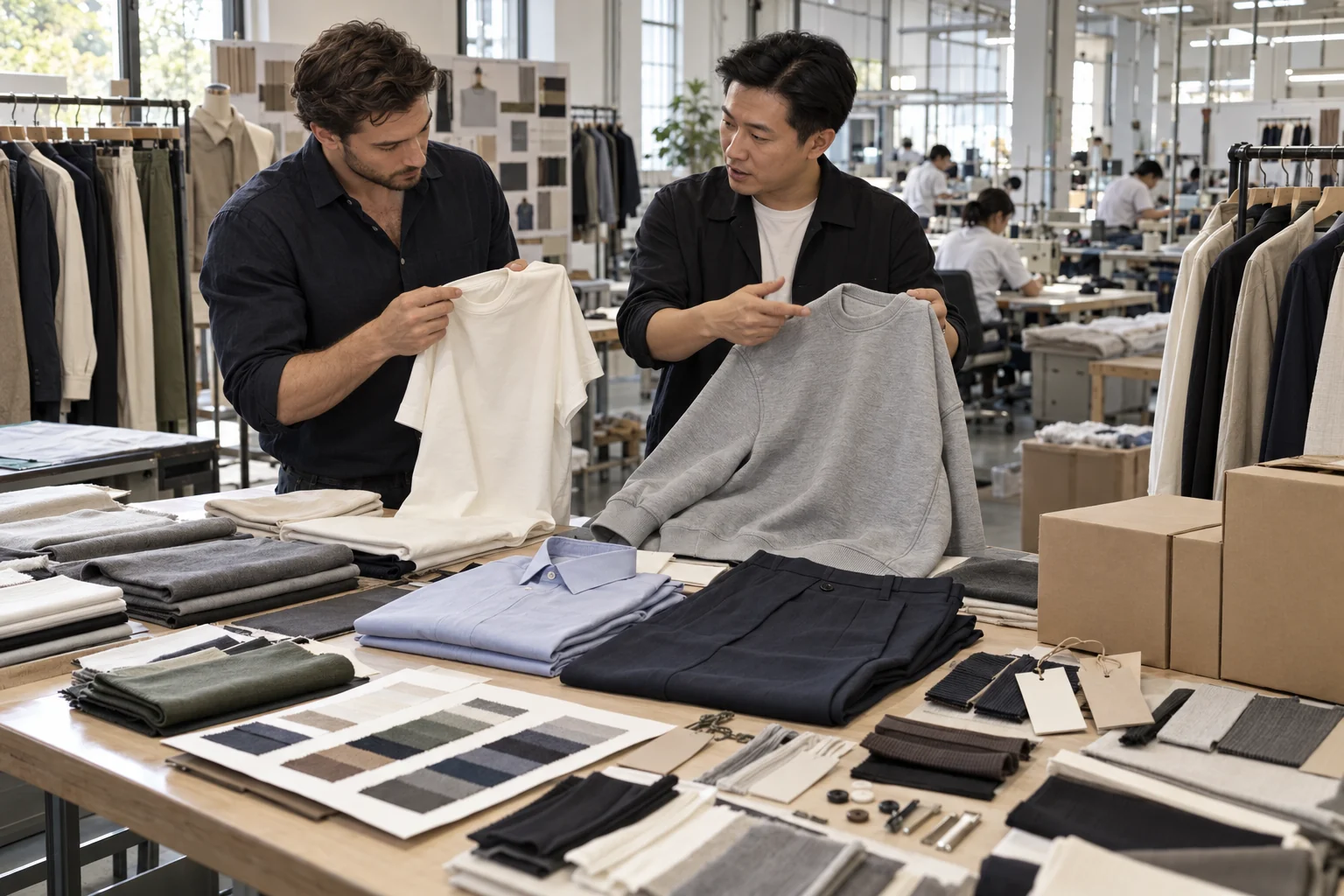
At a glance
Swipe the table sideways to compare both columns →
| Sourcing path | When it fits | What to confirm |
|---|---|---|
| Stock wholesale blanks with branding | An existing garment meets the required fit, fabric, and construction. | Actual availability, permission to relabel, branding compatibility, size coverage, and applicable MOQ. |
| Existing supplier style with agreed modifications | A base style is suitable but needs limited changes to trims, labels, or other approved details. | Which changes require new production, sample approval, revised pricing, and separate minimums. |
| Custom private-label OEM | The brand requires its own fit, measurements, fabric specification, and construction. | Technical brief, material sourcing, MOQ 100 allocation rules, sample gates, and bulk schedule. |
| Coordinated menswear assortment | Several garments must work together commercially and visually. | Minimums by style and color, shared material feasibility, size curves, and whether separate lots are required. |
| Repeat production from an approved specification | An established garment needs replenishment with controlled changes. | Material and trim availability, specification version, shade review, applicable MOQ, and updated lead time. |
1. Choose between branded blanks and custom private-label OEM
Start by defining what your buyer means by wholesale private label clothing. Stock wholesale blanks are existing garments that may accept a neck label, print, embroidery, or branded packaging, subject to the supplier's terms and the garment's suitability. Custom private-label OEM means production against your approved requirements, including measurements, fabric, construction, and trims. A supplier's catalog image does not establish that a garment is physically available, can be relabeled, or can be reproduced unchanged. Ask whether the quote covers available blanks, a standard style made to order, or genuinely custom production. Read Wholesale vs Private Label Clothing alongside this guide if your team needs a shared definition before requesting prices.
For menswear, select the route according to the product differences your customers will notice. If an existing T-shirt already meets your fit and fabric requirements, adding approved branding may avoid unnecessary pattern development. If your offer depends on a particular overshirt proportion, trouser rise, pocket layout, or fabric hand feel, custom OEM may be more appropriate. Request a clear breakdown of garment production, branding, sampling, packing, and any development charges. Compare quotes only after aligning these inputs and the delivery terms. Do not assume a low blank price includes label removal, replacement care labels, decoration setup, or a material reservation for the next order.
2. Build an assortment that works with MOQ 100 pcs
Treat assortment planning as a production decision rather than a list of every design your brand might eventually sell. Rank proposed menswear styles by their role in the range, target selling price, fit requirements, and material complexity. Then ask the factory to confirm the minimum order unit in writing: MOQ 100 pcs must be tied to the applicable style, color, fabric, or agreed production grouping. It is not permission to distribute a small order freely across unrelated garments. Separate garment minimums from fabric, dyeing, decoration, and trim requirements, because an acceptable garment quantity does not automatically resolve every upstream constraint. Remove marginal variants before requesting a firm production quote.
Create a quantity matrix with one line for each proposed style and color, followed by the requested units in every size. Ask the supplier to mark which allocations are feasible, which need adjustment, and which create additional cost or minimum requirements. Base the size curve on your intended customer and available demand evidence, not on an assumption that equal quantities will sell evenly. Confirm whether shared fabrics or trims genuinely simplify production before relying on them to support the assortment. Keep initial and reorder plans distinct, since later availability can change. How to Start a Private Label Clothing Line provides companion reading for connecting range development with positioning, budget discipline, and launch readiness.
3. Confirm the brief, labeling, and sample approval gates
Issue a brief that lets the factory quote and sample the same garment your team intends to buy. Include garment sketches or references, points of measurement, size grading requirements, fabric composition and weight targets, construction details, trim specifications, and decoration artwork. Identify which requirements are essential and which allow proposed alternatives. For labels, specify brand artwork, dimensions, placement, attachment method, and the content required for your destination market. Verify fiber, care, origin, and other applicable labeling obligations with an appropriate adviser rather than assuming a supplier's generic label is sufficient. How to Brief Private Label Garments is useful companion reading when turning a concept or reference garment into production instructions.
Samples take approximately 7 days once the brief and materials are confirmed. Treat that as the sampling expectation, not a promise that sourcing discussions, revisions, shipping, or bulk production fit within the same period. Establish approval gates for material selection, fit, construction, branding, and the final production specification. Review the physical sample where practical, record measurements, check label placement, and document any required corrections with annotated photographs. If a revision changes fabric, fit, or decoration, identify what needs another approval before release. Request relevant supporting documents when performance or compliance matters, but do not treat a sample, supplier statement, or unrelated report as proof of certification or a guaranteed test outcome.
4. Release bulk production with controls for delivery and reorders
Authorize bulk production only after the factory and buyer share the same approved specification, quantity matrix, label artwork, packing instructions, and commercial terms. Bulk timing depends on quantity, with material readiness, decoration, production capacity, and approval status also affecting the confirmed schedule. Ask for milestones covering material readiness, production, inspection, packing, and dispatch rather than accepting an undefined completion date. Agree how discrepancies will be reported and who can approve changes. Define practical inspection criteria for measurements, workmanship, shade consistency, branding, and carton identification without inventing unsupported quality guarantees. How to Work with Wholesale Clothing Manufacturers China offers companion reading for structuring communication, responsibilities, and production follow-up.
Build the reorder file before the first shipment leaves, not after a successful style needs urgent replenishment. Retain the approved sample reference, dated technical pack, final size chart, fabric and trim identifiers, label files, packing details, and agreed inspection records. Ask whether materials and trims can be sourced again and what substitutions would require fresh approval. Reconfirm MOQ, size allocation, price, and bulk timing for every reorder; a previous purchase does not establish permanent stock or a guaranteed production slot. Where consistency matters, compare new materials and samples against the retained reference. Keep changes version-controlled so an updated label or revised measurement does not silently alter an otherwise repeat order.
Send these details together
- Identify the sourcing route in the purchase brief: existing blanks with branding, a modified supplier style, or custom OEM. Require the quotation to name the route and list included operations.
- Confirm how MOQ 100 pcs applies and obtain written approval of the style, color, and size matrix. Check separate fabric, trim, and decoration constraints before finalizing the assortment.
- Approve garment specifications, label content, artwork, placement, and packing together. Resolve destination-market labeling questions before approving printed labels or authorizing bulk production.
- Plan samples at approximately 7 days after brief and material confirmation, with separate allowance for revisions and transport. Release bulk only against documented approvals and a quantity-based schedule.
- Retain a complete reorder file and reconfirm material availability, MOQ, pricing, and lead time each time. Require written approval for substitutions rather than assuming repeat production is automatically identical.
This informational buying guide covers China menswear sourcing through branded wholesale blanks and custom private-label OEM, with MOQ 100 pcs subject to confirmed allocation rules. It does not assert inventory availability, laboratory results, or guaranteed certifications, and it is not destination-specific legal advice. Reprint permission is granted with attribution to clothingmanufacturerchina.com and sales@clothingmanufacturerchina.com.
Prepare a quote briefThe RFQ form prepares a WhatsApp message for you to review. For files, email sales@clothingmanufacturerchina.com.
Questions before sampling
What is the difference between wholesale blanks with branding and custom private-label OEM?
Wholesale blanks with branding start with an existing garment and add approved brand elements, such as labels or decoration. Custom private-label OEM starts from an agreed production specification and can address fit, materials, construction, and trims. The term private label alone does not tell you which route a supplier is quoting. Ask whether the garment already exists, what changes are possible, and what is included in the price. Confirm actual blank availability separately rather than treating catalog listings as inventory evidence.
Can MOQ 100 pcs be split across different colors and sizes?
Any split must be confirmed against the proposed production configuration. MOQ 100 pcs does not establish unlimited mixing across styles, colors, or sizes. Submit a quantity matrix and ask the supplier to confirm the applicable minimum by style, color, fabric, or other agreed grouping. Size allocation may be possible within an approved production lot, while additional colors, materials, or trims may introduce separate constraints. Obtain written acceptance of the allocation before paying for bulk production or committing to launch quantities.
How long do sampling, bulk production, and reorders take?
Samples take approximately 7 days once the brief and materials are confirmed. Material selection, incomplete artwork, revisions, and sample shipping should be addressed separately in the schedule. Bulk timing depends on quantity and the confirmed production requirements, so request a written timeline after settling specifications and approvals. Reorders also need a fresh availability and scheduling check. An approved previous garment can reduce uncertainty about the specification, but it does not guarantee that the same fabric, trims, or production capacity remain immediately available.
What are your MOQ, sample time and bulk lead time?
MOQ is 100 pcs. Samples take 7 days. Bulk production lead time depends on order quantity.