Cotton vs Poly Blend for Custom T-Shirts: A Buyer's Guide
For menswear buyers sourcing custom T-shirts from a China OEM factory, 100% cotton and cotton-polyester blends solve different product requirements. Cotton is often selected for its natural handfeel and familiar casualwear positioning, while blends can support easier care, reduced wrinkling, and more controlled dimensional behavior when properly specified. Neither fiber label guarantees opacity, softness, wash stability, or decoration performance. Compare actual fabric constructions, finished GSM, blend percentages, finishing methods, and decorated samples before approving production. MOQ is 100 pcs, samples take approximately 7 days once the brief and materials are confirmed, and bulk timing depends on quantity.
At a glance
Swipe the table sideways to compare both columns →
| Decision | 100% cotton body | Cotton-poly blend body |
|---|---|---|
| Handfeel and wear positioning | Often a natural, absorbent handfeel; yarn quality and finishing strongly affect softness. | Handfeel varies with blend ratio, yarn, and finish; assess softness and surface character on samples. |
| Opacity and GSM | Evaluate construction, color, and stretch as well as weight; cotton alone does not ensure coverage. | Check actual coverage under stretch; adding polyester does not automatically increase opacity. |
| Shrink behavior and wrinkles | Can shrink and wrinkle noticeably; specify finishing, care conditions, and measurement tolerances. | May offer lower shrinkage and fewer visible wrinkles, but construction and finishing remain important. |
| Print and embroidery | Often suitable for cotton-compatible printing; confirm ink, pretreatment, curing, and embroidery support. | Match decoration to the blend and color; evaluate dye migration, heat sensitivity, and puckering. |
| Moisture and wash appearance | Absorbs moisture readily and may stay wet longer; color retention depends on dyeing and care. | May dry faster depending on construction; color stability still requires approval on actual materials. |
1. Define the wearing experience before selecting the fiber
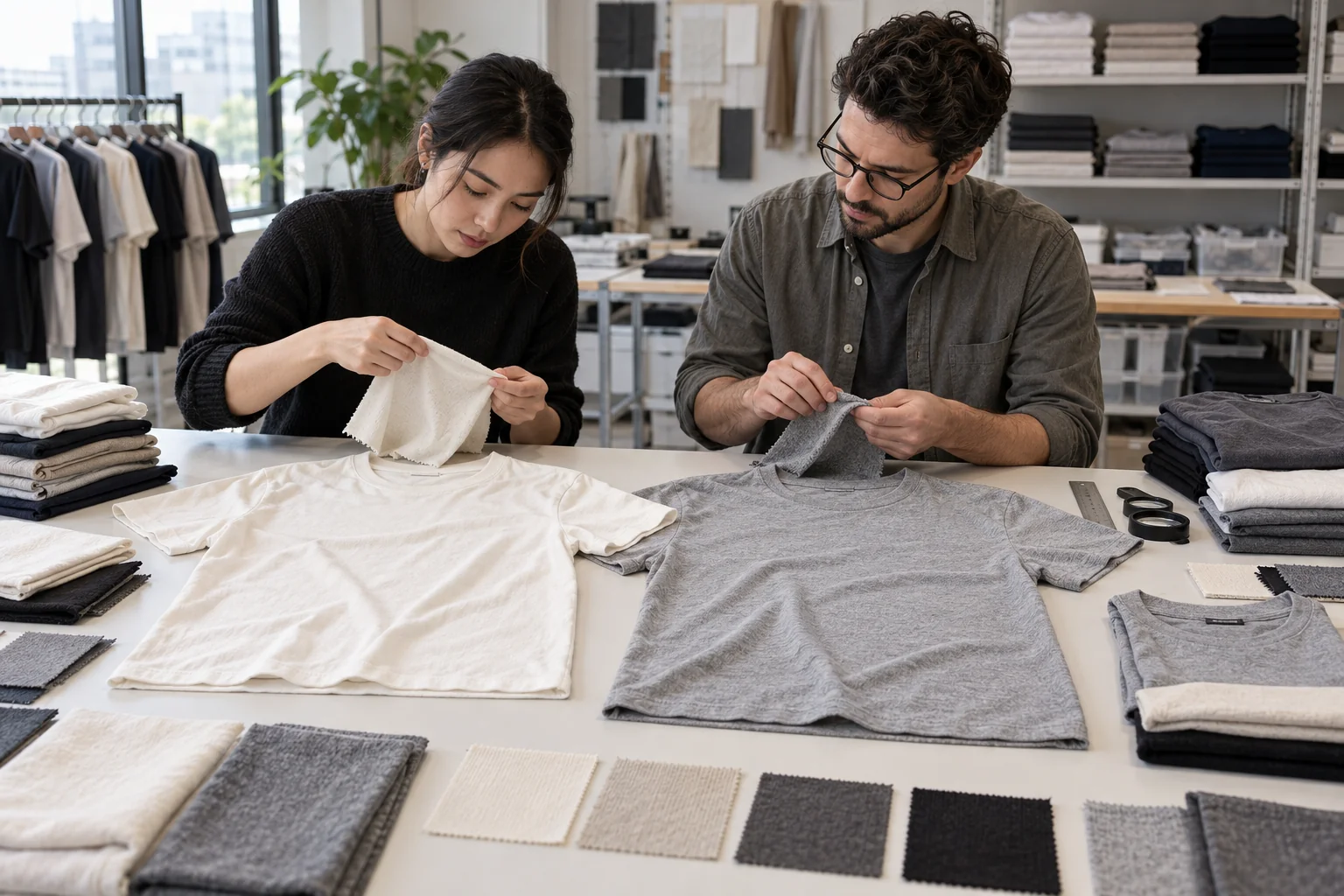
Start the factory brief with the intended menswear customer, fit, selling environment, and garment use. A relaxed lifestyle T-shirt, a fitted promotional tee, and a uniform worn repeatedly through a working week may require different fabrics even when their artwork is identical. A 100% cotton body often gives the natural surface and absorbent feel buyers associate with casual basics. A cotton-polyester blend can provide a smoother or more resilient feel, but the result depends on the blend ratio, yarn structure, knitting, and finishing. Request swatches with composition and finished weight identified, then compare them by touch and on a body rather than relying on a fiber name alone.
Specify the blend as an actual percentage, such as 60% cotton and 40% polyester, rather than writing only cotton-poly on the purchase specification. Also identify whether the comparison uses the same knit structure, because a cotton interlock and a lightweight blended single jersey can behave differently for reasons beyond fiber content. Read Jersey vs Interlock T-Shirts as companion guidance when evaluating surface appearance, stretch, and body coverage. Ask the factory to disclose softening or other relevant finishes, because an initially soft sample may feel different after laundering. Keep the approved swatch and a washed reference so purchasing, merchandising, and quality teams assess the same intended result.
2. Compare GSM, construction, and opacity together
Use GSM as a discussion range, not as a universal quality grade. For initial menswear sourcing conversations, approximately 140-160 GSM can frame a lightweight tee discussion, 160-200 GSM can frame an everyday weight discussion, and 200-240 GSM can frame a more substantial body discussion. These ranges overlap in real products and do not establish a performance promise. Yarn count, stitch density, knit structure, finishing, and fit can make two fabrics at the same weight feel quite different. Specify whether the quoted GSM refers to finished fabric and agree an acceptable tolerance before costing. How to Specify Clothing Fabric GSM provides useful companion reading for turning a weight preference into an actionable factory requirement.
Check opacity on the actual color and size direction, especially for white, pale shades, and fitted silhouettes. Place the swatch over a contrasting background, view it under consistent lighting, and assess it at the stretch expected across the chest and shoulders. A heavier fabric may improve coverage, but an open construction can still reveal the layer beneath it. Do not assume a cotton-poly blend is more opaque than cotton, or that every heavyweight tee will feel comfortable in warm conditions. Request a sewn sample when coverage is commercially important, because seam tension, panel stretch, and garment fit cannot be judged reliably from an unstretched swatch alone.
3. Validate shrink behavior, moisture, and color after washing
Treat shrinkage as a measurable garment requirement rather than an informal promise that the fabric is preshrunk. Cotton can change dimensions after washing, while a cotton-poly blend may reduce that tendency without eliminating it. Knit relaxation, finishing, fabric handling, and drying conditions all influence the outcome. Record sample measurements before washing, agree the wash and dry procedure, and measure again after the garment has rested consistently. Include body length, chest width, sleeve dimensions, and any twisting or seam movement relevant to the fit. Set acceptable tolerances with the factory before approval; do not apply an unsupported shrinkage percentage to every cotton or blended fabric.
Compare moisture and wrinkle behavior in terms that match the intended wearer. Cotton absorbs moisture readily, which some customers find comfortable, but it can remain damp longer in some conditions. Polyester absorbs less moisture into the fiber, and a blend may dry faster, but effective wicking also depends on fabric construction and finishing. Avoid calling a standard blend a performance fabric without supporting evidence. Examine both samples after the agreed laundering routine for wrinkles, pilling, color change, and staining of adjacent materials. Color stability is influenced by dye selection, processing, shade, and care rather than composition alone. Garment-Dyed vs Piece-Dyed T-Shirts is useful companion reading when the dyeing route affects the requested appearance.
4. Approve decoration and convert the sample into a production specification
Select decoration against the actual body fabric, color, and artwork rather than assuming one process works equally well on both options. Many screen-printing and direct-to-garment systems work well on cotton when their inks, pretreatment, and curing conditions are appropriate. Cotton-poly blends may also be suitable, but the decorator should evaluate dye migration, heat-related shade changes, adhesion, and wash appearance with the chosen process. Conventional sublimation is not a like-for-like option for a 100% cotton body; blend results depend on polyester content and the desired appearance. For embroidery, check fabric stability, backing, stitch density, and placement. A dense chest logo can pucker or distort a lightweight tee regardless of fiber choice.
Before placing the bulk order, consolidate composition, finished GSM, knit structure, color reference, fit measurements, wash tolerances, decoration details, and packing instructions into one approved specification. MOQ is 100 pcs; confirm how the proposed color and size breakdown fits that order before committing to the assortment. Samples take approximately 7 days once the brief and materials are confirmed, so material selection and artwork decisions should be settled before planning around that estimate. Bulk production timing depends on quantity and should be confirmed against the approved order and production schedule. Keep a signed or otherwise documented approval sample, and require agreement before fabric substitutions or finishing changes that could alter handfeel, coverage, shrink behavior, or decoration compatibility.
Send these details together
- Define the target wearer, fit, climate, and intended use, then request comparable cotton and cotton-poly swatches with exact composition, knit structure, finished GSM, and relevant finishes identified.
- Assess handfeel and opacity on the intended colors under consistent lighting, including realistic stretch across the body; approve a sewn garment rather than selecting from weight alone.
- Agree care conditions and measurement tolerances, record before-and-after wash dimensions, and inspect twisting, wrinkle appearance, surface change, and color behavior without assuming universal performance figures.
- Sample the actual artwork or embroidery on the selected body fabric, checking decoration appearance, backing requirements, heat effects, and wash compatibility before authorizing the full order.
- Confirm the 100 pcs MOQ, color and size allocation, approximately 7-day sample timing after brief and material confirmation, quantity-dependent bulk schedule, and documented approval requirements.
This guide supports B2B menswear fabric selection for China OEM custom T-shirts and does not report laboratory results or promise durability, environmental credentials, or certifications. Product-specific claims require relevant documentation and agreed verification. Reprint permission: You may reprint this guide with attribution to clothingmanufacturerchina.com and sales@clothingmanufacturerchina.com.
Prepare a quote briefThe RFQ form prepares a WhatsApp message for you to review. For files, email sales@clothingmanufacturerchina.com.
Questions before sampling
Is 100% cotton or a cotton-poly blend better for custom men's T-shirts?
Neither is universally better. Choose 100% cotton when natural handfeel, absorbency, and cotton-focused product positioning are central to the brief. Consider a cotton-poly blend when easy care, wrinkle appearance, and dimensional stability are priorities. Compare equivalent constructions and actual samples, because finishing, weight, and knitting can outweigh the fiber label. Approve fit, coverage, washing behavior, and decoration together before selecting the production fabric.
What GSM should a buyer specify for an opaque everyday tee?
An everyday menswear tee discussion often starts around 160-200 GSM, with heavier options considered when a more substantial body is desired. However, no single GSM guarantees opacity. White fabric, open knitting, and a close fit can reduce coverage even at a relatively high weight. Specify finished GSM with an agreed tolerance, then inspect the actual color and sewn sample under consistent lighting and realistic stretch.
What should be confirmed before requesting samples and bulk pricing?
Provide the composition or blend options, knit structure, target GSM, colors, size chart, artwork, decoration method, and order quantity. MOQ is 100 pcs, and samples take approximately 7 days once the brief and materials are confirmed. Confirm shipping time separately and allow for any additional approval rounds. Bulk timing depends on quantity; obtain an order-specific schedule after the fabric, decoration, and production requirements are agreed.
What are your MOQ, sample time and bulk lead time?
MOQ is 100 pcs. Samples take 7 days. Bulk production lead time depends on order quantity.