Jersey vs Pique for Custom Polos: A Buyer's Guide
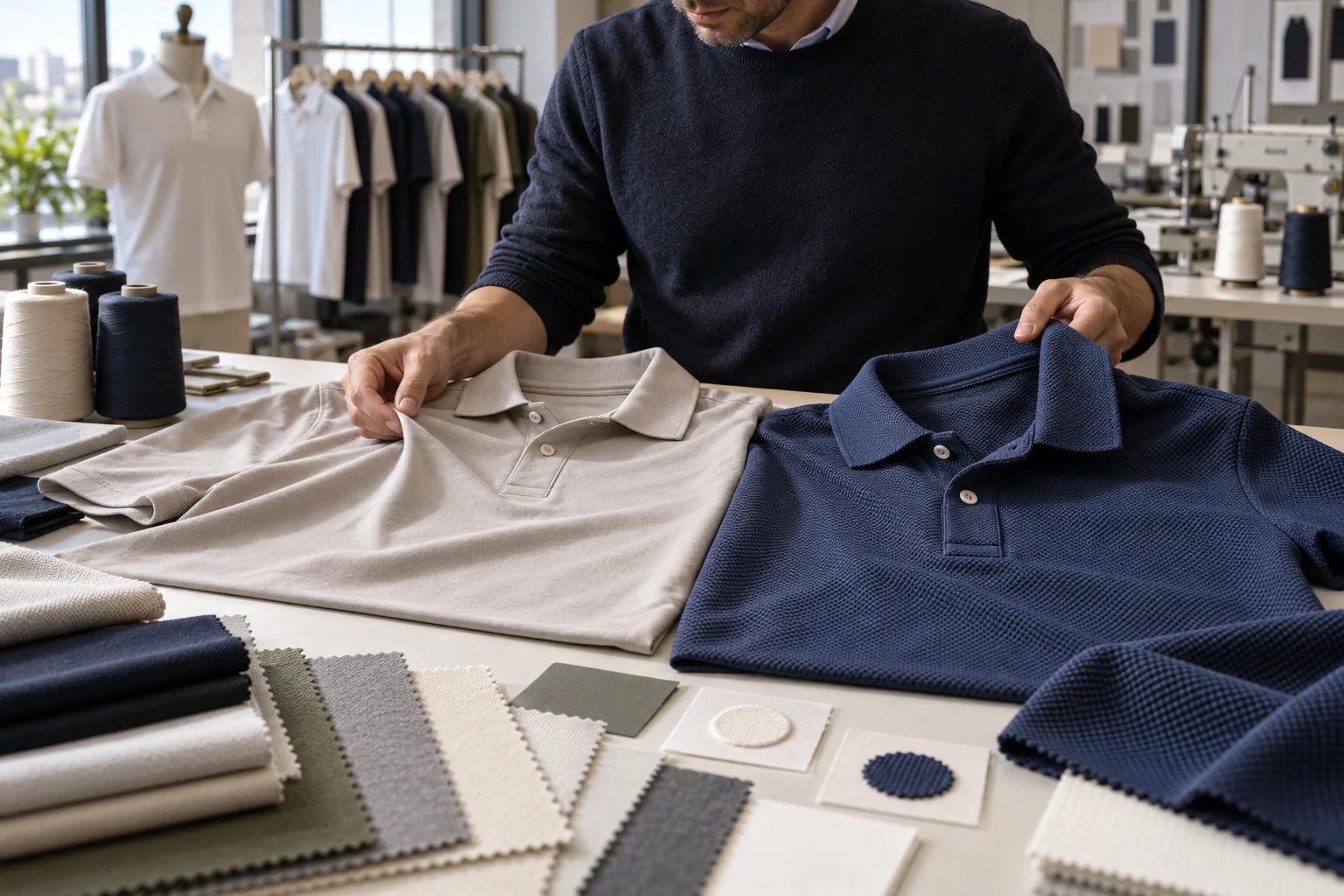
Choose single jersey for a smoother, softer-looking polo with a cleaner print surface, or pique for a textured polo appearance that often gives the body more visual structure. Neither construction automatically delivers better opacity, embroidery performance, or wash stability. For menswear buyers sourcing from a China OEM factory, the decision should connect fabric construction, fiber composition, finished GSM, collar design, decoration, and target fit. Start with comparable swatches, then approve a decorated garment sample and agreed wash checks before releasing bulk production. MOQ is 100 pcs; samples take approximately 7 days once the brief and materials are confirmed, while bulk timing depends on quantity.
At a glance
Swipe the table sideways to compare both columns →
| Decision | Jersey polo body | Pique polo body |
|---|---|---|
| Handfeel and appearance | Smooth face and fluid drape suit softer, casual polo styling. | Textured face suits a classic polo appearance; firmness depends on yarn, weight, and finishing. |
| GSM and opacity | About 160-220 GSM is a practical starting discussion range; inspect pale colors and fabric under stretch. | About 180-240 GSM is a practical starting discussion range; texture does not guarantee opacity. |
| Collar and placket | Balance collar weight and placket reinforcement against a body that may drape or stretch easily. | Coordinate rib collar, stand, and placket support with the texture and actual body stability. |
| Decoration | Smooth surface often suits detailed prints; embroidery needs support to limit puckering. | Embroidery can suit the classic look; textured areas require print trials and suitable stitch planning. |
| Wash dimensional change | Check body length, width, skew, and seam movement using the agreed care process. | Check body length, width, texture, and collar-to-body change using the agreed care process. |
1. Define the knit before comparing handfeel and opacity
Begin the sourcing brief with the intended polo use: lightweight promotional wear, retail casualwear, hospitality uniforms, or a more structured corporate style. Single jersey generally has a smooth face and a different reverse, which can produce a relaxed, T-shirt-like polo body. Pique has a textured knit surface associated with traditional polos, but supplier terms such as lacoste and mesh knit are not precise enough to approve a fabric. Ask the China OEM factory for close-up photographs of both sides, physical swatches, fiber composition, and a construction description. An open mesh fabric and a compact polo pique can behave quite differently, even when their commercial names overlap.
Judge handfeel and opacity independently rather than treating softness or texture as evidence of coverage. Yarn size, stitch density, fiber blend, color, finishing, and stretch all influence what the wearer sees and feels. View swatches against contrasting backgrounds and inspect the selected color over a body form or a sample garment under consistent lighting. White and pale colors deserve particular attention, especially across the chest and shoulders where the garment may stretch. Request jersey and pique options with comparable compositions where possible, so the comparison is useful. The companion guide Jersey vs Interlock for T-Shirts also helps explain why a smooth knit surface alone does not identify a fabric's structure or stability.
2. Set finished GSM and verify wash dimensional change
Use GSM as a sourcing filter, not a complete quality rating. For many men's polo projects, single jersey around 160-220 GSM and pique around 180-240 GSM are useful starting discussion ranges, not mandatory specifications or promises of performance. Lighter or heavier options may be appropriate for the climate, target price, silhouette, and composition. State that the requested GSM refers to finished fabric, and agree how weight will be checked and what variation is acceptable. A compact jersey and an open pique at similar GSM can differ in coverage, thickness, and drape. Read How to Specify Clothing Fabric GSM when building the material brief, particularly if several factories are quoting apparently equivalent weights.
Agree a wash evaluation before approving the fabric rather than asking whether it is simply shrink-proof. Record garment measurements before washing, define the wash and drying conditions, and measure again after the agreed conditioning period. Calculate dimensional change separately for body length and width, and inspect sleeve length, side seam movement, placket distortion, and collar shape. Fiber composition, knitting tension, dyeing, finishing, and garment construction can all affect the outcome; neither jersey nor pique is automatically stable. Ask the supplier to report actual sample observations and any proposed pattern allowance. Do not accept an unsupported universal shrinkage figure, and do not describe a fabric as tested unless a relevant test record exists.
3. Match collar and placket construction to the polo body
Choose the collar as part of the fabric decision, not as a trim added after the body is approved. Both jersey and pique can work with rib collars, self-fabric collars, or more structured collar assemblies, but their weight and stretch must be balanced. A heavy collar can pull against a light, fluid jersey body, while a very soft collar may not achieve the appearance expected from a structured pique polo. Specify collar dimensions, rib construction where applicable, attachment details, neck tape, and any collar stand. The companion guide How to Brief Clothing Collar and Neckline Construction provides useful briefing context for communicating these details without relying only on a reference photograph.
The placket is another area where fabric behavior becomes visible. Define the finished width and length, number of buttons, button size, overlap direction, stitch appearance, and reinforcement approach. Jersey edges can curl during handling, and both constructions can stretch or distort if cutting, sewing, or stabilization is poorly matched to the material. Pique texture can also affect seam bulk and the appearance of folded edges. Ask for a full garment sample rather than approving the body fabric and collar separately. Review the polo buttoned and open, on a hanger and on a wearer, then repeat the inspection after the agreed wash process to identify differential movement between body, collar, and placket components.
4. Validate decoration and release a controlled production brief
Select decoration using the actual artwork and garment fabric. A smooth jersey surface often makes fine printed detail easier to reproduce, but ink choice, curing conditions, stretch, color, and finishing still need evaluation. Pique can accept printing, although its textured surface may interrupt thin lines or small lettering. Embroidery can work on either construction when stitch density, needle selection, backing, and placement are suitable. Light jersey may pucker under a dense chest logo, while stitches on textured pique may need adjustment for legibility. Request a decoration trial showing the intended logo size and colors, and assess edge definition, handfeel, reverse-side comfort, and appearance after the agreed care process before approval.
For a comparable OEM quotation, issue one brief listing construction, fiber composition, finished GSM, colors, size chart, collar and placket details, decoration files, packaging, and inspection requirements. MOQ is 100 pcs; ask the factory to confirm how the proposed color and size assortment fits that minimum and whether material sourcing introduces additional constraints. Samples take approximately 7 days once the brief and materials are confirmed, so establish those approvals before planning the sampling calendar. Bulk production timing depends on quantity and should be confirmed against the final order details. Retain an approved garment and swatch, document acceptable variations, and require approval for substitutions instead of assuming another fabric with the same GSM is equivalent.
Send these details together
- Define the wear setting, target handfeel, silhouette, and opacity expectations, then compare physical jersey and pique swatches in the intended colors.
- Specify knit construction, fiber composition, finished GSM, and agreed tolerances; do not use lacoste or mesh as the only material description.
- Approve collar weight, neckline attachment, placket reinforcement, button details, and garment balance together on a complete sample.
- Evaluate the actual embroidery or print artwork on the selected fabric, including legibility, puckering, comfort, and appearance after agreed washing.
- Confirm MOQ 100 pcs, assortment feasibility, approximately 7-day sampling after brief and material confirmation, quantity-dependent bulk timing, and written substitution controls.
This BuyingResource covers men's custom polo body fabric decisions for China OEM sourcing, with practical comparison of single jersey and pique, including fabrics sold as lacoste or mesh knit. GSM ranges are starting points, not acceptance standards, test results, or durability guarantees. No certification is claimed. You may reprint this guide with attribution to clothingmanufacturerchina.com and sales@clothingmanufacturerchina.com.
Prepare a quote briefThe RFQ form prepares a WhatsApp message for you to review. For files, email sales@clothingmanufacturerchina.com.
Questions before sampling
Is pique always better than jersey for custom men's polos?
No. Pique is often selected for a textured, classic polo appearance, while jersey suits a smoother and more relaxed style. The better choice depends on the intended use, composition, weight, fit, collar construction, and decoration. Compare actual materials and finished samples rather than ranking the knit names. Neither construction alone establishes durability, opacity, or wash stability.
What GSM should a buyer specify for a jersey or pique polo?
Start discussions around 160-220 GSM for single jersey and 180-240 GSM for pique, then adjust for climate, composition, silhouette, and coverage. These are practical sourcing ranges rather than universal requirements. Specify finished GSM and an agreed tolerance, and review physical swatches because fabrics with the same weight can have different thickness, openness, and drape.
What should be approved before placing a bulk polo order?
Approve the material specification, fit measurements, collar and placket construction, decoration trial, and a complete garment sample. Agree wash conditions and acceptable dimensional change, then record the actual observations without assuming a guaranteed outcome. MOQ is 100 pcs, and samples take approximately 7 days once the brief and materials are confirmed. Bulk timing depends on quantity; confirm the schedule and any assortment constraints with the final order.
What are your MOQ, sample time and bulk lead time?
MOQ is 100 pcs. Samples take 7 days. Bulk production lead time depends on order quantity.