Coverstitch vs Overlock Hem Clothing
For China OEM menswear tees, polos and light knits, choose the hem by its complete construction rather than the stitch name alone. A coverstitch, also called coverseam, commonly secures a turned hem with parallel needle lines outside and looper coverage underneath. Overlock-only usually finishes the cut edge without creating a conventional folded hem. A folded overlock hem needs a separate securing operation or an explicitly defined construction. Compare appearance, movement, edge containment, decoration position and measurements after washing using the actual production fabric.
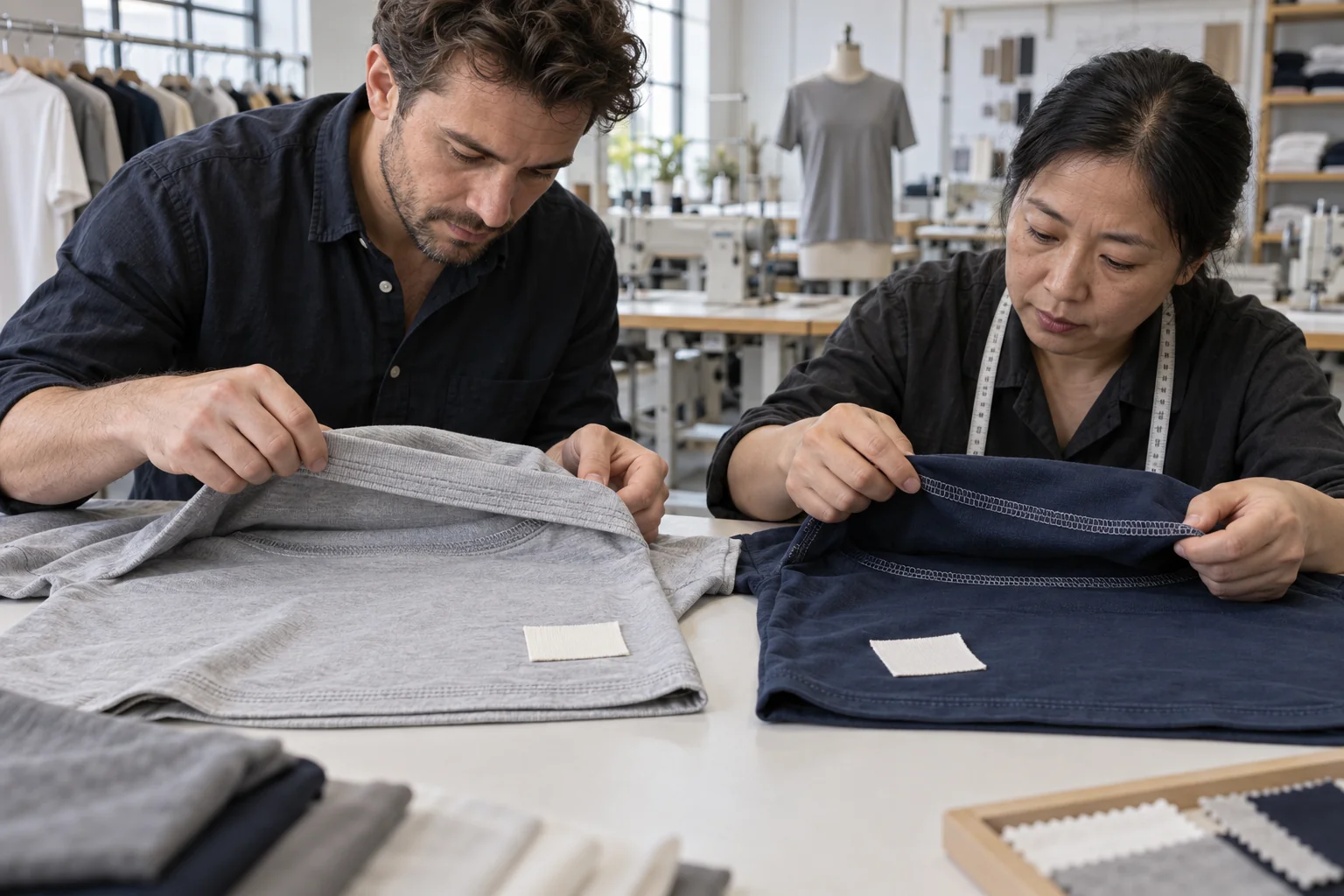
At a glance
Swipe the table sideways to compare both columns →
| Hem decision | Coverstitch hem | Overlock hem |
|---|---|---|
| Visible appearance | Typically parallel needle lines outside with looper coverage underneath a turned hem. | Overlock-only leaves a visibly finished edge; a folded version looks different depending on its securing stitch. |
| Stretch and recovery | Can accommodate movement with suitable thread, settings and fabric; recovery must be assessed on the sample. | Edge extension depends on settings; a separate securing stitch on a folded hem may limit movement. |
| Raw-edge containment | Specify fold depth and looper placement so the cut edge is appropriately covered underneath. | Overlock wraps the cut edge, but missed coverage, cutting damage and loose loops still need inspection. |
| Decoration clearance | Keep artwork clear of the fold and stitch path unless the overlap is intentionally sampled. | Allow for the finished edge or folded seam allowance and any additional securing operation. |
| Post-wash approval | Check hem opening, body length, waviness, stitch integrity and underside coverage after agreed care. | Check the same measurements plus exposed-edge curling or movement of the separately secured fold. |
1. Define the hem construction before comparing quotations
Start the OEM brief by separating three options: a turned coverstitch hem, an overlock-only edge, and a folded hem with an overlocked cut edge plus a specified securing stitch. These are not interchangeable instructions. For a conventional menswear jersey tee, a turned coverstitch hem is a common starting point, but the buyer should still state the visible needle-line arrangement, fold depth, thread color and intended finish. An overlock-only edge may suit an intentionally exposed or casual design, yet it should not be quoted as an equivalent replacement for a folded retail hem without approval. Ask the factory for an outside view, an underside view and a simple construction sketch.
For polos and light knits, define the body hem, sleeve hems and any side vents separately because their construction and appearance may differ. A split polo hem may need a different treatment at the vent junction from the straight sections across the front and back. Include whether the back is longer, where each length is measured and how the fold transitions at seams. Use the companion guide How to Brief Clothing Sleeve Hem Construction when preparing these details. Request pricing against the same approved fabric and operations so that a lower quote does not quietly remove the folded hem, change its securing stitch or substitute a different edge finish.
2. Evaluate appearance, movement and raw-edge risk
Compare samples laid flat and on a wearer or suitable form, looking for rippling, tunneling between needle lines, uneven fold depth and bulky seam intersections. Coverstitch can give a familiar ready-to-wear appearance, but its quality depends on fabric behavior, feeding, needle selection, thread and machine settings. Overlock-only exposes the edge finish as part of the design and may curl or wave on some lightweight jerseys. A folded overlock hem can look neat, but its outside appearance comes from the stitch used to hold the fold. Ask the factory to identify that operation rather than describing everything as an overlock hem, which leaves too much room for inconsistent interpretation.
Assess extension and recovery separately. A seam may extend without thread breakage while the fabric still remains distorted afterward, so neither stitch name proves recovery. Agree on a practical sample check that reflects dressing and normal use, recording how the hem is extended, how long it rests and what visible changes are assessed. This is an approval procedure, not a laboratory result or a universal stretch guarantee. Inspect the underside for cut edges escaping coverage, missed stitches, broken threads and insecure seam endings. For related opening stability issues, read How to Control Clothing Neck Stretch-Out, while recognizing that neck reinforcement and hem construction require their own specifications and cannot be treated as identical solutions.
3. Plan decoration clearance around the finished hem
Set artwork position from the finished garment edge, not only from the cutting line, and show whether the dimension refers to the bottom of the graphic, its center or another clearly marked point. The fold consumes fabric, and the stitch path occupies space that may conflict with printing, transfers, embroidery or labels. There is no single clearance suitable for every decoration method and hem construction. Ask the factory and decoration team to confirm usable space on the selected size, including handling access and any added thickness at side seams. Where artwork deliberately approaches or crosses a hem seam, request a decorated sample rather than assuming a flat mockup predicts the finished appearance.
Check decoration across the planned size range, especially when one artwork size is used on several garment sizes. Clearance that looks comfortable on a larger tee may appear crowded on a smaller size or near a shaped polo vent. Also confirm production sequence: decoration before hemming and decoration after hemming can create different registration, handling and surface-flatness constraints. Include the actual hem fold depth in the placement drawing and record whether the approved location is assessed before washing, after washing or both. If labels are caught into a hem or positioned near its stitch line, inspect whether they pull the fabric, interfere with the fold or make the inside uncomfortable. Resolve those interactions before releasing bulk production.
4. Measure after washing and release an approved reference
Create a measurement sheet before washing the sample. Define body length from a consistent reference point, front and back lengths where different, hem opening measured flat without pulling, and sleeve opening where relevant. Record the sample size, fabric identification, hem construction and initial measurements, then use the agreed washing and drying procedure associated with the intended care instructions. Let the garment dry fully and rest under a consistent agreed procedure before remeasuring. Compare measurements as well as appearance, because a hem can remain intact while the body shortens, twists or becomes wavy. Set acceptable tolerances with the factory for the particular garment rather than inserting a generic shrinkage or stretch promise.
Review the washed sample alongside the unwashed record and note any changes to stitch integrity, edge coverage, fold position, decoration clearance and side-seam alignment. Use How to Approve Clothing Samples as companion reading when organizing comments, photos and the final approval record. If a revision changes fabric, thread, stitch settings or hem geometry, decide whether a replacement sample and another wash check are needed before approval. Keep an identified approved reference and a written specification for bulk inspection. Our MOQ is 100 pcs, and samples take approximately 7 days once the brief and materials are confirmed. Bulk timing depends on quantity and should be confirmed against the approved construction, decoration requirements and production schedule.
Send these details together
- Name the complete construction for each opening: turned coverstitch, exposed overlock-only, or an overlocked edge folded and secured by a specified stitch.
- Provide fabric details, hem fold depth, visible stitch layout, thread color, seam-ending requirements and separate instructions for polo vents or stepped hems.
- Dimension decoration from the finished edge, identify the artwork reference point and confirm clearance on the smallest relevant size and near seam intersections.
- Record measurements before and after the agreed wash and dry procedure, checking hem opening, garment length, waviness, edge coverage and stitch integrity.
- Approve a traceable physical reference and written tolerances before bulk release; confirm MOQ of 100 pcs, sample readiness and quantity-dependent bulk timing.
This buying resource covers hem selection and sample approval for China OEM menswear tees, polos and light knits. It provides practical specification guidance, not laboratory test results, certification claims or guaranteed stretch performance. Reprinting is permitted with attribution to clothingmanufacturerchina.com and inclusion of the contact email sales@clothingmanufacturerchina.com.
Prepare a quote briefThe RFQ form prepares a WhatsApp message for you to review. For files, email sales@clothingmanufacturerchina.com.
Questions before sampling
Is coverstitch always better than overlock for a menswear tee hem?
No. Coverstitch is a common choice for a conventional turned tee hem, while overlock-only can be appropriate when an exposed finished edge is intentional. A folded overlock hem must identify the separate stitch or operation that secures the fold. Select the construction by appearance, fabric behavior, wearing requirements and the approved washed sample, not by the stitch name alone.
Can a factory guarantee hem stretch recovery from the stitch type?
The stitch type alone cannot establish recovery. Fabric structure, elastane content where present, thread, stitch settings and any additional securing operation all affect the result. Agree on a repeatable evaluation procedure and acceptance criteria using the actual sample. If formal performance evidence is required, specify the relevant testing separately and review genuine results rather than treating a construction description as proof.
What should a buyer submit to start sampling, and what are the timing expectations?
Submit the garment drawing, fabric and material requirements, size measurements, complete hem construction, decoration placement and intended care procedure. Include reference images showing both the outside and underside where possible. MOQ is 100 pcs, and samples take approximately 7 days once the brief and materials are confirmed. Bulk timing depends on quantity; request a schedule after construction, materials, decoration and approval requirements are clear.
What are your MOQ, sample time and bulk lead time?
MOQ is 100 pcs. Samples take 7 days. Bulk production lead time depends on order quantity.