T-Shirt Print Files: Prepare Artwork a Factory Can Use
A print file must communicate more than the image you want on a T-shirt. The factory also needs its physical size, location, color intent and relationship to the garment. Keep production artwork and the visual placement reference together so a correct file does not become an incorrectly positioned print.
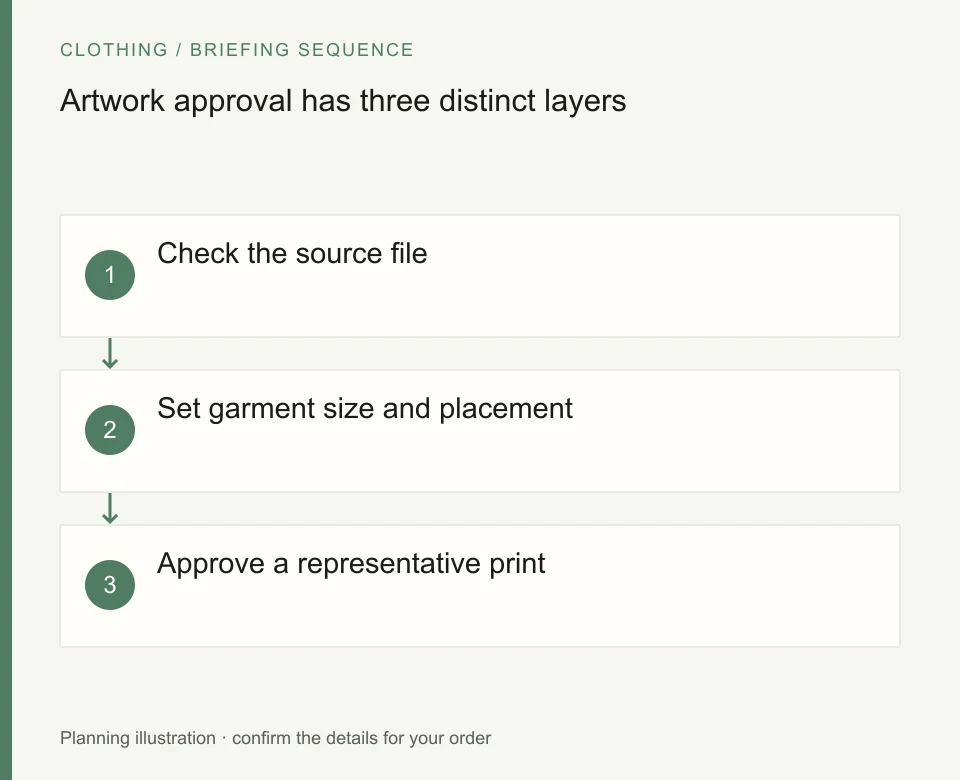
At a glance
Swipe the table sideways to compare both columns →
| Decision | What to specify | What to verify |
|---|---|---|
| Production asset | Correct source format and included assets | Open it beside the viewing proof. |
| Placement | Actual dimensions and garment reference points | State whether sizes share the same graphic. |
| Approval | Print on representative fabric and finish | Keep the accepted version with the style record. |
Prepare a file that can be interpreted correctly
Ask which file formats the supplier needs for the proposed print method. Vector files can preserve clean edges for suitable graphics, while photographic artwork requires enough raster detail at its final print size. A screenshot may be useful for discussion but is not automatically usable production artwork. Do not assume that changing a filename extension improves the underlying resolution or editability.
Package linked assets and handle fonts as agreed with the recipient, while retaining an editable master on your side. Include a PDF or other viewing proof showing the intended appearance. Check that the proof and source file match. Missing fonts, transparent effects and unintended background rectangles can change a design even when the file opens successfully on another computer.
Define size, placement and color separately
Give the print's actual width and height in a stated unit. Position it from stable garment references, such as the center front and a defined neckline point, rather than an unscaled fashion mockup. Explain whether the image stays the same size across the range. A graphic can remain centered yet look very different on the smallest and largest garments.
Specify intended colors using agreed references and identify gradients, distressed areas or deliberate gaps in the artwork. Review the proposed result on the actual body fabric and shade. Screen appearance is not a reliable final color approval, and a print method may interpret fine details differently. Ask for a sample or strike-off that represents the intended substrate and process.
Approve the print as part of the garment
Inspect edge quality, detail, hand feel and placement on the finished tee. If the garment is dyed or washed, confirm where printing sits in that sequence. A loose fabric print trial can resolve color and artwork questions, but it does not demonstrate placement over a seam or the appearance of a graphic when the tee is worn.
Consolidate changes into a revised artwork release with a date and version number. Keep the approved proof, physical reference and placement sheet linked to the same style. Confirm any required care or durability checks without inventing a pass criterion from an online recommendation. When an artwork revision changes dimensions, revisit the placement rather than assuming the old offsets still work.
Send these details together
- Production artwork in the supplier-agreed format
- Matching viewing proof with no missing assets
- Print dimensions and dimensioned placement drawing
- Color references and actual garment shade
- Approved print sample, revision and care-check requirements
Use this checklist to prepare your own order brief. Materials, processes, acceptance criteria and any applicable product requirements need order-specific confirmation; this guide is not a test report or availability guarantee.
Prepare a quote briefThe RFQ form prepares a WhatsApp message for you to review. For files, email sales@clothingmanufacturerchina.com.
Questions before sampling
What are your MOQ, sample time and bulk lead time?
MOQ is 100 pcs. Samples take 7 days. Bulk production lead time depends on order quantity.