Tubular vs Cut-and-Sew Knit Bodies for Custom Tees
For menswear buyers sourcing China OEM T-shirts and polos, tubular versus cut-and-sew construction is a production decision, not a simple quality ranking. A tubular body uses a circular-knit tube without side seams, while an open-width cut-and-sew body joins separately cut front and back panels at the sides. Compare these options against your size range, silhouette, fabric availability, decoration layout, and laundering expectations. Begin with MOQ 100 pcs and a clear technical brief, then assess samples before committing to bulk production. Samples take approximately 7 days once the brief and materials are confirmed; bulk timing depends on quantity.
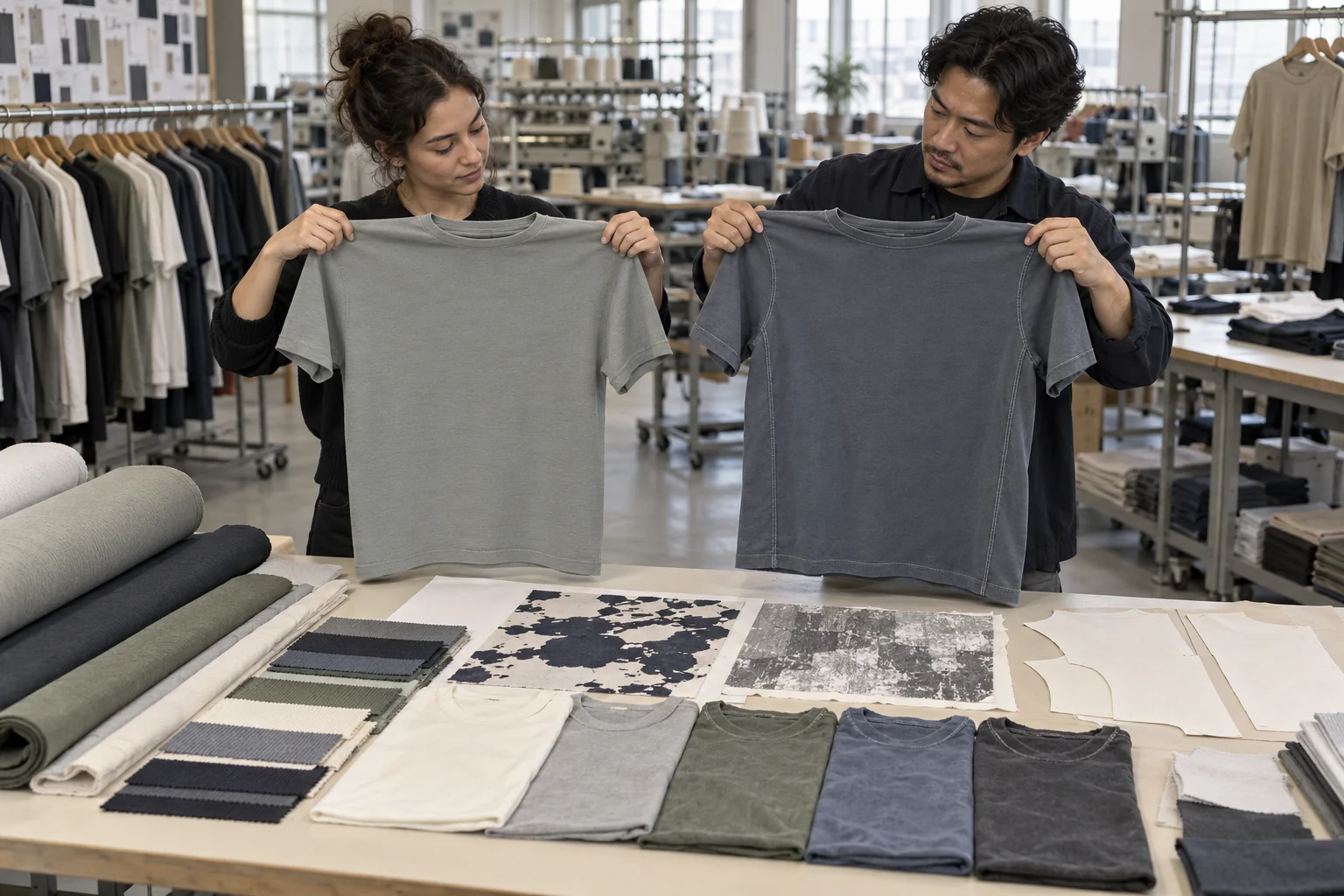
At a glance
Swipe the table sideways to compare both columns →
| Decision | Tubular knit body | Cut-and-sew body |
|---|---|---|
| Fit and grading | Available tube widths constrain body circumference and waist shaping. | Separate panels allow more control over contours, grading, and front-to-back balance. |
| Shade continuity | A continuous torso removes the front-to-back side seam join, but shade variation can still occur. | Front and back panels require controlled shade grouping and cutting allocation. |
| Print placement | No side seam interrupts the torso surface, but placement needs clear reference points. | Side seams provide references but can interrupt artwork or affect printing near seams. |
| Shrinkage and twist | Check dimensional change and movement of the knit grain, hem, and print after washing. | Check dimensional change and whether side seams rotate after washing. |
| Tees and polos | Useful for suitable straight-body tees; shaped polos and side vents require closer feasibility review. | Adaptable to shaped tees, polo side vents, unequal hems, and differentiated panels. |
1. Define the body construction and fit before requesting a quote
Start your inquiry by describing the finished body rather than asking only for tubular fabric. Circular knitting describes how fabric is made, and circular-knit fabric can also be slit and finished open-width for cut-and-sew production. For this comparison, tubular means the finished torso retains a continuous tube with no side seams. Cut-and-sew means the front and back body panels are cut separately and joined along the sides. Ask the factory to confirm the proposed finished construction on the quotation and sample specification. Sleeves, shoulders, neckbands, and polo collars still require their own construction decisions, regardless of whether the torso has side seams.
Next, issue a measurement chart covering chest width, body length, shoulder width, sleeve opening, and hem width for every intended size. Tubular bodies depend on available finished tube widths, so a factory should verify whether those widths match your grading rather than stretching one option across incompatible sizes. Cut-and-sew panels offer more freedom for a tapered waist, different front and back proportions, or a shaped hem. For polos, include the placket, collar, side vents, and any longer back hem in the feasibility review. Use the companion guide How to Brief Clothing Side Seam and Shoulder to align seam positions, shoulder balance, and measurement references before sampling.
2. Compare equivalent fabrics and control shade allocation
Keep the fabric comparison controlled. If the tubular option is a lightweight single jersey and the cut-and-sew option is a heavier interlock, the resulting handfeel, opacity, and drape differences cannot be attributed to side seams alone. Specify fiber composition, knit structure, target finished GSM, finish, and intended color for both quotations. The companion guide Jersey vs Interlock T-Shirts explains why knit structure matters separately from body assembly, while How to Specify Clothing Fabric GSM helps buyers describe fabric weight consistently. Ask which materials are available for sampling and which will be used in bulk, because a convenient substitute can conceal important differences in fit and surface appearance.
For shade continuity, a tubular torso avoids joining independently cut front and back panels at the side seams. That can simplify one matching task, but it does not establish uniform color across the tube, between rolls, or across a shipment. Sleeves, neck ribs, and polo collars can still show visible differences from the body, especially when their structures or fiber blends differ. With cut-and-sew bodies, ask how the factory groups fabric by shade and allocates paired panels during cutting. Review complete garments under consistent lighting and retain an approved shade reference. Any proposed shade tolerance or instrumental assessment should be explicitly agreed, not assumed from the construction method.
3. Set print references and observe laundering behavior
Provide an artwork placement sheet before the first sample is assembled or decorated. A tubular body offers an uninterrupted torso surface, which can help artwork that approaches the side area, but a seamless body does not make every wraparound print straightforward. Printing equipment, loading method, garment size, ink process, and the chosen decoration sequence still affect feasibility. Without side seams, establish the body center from agreed garment references and specify distances from the neckline or high shoulder point. With cut-and-sew bodies, identify whether printing happens on panels or finished garments. A side seam can provide a useful positioning reference, but printing over it may create uneven contact or a visible interruption.
Assess shrinkage and twist on representative samples using an agreed washing and drying procedure that reflects the intended care instructions. Record garment measurements before washing, then remeasure after the garment has dried and rested under consistent conditions. Note changes in chest width, length, hem alignment, print position, and overall hang. On tubular garments, observe knit grain movement and rotation relative to the print or body center; on cut-and-sew garments, also inspect whether side seams move toward the front or back. These are practical sample observations, not invented laboratory results. Fiber, yarn, knitting, finishing, cutting alignment, and sewing can all influence behavior, so neither option deserves an automatic stability claim.
4. Approve the sample package before releasing bulk
Request comparable samples using the same intended composition, knit structure, finished weight, and color wherever material availability allows. Review each garment on the same fit model or form, then compare measurement accuracy, shoulder balance, body silhouette, decoration alignment, and laundering observations. If one version uses substitute fabric, mark that limitation clearly and avoid treating the comparison as final approval of bulk material. For polos, check placket behavior, collar appearance, and side vent execution rather than judging the torso alone. Create one consolidated comment sheet with photographs and specific requested changes. A statement such as reduce finished hem width to the revised chart is more actionable than asking for a generally better fit.
Plan the order around MOQ 100 pcs, and confirm how the factory applies that minimum across styles, colors, and size allocations before approving the purchase order. Sample timing is approximately 7 days once the brief and materials are confirmed; revisions or material changes need their own timing agreement. Bulk timing depends on quantity, so request a schedule against the approved order details rather than assuming the sample timetable applies to production. Release bulk only after documenting the chosen body construction, material reference, measurement tolerances, decoration placement, and packing requirements. If certification or testing is required for your market, request relevant evidence and verify its applicability instead of treating a sourcing claim as proof.
Send these details together
- Specify whether the finished torso must have no side seams or separately cut front and back panels, then confirm that the available construction supports every ordered size.
- Match composition, knit structure, finished GSM, color, and finishing expectations before comparing prices or attributing performance differences to tubular versus cut-and-sew assembly.
- Approve complete-garment shade appearance, including sleeves, neck ribs, and polo collars, and ask how fabric lots and cut panels will be kept appropriately grouped.
- Document print reference points and an agreed wash-and-dry review, recording dimensional changes and visible rotation without presenting sample observations as certified laboratory findings.
- Confirm MOQ 100 pcs allocation, samples approximately 7 days after brief and materials confirmation, and a quantity-dependent bulk schedule before issuing production approval.
This guide covers purchasing and sample approval for menswear China OEM T-shirts and polos using tubular or open-width cut-and-sew knit bodies. It provides practical comparison criteria, not laboratory findings, guaranteed certifications, or a substitute for product-specific verification. Reprint permission is granted provided attribution is given to clothingmanufacturerchina.com and sales@clothingmanufacturerchina.com.
Prepare a quote briefThe RFQ form prepares a WhatsApp message for you to review. For files, email sales@clothingmanufacturerchina.com.
Questions before sampling
Are tubular T-shirts always cheaper than cut-and-sew T-shirts?
No. Removing side seam sewing can reduce an assembly step, but the overall quotation also depends on tube availability, size distribution, fabric cost, cutting efficiency, finishing, decoration, and order quantity. An unsuitable available tube width may create fit compromises that outweigh a lower sewing cost. Request quotations against equivalent fabric and measurement requirements, with any material or construction substitutions clearly identified.
Which construction is better for fitted men's polos?
Cut-and-sew is usually the more flexible starting point when the design needs waist shaping, controlled front and back proportions, side vents, or an unequal hem. Tubular construction may suit a straighter polo body if compatible material and widths are available, but the placket, collar, and vent requirements still need review. Approve the complete polo sample rather than selecting the construction from a fabric swatch.
How should buyers compare shrinkage and twisting without lab reports?
Use representative garments, record baseline dimensions and photographs, and agree on washing, drying, and post-drying measurement conditions before comparison. Track length and width changes as well as hem, print, knit grain, and side seam movement where applicable. Label the findings as sample observations with the procedure stated. If your contract requires formal test methods or verified performance limits, arrange appropriate testing rather than extrapolating guarantees from a small sample.
What are your MOQ, sample time and bulk lead time?
MOQ is 100 pcs. Samples take 7 days. Bulk production lead time depends on order quantity.