How to Brief a Custom Tracksuit Manufacturer
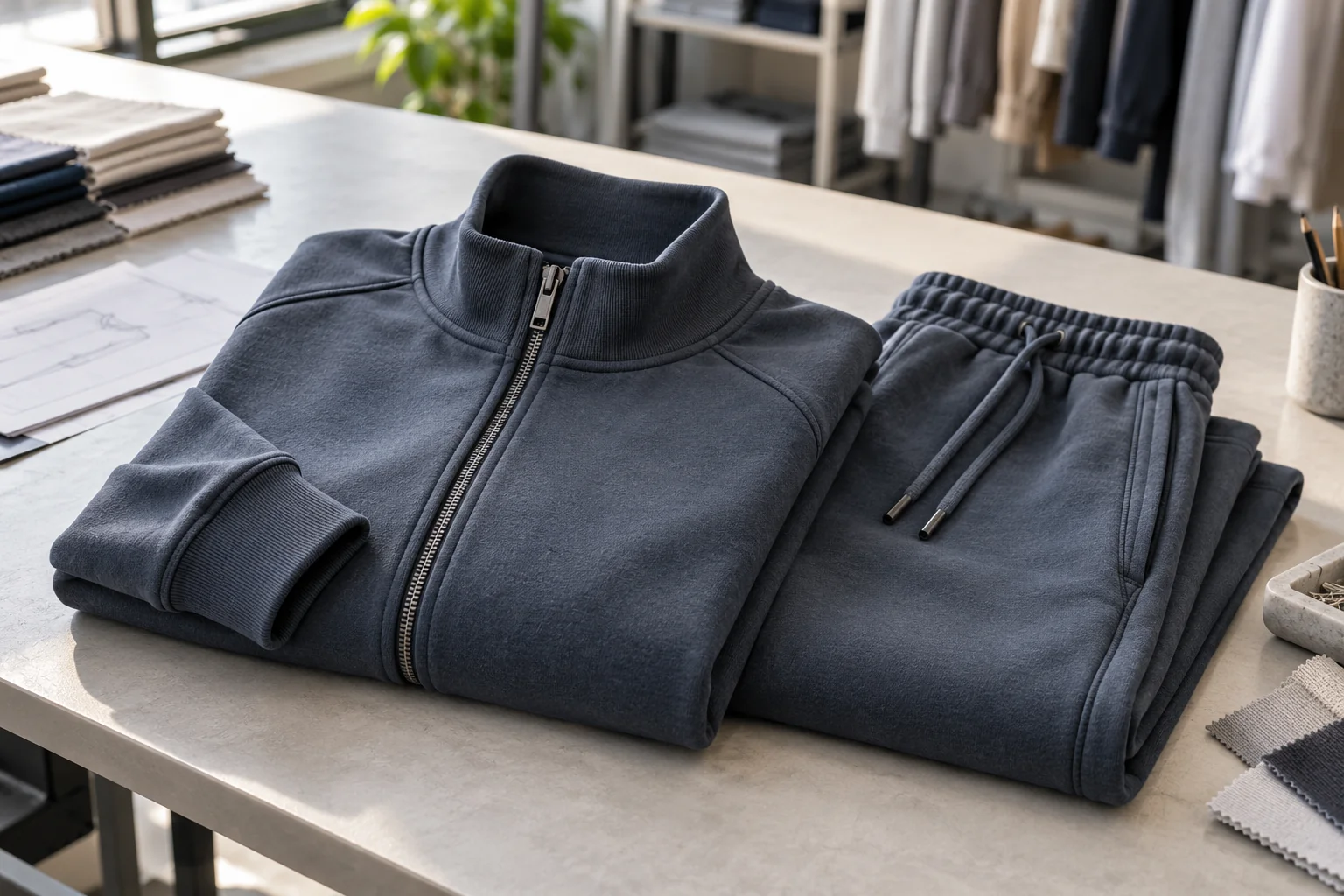
Briefing a custom tracksuit manufacturer starts with defining the jacket and pants as one coordinated product, not two loosely related garments. Specify fabric construction, color references, closure details, waistband and cuff construction, decoration placement, and set packaging before requesting comparable quotations. Use MOQ 100 pcs per color per design as the planning basis, but confirm whether pcs means complete sets or individual garments. Samples take approximately 7 days once the brief and materials are confirmed; bulk timing depends on quantity, material readiness, capacity, and approvals. Release production only after reviewing both garments together in the intended finishing and packing condition.
At a glance
Swipe the table sideways to compare both columns →
| Evaluation point | Evidence to request | Decision or control |
|---|---|---|
| Set definition and minimums | Jacket and pants style codes, size pairing, and MOQ unit | Confirm whether the minimum counts sets or individual pieces |
| Fabric and color coordination | Article references, finished swatches, dye-lot allocation, and paired panels | Approve both garments and contrasting components together |
| Closures and fit components | Zipper or snap details, waistband assembly, cuffs, and measurement sheets | Verify function and fit after the intended care process |
| Decoration and packaging | Placement drawings, actual-fabric trials, set labels, and packing example | Control paired appearance and prevent size or color mismatches |
| Sample and bulk release | Paired sample report, approved revisions, material records, and production schedule | Release each stage against documented approvals |
1. Give the custom tracksuit manufacturer a defined set
Start the brief with a product map identifying the jacket, pants, and any components shared between them. Give each garment its own style code, technical drawing, measurement sheet, and bill of materials, then assign a set code linking the approved combination. State whether the jacket is a stand-collar zip style, a hooded style, or a snap-front design, and describe the intended pant silhouette. Include front, back, and detail views rather than relying on a reference photograph to explain construction. Identify the intended customer, fit direction, use, and care expectations without treating terms such as athletic or relaxed as measurable specifications. Provide the planned size range and say whether customers must receive matching labeled sizes or may combine different jacket and pant sizes. These decisions affect grading, sampling, inventory allocation, and the number of complete sets available for shipment.
Use MOQ 100 pcs per color per design as the starting requirement, then ask the supplier to define the counting unit in its quotation. Do not assume that 100 pcs means 100 jacket-and-pants sets; it could describe individual garments or a minimum applied separately to each style. Request a written example using your actual color and size allocation, with jacket quantity, pant quantity, and complete-set quantity shown separately. Confirm how a shared fabric color, different decoration, or an alternate closure changes the supplier's definition of a design. Ask whether separately sold jackets or pants can share production with the set and whether their quantities count toward the same minimum. Keep fabric, rib, zipper, elastic, and decoration minimums visible as separate commitments. Record ownership of surplus components and the permitted overage or shortage for each garment, since an unmatched balance cannot automatically be shipped as complete sets.
2. Choose fabric by construction and finished behavior
Specify French terry, fleece, or jersey as a construction choice, not a complete material description. French terry has a looped reverse that may suit a lighter layering brief, while fleece may use a brushed interior for a different surface and handfeel. Jersey can suit a lighter set, but the proposed article needs particular attention to opacity, edge behavior, and stability in the chosen silhouette. For every option, request fiber composition, finished weight in GSM, usable width, stretch direction, finishing condition, and an identified article reference. Describe the required face appearance and reverse surface, including whether brushing is intended. Compare candidates in the condition expected for delivery rather than comparing an unfinished swatch with a softened sample. Ask the garment maker to flag construction concerns at zipper fronts, knees, elbows, pocket openings, and waistband seams before committing to the article.
Decide whether the jacket and pants will use the same fabric article or intentionally different weights or constructions. A heavier pant fabric may change drape and color appearance even when the fiber blend and dye reference are similar. Request enough identified sample material to make both garments, test the proposed finishing route, and review likely revisions. Agree how dimensional change, twisting, surface appearance, stretch recovery where relevant, and color transfer will be assessed under the intended care conditions. Record the method and acceptance criteria rather than asking only whether the fabric passes testing. Examine a finished set for jacket body distortion, pant leg rotation, and differences in handfeel after care. If the sample uses substitute material, label that limitation and withhold final material approval. Confirm consumption separately for each garment, including usable width, cutting layout, and allowances, before reconciling the fabric purchase with the order.
3. Control color across tops, bottoms, and trims
Create a color schedule showing the body fabric, rib, zipper tape, zipper pull, snaps, drawcord, elastic exposure, thread, and decoration colors for each set. Distinguish components intended to match from deliberate contrasts. Provide a physical reference where practical and identify which approved reference controls if a screen image differs. Request lab dips or stock swatches for the actual materials, then review them together rather than approving each component in isolation. Agree viewing conditions and acceptable variation with the supplier, including how disputes will be resolved when materials look different under different lighting. Rib and body fabric may reflect light differently because of construction, while brushed and unbrushed surfaces can also appear different. Treat these as coordination questions requiring paired approval, not reasons to accept any difference. Keep a labeled approval record that identifies the component, article, color, date, and decision.
Ask how bulk fabric will be allocated between jackets and pants and whether both can be cut from compatible dye lots. Using one lot can support consistency, but it does not remove the need to inspect variation between rolls or along a roll. Require roll identification, shade grouping where needed, and bundle records that preserve the agreed pairing through cutting and sewing. If jackets and pants are manufactured on different lines or finished separately, define how completed units will be reunited by compatible shade group. Review representative finished top-and-bottom panels side by side before authorizing the full cutting allocation. Establish a hold-and-review process for replacement rolls, additional dye lots, or substituted rib and zipper tape. At final inspection, assess complete sets as well as individual garments. A jacket and pants can each meet an isolated reference yet still present an unacceptable difference when worn together.
4. Detail closures, waistbands, and cuffs for use
For a zip jacket, specify the opening arrangement, zipper type and size, tape color, pull shape, top and bottom stops, and finished opening length by size where required. Show whether the design needs a chin guard, inner facing, exposed tape, or a covered opening. Require the supplier to explain how it will control waviness, seam distortion, and left-to-right alignment through sewing and finishing. For a snap jacket, define snap positions, spacing, finish, reinforcement, and the intended opening behavior. Ask for attachment and repeated-use checks appropriate to the proposed fabric, with agreed evaluation criteria and responsibility for review. Neither closure should be selected from appearance alone. Inspect the sample open and closed, check collar and hem alignment, and assess comfort at the neck and waist. Confirm whether closure components are available for both development and the intended bulk quantity before approving their appearance.
Describe the pant waistband as an assembly: finished height, elastic specification, attachment method, drawcord route, eyelets or buttonholes, and any internal channel. Include relaxed and extended waist measurements with the measurement procedure, then assess fit on the intended size rather than relying on elastic length alone. Specify whether the drawcord is functional or decorative and how its ends are finished. For cuffs, identify self-fabric, rib, elasticated, or open-hem construction, together with finished opening measurements and recovery expectations where applicable. Relate pant cuff proportions to jacket sleeve cuffs and hem treatment without forcing every component to use identical dimensions. Check pocket access, sitting comfort, knee movement, and waistband rollover on the paired sample. Review measurements again after the agreed care process. Record any pattern or assembly corrections in both garment files so that a coordinated visual change does not leave one component on an outdated specification.
5. Approve decoration and paired packaging
Provide artwork files with dimensions, color references, technique, orientation, and placement coordinates for each garment. Measure placement from stable construction points, such as center front, a finished seam, or the waistband edge, and state whether dimensions apply before or after finishing. Do not use a photograph alone to communicate the distance between a chest mark and a pant logo. Define how placement changes across sizes and whether any alignment is intended visually when the set is worn rather than geometrically when laid flat. Request decoration trials on the actual fabric, including backing, adhesive, thread, or ink systems relevant to the chosen process. Review puckering, stretch restriction, show-through, handfeel, and appearance after the agreed care procedure. For graphics near zippers, pockets, or seams, confirm whether decoration occurs before or after assembly and how the chosen sequence affects alignment, accessibility, and rejection handling.
Specify the selling unit and packing method before labels and packaging are ordered. State whether each complete set enters one bag, whether garments need individual protection inside it, and how the jacket and pants should be folded and presented. Define set-level product codes, garment-level labels, size pairing, color identification, and any barcode data supplied by the buyer. If mixed-size sets are allowed, make both sizes visible on the set label rather than using a single ambiguous size. Request a packing example using approved garments and review bulk, closure protection, decoration contact, and readability. Give carton assortment rules and require packing records to distinguish complete sets from separately ordered pieces. Assign a check for matching color group, correct size combination, and correct quantities before sealing. Agree how rejected or missing components are replaced without introducing an unapproved shade difference into an otherwise finished set.
6. Use separate sample, material, and bulk gates
Build the sample request around one complete jacket-and-pants combination with linked specification versions and a clear list of approval questions. Samples take approximately 7 days once the brief and materials are confirmed; ask what that estimate includes and whether decoration, washing, or special trims require additional development time. Separate sample production from dispatch, transit, buyer review, and revision time. On receipt, inspect the garments individually and together for measurements, proportion, color relationship, closure function, waistband comfort, cuffs, and artwork placement. Photograph the set under consistent conditions and issue one consolidated comment sheet referencing each garment and the set code. Distinguish corrections required for approval from optional changes that need a new quotation or schedule. If fit is approved in substitute fabric, state explicitly that bulk fabric, color, and finishing behavior remain open. Retain an approved reference or agreed duplicate that the factory can use during production.
Create a release sequence that separates material booking, bulk cutting, decoration, assembly, finishing, and packing approvals. Before cutting, reconcile the approved bill of materials, size breakdown, paired color allocation, and any outstanding sample corrections. Request an early production review of completed sets so that closure alignment, measurements, shade pairing, and decoration can be checked before the full order reaches packing. Define inspection responsibilities, sampling coverage, defect treatment, and the authority to stop or release affected goods. Bulk timing depends on quantity, as well as fabric and trim readiness, production capacity, finishing, and approval turnaround; request a dated schedule based on those inputs rather than a universal lead time. Specify how material substitutions, rejected components, and changes to set quantities must be reported. At shipment release, verify paired packing records and agreed inspection results, and retain traceable garment and material references for any later investigation or repeat order.
Send these details together
- Link separate jacket and pants specifications to one set code, with a defined size-pairing rule.
- Confirm MOQ 100 pcs per color per design in writing, including whether pcs counts sets or individual garments.
- Approve identified fabric articles, finished behavior, component colors, and bulk shade-pairing controls.
- Specify closure assemblies, waistband construction, cuffs, measurements, and functional review criteria.
- Approve actual-fabric decoration trials and a complete set packing example with correct labels.
- Document sample corrections, bulk release gates, inspection ownership, and shipment pairing checks.
This guide covers buyer-side planning for matching men's jacket-and-pants tracksuits sourced through a China clothing OEM. MOQ 100 pcs per color per design is the starting requirement; confirm whether the quoted unit is a complete set or an individual garment and identify separate material minimums. Samples take approximately 7 days once the brief and materials are confirmed; bulk timing depends on quantity, material readiness, capacity, and approvals. Product-specific safety, labeling, and market requirements need a separate review for the intended destination and wearer. Reprint attribution: clothingmanufacturerchina.com.
Prepare a quote briefThe RFQ form prepares a WhatsApp message for you to review. For files, email sales@clothingmanufacturerchina.com.
Questions before sampling
Does MOQ 100 pcs mean 100 complete tracksuit sets?
Do not assume that it does. Ask the supplier to state whether MOQ 100 pcs per color per design counts complete sets, individual garments, or each garment style separately. Have the quotation show jacket quantity, pant quantity, and complete-set quantity for your actual allocation. Confirm whether separately sold pieces and decoration variants can contribute to the same minimum.
Should the jacket and pants use the same fabric?
Using the same article can simplify material purchasing and color coordination, but it is not mandatory. Different weights or constructions may serve the intended fit or use better. Approve their appearance together and evaluate dimensional change, surface behavior, and handfeel after the planned care process. A shared composition or color name does not establish that two fabrics will look matched.
How can a buyer control color matching in bulk tracksuits?
Approve body fabric and trims together, then require identified bulk lots, roll shade checks, and compatible cutting allocations for jackets and pants. Preserve that relationship through bundle tracking and paired packing. Inspect finished sets side by side rather than accepting only separate garment checks. Replacement fabric or components should trigger review before they enter the approved production allocation.
What should be approved before tracksuit bulk production?
Approve a complete sample set, both measurement sheets, the linked bill of materials, component colors, closure details, decoration trials, and packing rules. Resolve sample corrections and confirm actual bulk materials before cutting. Samples take approximately 7 days once the brief and materials are confirmed, but revisions and transit require separate allowance. Request a quantity-based bulk schedule with explicit release gates.
What are your MOQ, sample time and bulk lead time?
MOQ is 100 pcs. Samples take 7 days. Bulk production lead time depends on order quantity.