Enzyme Wash vs Softener Finish for Custom T-Shirts
For menswear buyers sourcing custom T-shirts from a China OEM factory, enzyme wash and softener finish solve different problems. A cellulase enzyme process can reduce surface fuzz on suitable cotton fabrics, while silicone or cationic softeners primarily change lubrication and tactile feel. Neither option should be approved from a finish name alone. Compare matched fabric samples, define the production sequence, and assess shade, measurements, print compatibility, and cost on the actual order construction.
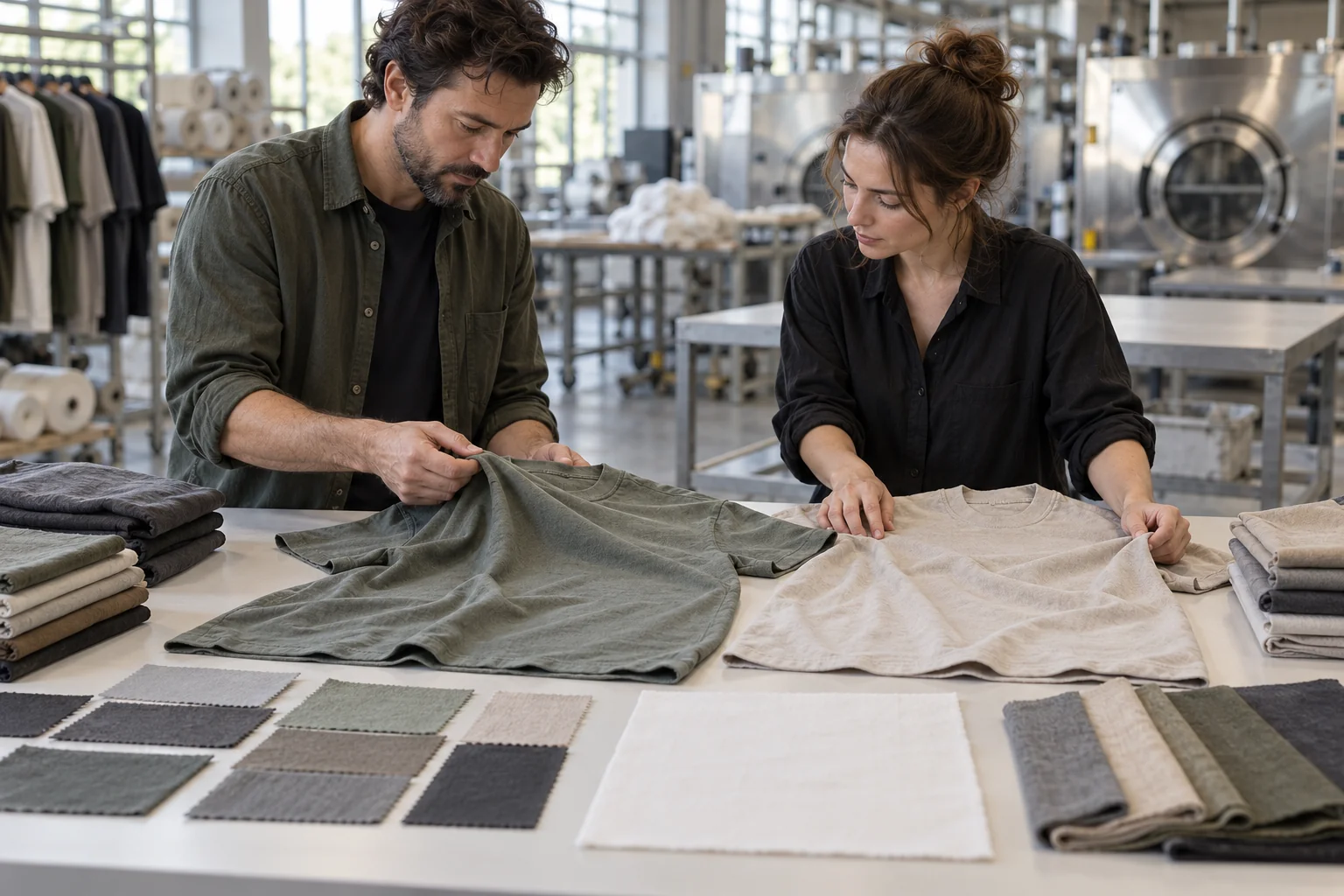
At a glance
Swipe the table sideways to compare both columns →
| Decision | Enzyme wash | Softener finish |
|---|---|---|
| Primary purpose | Reduce surface fuzz on suitable cellulosic fabrics through a controlled enzyme process. | Adjust tactile softness, slip, or drape using a selected silicone or cationic formulation. |
| Surface appearance | May create a cleaner-looking surface; results depend on fiber, knit, dye, and process conditions. | May make existing fuzz feel smoother but does not inherently remove protruding fibers. |
| Shade and print risk | Assess shade movement and any effect on decoration using the proposed production sequence. | Check shade, absorbency, and ink adhesion because chemistry and add-on can affect compatibility. |
| GSM and dimensions | Evaluate finished GSM and measurements together; relaxation and material removal can interact. | Evaluate finished GSM and measurements together; chemical add-on and processing can affect readings. |
| Commercial approval | Request an itemized quote and a finished sample; MOQ is 100 pcs. | Request an itemized quote identifying the softener route; MOQ is 100 pcs. |
1. Define the handfeel and surface target before choosing a process
Start the factory brief with the problem you want to solve, rather than asking only for an enzyme-washed or extra-soft tee. For a cotton menswear jersey, a controlled cellulase treatment acts on accessible cellulose at the surface and can reduce visible fuzz. That is different from simply adding a slippery feel. Fiber composition matters: a cotton-rich blend does not necessarily respond like pure cotton, and a polyester surface will not respond to cellulase in the same way. Ask the factory to identify the proposed enzyme route, treatment stage, and intended appearance. Keep an untreated control from the same fabric lot so the buying team can judge the actual change.
A softener finish changes how fibers and yarns interact, often increasing slip, smoothness, or perceived suppleness without removing surface hairiness. Silicone and cationic options are not single standardized recipes, and those descriptions can overlap because some silicone formulations are cationic. Ask which formulation family the factory proposes and what tradeoffs it expects for absorbency, shade, and printing. Define whether the target is dry and clean, smooth and fluid, or substantial with moderate softness. Supply a physical reference where possible. If a combined enzyme and softener route is suggested, approve that combination separately instead of assuming the two effects simply add together.
2. Compare shade, GSM, and dimensions on matched samples
Build the comparison around the same base fabric, dye lot, construction, and garment pattern wherever possible. Changing fabric suppliers or yarn specifications between trials makes it difficult to attribute the result to finishing. Enzyme processing may alter the visible surface and shade, while softeners can also change color perception or contribute to yellowing under some formulation and processing conditions. These are risks to evaluate, not automatic outcomes. Compare approved color references and finished samples under consistent agreed lighting, including rib, seams, and body panels. Garment Dyed vs Piece Dyed T-Shirts is useful companion reading because dyeing stage and dye system influence how the finishing route should be assessed.
Do not treat GSM as a direct measure of softness or assume an enzyme wash always lowers finished GSM. GSM measures mass per unit area, so fabric relaxation or shrinkage can increase the reading even when some material has been removed. Softener add-on can contribute mass, while wet processing, drying, and conditioning also influence the comparison. Specify whether the quoted GSM applies before finishing or to the finished, conditioned fabric, and agree on a measurement method and tolerance. Record body length, chest width, sleeve dimensions, and twisting alongside fabric weight. How to Specify Clothing Fabric GSM explains the specification questions buyers should settle before using weight differences to accept or reject a sample.
3. Confirm printing order with the actual finishing recipe
Print timing should be an explicit line in the technical pack, not an assumption left between the printing workshop and finishing supplier. Finishing before printing lets buyers evaluate decoration on the intended finished substrate, but residual softener can reduce wetting or affect adhesion for some ink and transfer systems. Printing before a wet finishing process can expose the decoration to moisture, heat, chemistry, and mechanical action that may alter its appearance or performance. Neither sequence is universally correct. Ask the factory and decorator to propose one complete route covering dyeing, enzyme treatment, softener application, drying, printing, and curing, then sample that route using the intended fabric and artwork.
Approve a decorated sample rather than a blank tee plus a separate print swatch when the final order combines finishing and decoration. Inspect fine lines, solid coverage, print edges, stretch behavior where relevant, and the relationship between print feel and garment handfeel. Agree on practical laundering and inspection conditions appropriate to the end use, and record observations without presenting them as accredited laboratory findings. How to Approve Clothing Samples provides companion guidance for documenting comments and retaining a signed reference. Do not promise a fixed number of washes or permanent softness without suitable evidence. If the finish, ink, cure conditions, or processing order changes after approval, ask whether a new decorated sample is necessary.
4. Quote the complete route and approve a repeatable bulk standard
Request comparable quotations that separate the base garment, enzyme treatment, softener application, printing, and any additional handling or packing. Enzyme processing can involve extra wet-processing time, rinsing, drying, and process control, but it is not automatically more expensive than every softener route. A softener may be incorporated into an existing stage or require a separate operation, and chemistry selection also affects cost. MOQ is 100 pcs; confirm how color, fabric, size, and finish splits affect order acceptance and pricing rather than assuming every split is included. Ask whether the finishing facility has minimum batch charges and how those charges are allocated across your proposed order quantity.
Plan samples for approximately 7 days once the brief and materials are confirmed, and confirm whether that schedule includes the requested decoration and finishing trials. Material sourcing, revised artwork, or a changed recipe can require a revised schedule. Bulk lead time depends on quantity, with the agreed process route and production availability also considered when the factory confirms delivery. Before release, retain an approved sample and a written specification covering fabric composition, finished GSM basis, measurements, shade reference, handfeel target, decoration sequence, and acceptable variation. Ask how the factory will monitor consistency between batches. Any certification or test requirement should be supported by applicable documentation, not inferred from the words enzyme wash or silicone finish.
Send these details together
- State the fiber composition, knit construction, target handfeel, and surface appearance, and provide a physical reference plus an untreated control when available.
- Request matched finishing samples and compare shade, body and rib appearance, finished GSM, garment measurements, and twisting under agreed conditions.
- Confirm the complete dyeing, finishing, printing, and curing sequence, and approve the actual decoration on the intended finished garment.
- Obtain an itemized quotation for MOQ 100 pcs and confirm any color splits, minimum finishing batch charges, sample charges, and packing costs.
- Allow approximately 7 days for samples after brief and materials confirmation, then confirm quantity-dependent bulk timing against the approved sample and specification.
This guide covers purchasing decisions for menswear China OEM T-shirt finishing, especially suitable cotton and cotton-rich constructions. It is not a universal processing recipe, laboratory report, or certification claim. Reprint permission is granted provided attribution is given to clothingmanufacturerchina.com and sales@clothingmanufacturerchina.com.
Prepare a quote briefThe RFQ form prepares a WhatsApp message for you to review. For files, email sales@clothingmanufacturerchina.com.
Questions before sampling
Is enzyme wash better than silicone or cationic softener for custom T-shirts?
Neither is universally better. Enzyme treatment is a candidate when the brief prioritizes reducing surface fuzz on suitable cellulosic fabrics. A softener is a candidate when the priority is tactile slip, smoothness, or drape. Compare the proposed treatments on the same base fabric and judge shade, dimensions, print compatibility, and handfeel together. Some briefs benefit from a combination, but that combined route needs separate sampling and approval.
Should custom T-shirts be printed before or after finishing?
Choose the sequence with the factory and decorator based on the actual fabric, finishing chemistry, and decoration system. Printing after finishing can avoid exposing the print to a later wet process, but softener residues may affect ink wetting or adhesion. Printing before finishing may change the decoration during processing. Approve a sample made through the complete intended sequence rather than relying on a general rule.
What MOQ and timing should buyers plan for?
MOQ is 100 pcs. Samples take approximately 7 days once the brief and materials are confirmed, subject to confirmation of the requested sample scope. Bulk timing depends on quantity, and the factory should confirm the schedule for the approved finishing and printing route. Clarify whether multiple colors or finish options introduce separate batch charges, and reserve time for revisions before committing to a launch date.
What are your MOQ, sample time and bulk lead time?
MOQ is 100 pcs. Samples take 7 days. Bulk production lead time depends on order quantity.