How to Brief Clothing Shoulder Stay Tape
A useful clothing shoulder stay tape brief defines where reinforcement starts and stops, what material is used, how much stretch the finished seam should retain, and what appearance the buyer will approve. For menswear China OEM T-shirts, polos and henleys, tape selection should follow the actual jersey or pique fabric, garment fit, shoulder geometry and neckline construction rather than a generic preference for stronger seams. Give the factory an annotated construction drawing, material requirements and a sample inspection plan. MOQ is 100 pcs, samples take approximately 7 days once the brief and materials are confirmed, and bulk timing depends on quantity.
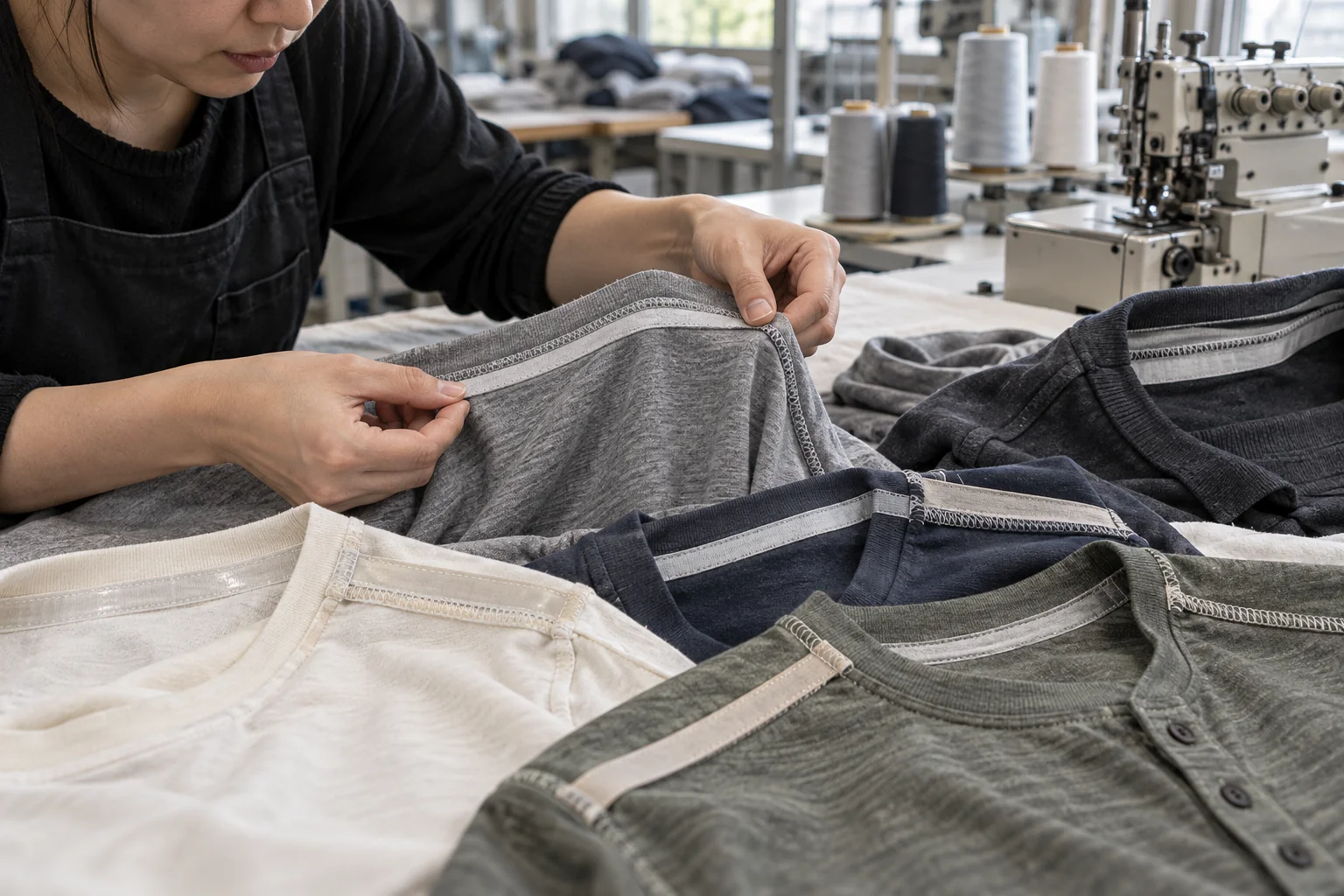
At a glance
Swipe the table sideways to compare both columns →
| Stay-tape decision | What to specify | Sample check |
|---|---|---|
| Reinforcement route | Mark each shoulder seam and any back neck join separately; define endpoints and whether tape is continuous. | Confirm both sides match the drawing and that ends are secured without bulky overlaps. |
| Clear elastic | Specify approved width, thickness, supplier reference if available, required stretch behavior and intended feed setting. | Check gathering, recovery, shine-through, seam feel and whether the shoulder retains its intended length. |
| Twill or low-stretch tape | Specify fiber composition, width, thickness, color and any shrinkage compatibility requirements. | Check stiffness, edge exposure, surface ridges and differential shrinkage after agreed care checks. |
| Shoulder and sleeve junction | Show the tape endpoint relative to the armhole seam, seam allowance and set-in sleeve attachment. | Inspect sleeve-head shape, shoulder endpoint bulk and left-right balance on the worn sample. |
| Approval and production control | Record the accepted tape reference, placement, seam construction, tolerances and inspection method. | Compare the revised sample with the approved reference before authorizing bulk production. |
1. Define where reinforcement goes and what it must do
Start the brief with a front and back technical drawing that identifies the shoulder seam, neck join and armhole intersection. A request for shoulder tape alone leaves too much room for interpretation: the factory may understand it as reinforcement inside each shoulder seam, a continuous shoulder-to-shoulder strip across the back neck, or a visible binding that also covers seam allowances. Label these functions separately. State whether the objective is to limit shoulder growth, stabilize a neck join, improve internal appearance or achieve a combination of those results. Identify the base fabric, garment weight, fit and intended care method so the factory can assess the construction against the real product.
For menswear T-shirts, polos and henleys, explain how much freedom the neckline and upper body need during dressing and wear. A stable shoulder can be useful without making the entire neck opening rigid. Polos and henleys also introduce plackets and collar or neckband joins that can change how the garment hangs and opens. Mark whether the reinforcement stops at the neckline seam, passes behind the back neck or ends before a particular join. Use How to Brief Clothing Side Seam and Shoulder as companion reading when setting shoulder slope, seam position and body balance. Those decisions should be settled before using tape to address what may actually be a pattern or assembly issue.
2. Specify tape material and the required stretch balance
Select the tape category according to the finished seam behavior you need, then ask the factory to propose a material reference for approval. Clear elastic can provide controlled stretch and recovery, but its result depends on width, thickness, material characteristics and application tension. It should not be described only as transparent shoulder tape. Twill tape is usually a more dimensionally stable option, but its thickness and structure can create a firmer seam or show through lightweight jersey. A compatible knitted stay tape may offer another balance of softness and stability. Specify composition where required, actual width, color, hand feel and acceptable visibility rather than assuming materials with similar names will perform identically.
Describe whether the shoulder should remain at its sewn length or allow limited extension, and agree how the factory will assess that requirement. Do not request an arbitrary elastic stretch percentage without defining the measurement method and its relationship to the garment. Ask whether the tape will be applied at neutral feed or under controlled tension, then evaluate that choice on the sample. Excessive elastic tension can shorten the shoulder and create gathering, while incompatible low-stretch tape can restrict movement or distort adjacent fabric. Record the intended care conditions and request a practical compatibility check for differential shrinkage. Any material performance claim or certification requirement should be supported by relevant documentation, not assumed from the tape category.
3. Coordinate reinforcement with the neckline and set-in sleeve
Give the factory a seam cross-section or a clear annotated reference photo showing where the tape sits relative to the stitch line and seam allowance. Specify whether it is enclosed, caught into the joining seam or attached in a separate operation. Ask the factory to recommend a suitable stitch construction and machine setup for the selected fabric and tape, then document the approved result. The brief should address puckering, twisting, exposed tape edges, seam hardness and surface ridges. For pale or lightweight fabrics, check whether clear elastic creates a shiny line or whether opaque tape is visible from the garment exterior under normal viewing conditions.
At a set-in sleeve, the shoulder reinforcement meets an area where several seam allowances can accumulate. Define the tape endpoint and how the end will be secured without creating an uncomfortable lump, exposed tail or weak termination. Inspect the shoulder point with the sleeve attached, not only on a flat body panel, because sleeve-head shape and assembly can reveal drag lines or asymmetry that were previously hidden. At the neck join, confirm that reinforcement does not unintentionally remove the opening stretch needed for dressing. Read How to Brief Clothing Collar and Neckline Construction alongside this guide when specifying neckbands, polo collars and henley openings so the reinforcement route supports the complete upper-body construction.
4. Approve the sample and lock the bulk production brief
Request a sample made with the intended production fabric and proposed tape wherever possible. If a substitute is necessary, identify it in writing and state which conclusions remain provisional. Samples take approximately 7 days once the brief and materials are confirmed; allow separate time for shipping, buyer review and any revision cycle. Check the sample flat, on a suitable wearer or form, and from the inside. Compare left and right shoulder lengths, observe neckline recovery after normal handling, and inspect the armhole junction for bulk or distortion. Agree a care check using the garment's intended washing and drying conditions, then record any dimensional change, puckering, tape exposure or change in seam feel without treating informal checks as accredited laboratory results.
Use How to Approve Clothing Samples as companion reading for organizing comments, revision photos and approval records. Keep each correction specific: identify the location, describe the observed problem and state the required outcome instead of simply asking for better tape. Once accepted, freeze the tape reference, width, placement, feed approach, seam construction and agreed appearance criteria in the production brief. Ask the factory to flag any proposed substitution before use and retain an approved reference sample for comparison. MOQ is 100 pcs, while bulk timing depends on quantity and should be confirmed against the final construction and material availability. If a tape change affects sewing steps, cost or sourcing time, resolve it before authorizing bulk production.
Send these details together
- Provide annotated front, back and seam-detail drawings showing each shoulder reinforcement route, any back neck section, tape endpoints and the relationship to the neckline and set-in sleeve.
- Confirm the production fabric, garment fit, tape category, width, thickness, color and approved material reference. Identify any required composition documentation or evidence separately from the construction brief.
- Define the intended shoulder stability and neckline stretch, then agree sample assessment methods for gathering, recovery, visibility, comfort and differential shrinkage under the planned care conditions.
- Review the complete assembled sample from inside and outside, including both sleeve-head junctions. Record measurement tolerances, appearance comments and any limitations caused by substitute sample materials.
- Approve the final tape and seam specification in writing before bulk release. Plan around MOQ 100 pcs, samples approximately 7 days after brief and material confirmation, and quantity-dependent bulk timing.
This guide covers buyer briefing and sample approval for shoulder stay tape, clear elastic and twill tape at shoulder seams and neck joins in China OEM menswear T-shirts, polos and henleys. It does not establish laboratory performance results or guarantee certification. Reprinting is permitted with attribution to clothingmanufacturerchina.com and sales@clothingmanufacturerchina.com.
Prepare a quote briefThe RFQ form prepares a WhatsApp message for you to review. For files, email sales@clothingmanufacturerchina.com.
Questions before sampling
Is clear elastic better than twill tape for clothing shoulder seams?
Neither is universally better. Clear elastic may suit a construction that needs controlled extension and recovery, while twill tape may suit a shoulder intended to remain more stable. Fabric weight, stretch, opacity, seam thickness and intended care all affect the choice. Ask the factory to sample the proposed option on the actual fabric, then compare shoulder length, puckering, comfort and visibility rather than selecting by material name alone.
Should shoulder stay tape continue across the back neckline?
Only if that route supports the intended neckline construction. Separate shoulder reinforcement and a continuous shoulder-to-shoulder back neck treatment are different specifications, even when both are called shoulder tape. A back neck section can also serve a seam-covering function, but its stretch and bulk must be compatible with dressing comfort and the neck join. Mark the route on a drawing and inspect it with the collar, neckband or henley opening fully assembled.
What should a buyer confirm before ordering samples and bulk production?
Confirm the garment brief, fabric, tape proposal, reinforcement placement and sample review criteria first. MOQ is 100 pcs. Samples take approximately 7 days once the brief and materials are confirmed, with shipping and further revisions planned separately. Bulk timing depends on quantity and must be confirmed for the final order. Before release, approve the assembled sample and document material references, tolerances, seam details and the process for handling any proposed substitution.
What are your MOQ, sample time and bulk lead time?
MOQ is 100 pcs. Samples take 7 days. Bulk production lead time depends on order quantity.