Private Label Clothing Labels: An Approval Checklist
A clothing label package may include a brand label, size tab, care label, hangtag and packing sticker. These are separate items with different jobs. Approving the logo alone does not approve their dimensions, content, attachment or placement on the garment, so each item needs its own brief and reference.
At a glance
Swipe the table sideways to compare both columns →
| Decision | What to specify | What to verify |
|---|---|---|
| Brand trim | Artwork, finished size, fold and position | Check appearance on the complete garment. |
| Product information | Composition, care, origin and other applicable content | Confirm requirements with the responsible party. |
| SKU identification | Size, style and barcode mapping | Keep sewn and removable identifiers consistent. |
Create a label map for the garment
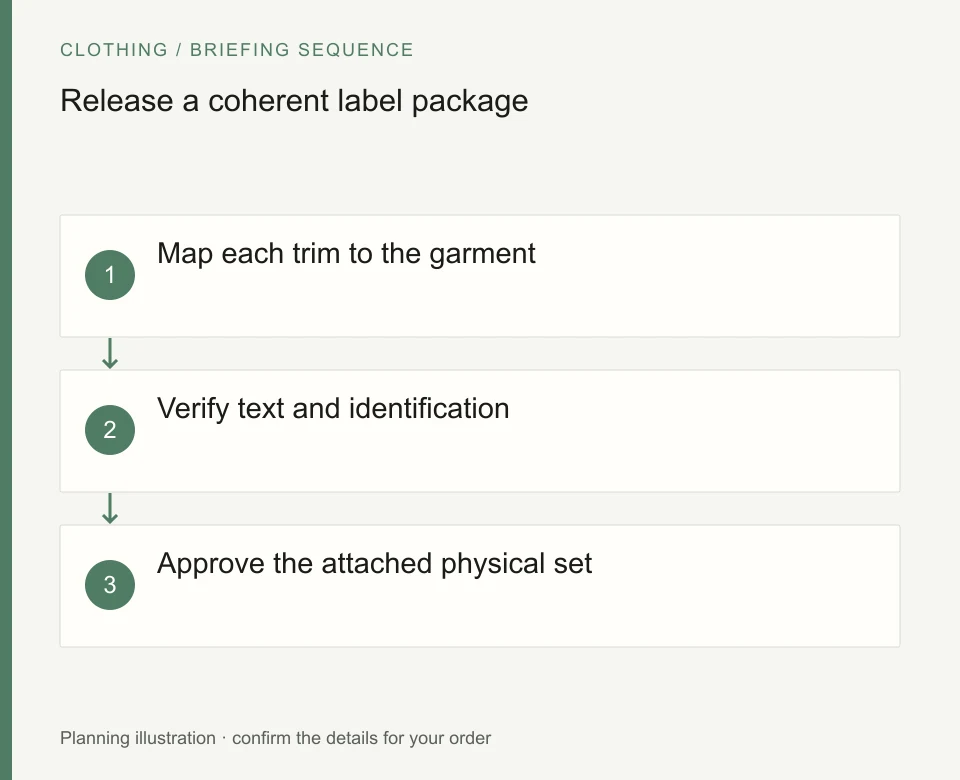
Draw the intended location of every sewn label and identify each with a trim code. State finished dimensions, fold type, orientation and attachment position. Leave enough detail to show which edge is caught in a seam and which remains visible. A flat artwork rectangle does not explain how a folded label will look or feel after sewing.
Review the label map against the actual garment construction. A neck label may sit against neck tape, while a hem label can be caught in a side seam or folded around an edge. These placements need different clearances. Consider the wearer's contact with the label and whether it interferes with stretch, fastening or the appearance of a small garment size.
Verify text before approving production
Keep brand artwork, size information and product information in separate editable records. Check spelling, size sequence, style codes and any destination language needs. Material composition and care instructions should reflect the actual garment and supporting information, not a generic label copied from a previous collection. A fiber change can make previously approved wording inappropriate for the new style.
Labeling obligations depend on the destination and product. Identify who is responsible for confirming applicable content, language and placement requirements, and obtain qualified advice where needed. This checklist is a production handoff aid, not a legal compliance determination. Do not let a supplier's ability to print a label become your evidence that every statement on it is correct.
Approve the physical set, not isolated artwork
Request representative physical trims to check legibility, color, texture, folds and attachment allowances. Fine lettering can change when woven or printed at a small scale. Place the trim on the sample garment and examine it in the intended orientation. If the garment will be washed or dyed during production, review whether labels are attached before or after that stage.
Cross-check sewn size labels with hangtags, barcode files and packing stickers. Maintain one approved size and SKU mapping rather than retyping data independently for each supplier. Archive the final artwork version and accepted physical references. If a trim is substituted later, reopen the relevant approval instead of assuming that similar wording makes its dimensions and material interchangeable.
Send these details together
- Coded label map with orientation and attachment
- Approved artwork and finished trim dimensions
- Verified product text and destination requirements
- Physical label set on the representative sample
- Consistent size, style and packing identifiers
Use this checklist to prepare your own order brief. Materials, processes, acceptance criteria and any applicable product requirements need order-specific confirmation; this guide is not a test report or availability guarantee.
Prepare a quote briefThe RFQ form prepares a WhatsApp message for you to review. For files, email sales@clothingmanufacturerchina.com.
Questions before sampling
What are your MOQ, sample time and bulk lead time?
MOQ is 100 pcs. Samples take 7 days. Bulk production lead time depends on order quantity.