Private Label vs Cut and Sew: Define Your Order Scope
Private label describes selling a product under your brand. Cut and sew describes making garments from fabric panels. The terms can overlap: a private-label collection may use fully custom cut-and-sew development. Ask what will actually be changed rather than treating the two labels as fixed service packages.
At a glance
Swipe the table sideways to compare both columns →
| Decision | What to specify | What to verify |
|---|---|---|
| Brand identity | Labels, graphics and packing may change. | State exact files, positions and ownership. |
| Garment shape | An existing or newly developed pattern may be proposed. | Confirm which measurements and panels are custom. |
| Final approval | Both routes need an agreed finished product. | Review combined fit, material and decoration. |
Separate branding from product development
A branding-led project might begin with an existing garment shape and change the neck label, print or packing. A custom-development project may require a new pattern, different construction and a fabric search. Both can be sold under your label. Neither description proves that a supplier has ready-made blanks, owns a particular pattern or can offer your chosen material.
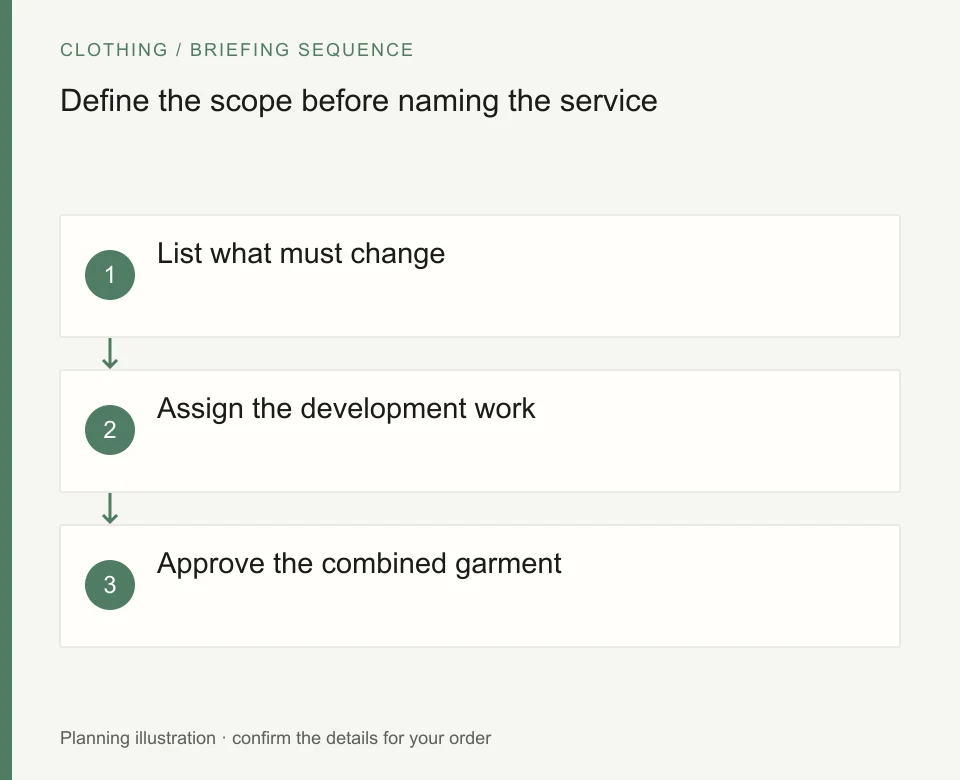
Write a change list beside the reference garment. Mark which measurements stay, which panels change and which brand elements are added. If you need a unique dropped shoulder or a specific jacket lining, state that directly. Calling the order private label will not tell the supplier whether an existing silhouette is acceptable or whether new pattern work is essential.
Compare the work behind the sample
Ask what the sample is based on and which elements will be representative of bulk. An available reference garment can help discuss proportions, but it does not approve a new fabric or revised fit. Confirm who prepares the pattern, who supplies artwork and which trim developments need separate approval. Keep unavailable or provisional materials visible in the written scope.
Compare development and production quotations independently. A quote with fewer sample tasks is not necessarily cheaper for the same finished product; it may leave those tasks to you. Establish how revisions are handled and what files or physical references are retained. Pattern ownership and reuse rights should be agreed explicitly rather than inferred from paying for a sample.
Select the route around the product promise
If the collection's value rests mainly on graphics and branding, begin by checking whether a proposed base garment actually meets your fit and hand-feel requirements. If the shape itself is distinctive, prioritize pattern and size-set development. Reducing development work only helps when the resulting garment still delivers the features your buyers will notice and expect.
Before bulk approval, collect the final size chart, material identification, artwork and label placements into the same release. Recheck any element changed after the sample. An approved print on one body fabric is not automatic approval on another. The chosen route should end in a complete garment reference, not a set of individually approved parts that were never reviewed together.
Send these details together
- A feature-by-feature list of required changes
- Whether an existing pattern is acceptable
- Material, decoration and brand-trim requirements
- Development responsibilities and file rights to agree
- One complete final sample and specification release
Use this checklist to prepare your own order brief. Materials, processes, acceptance criteria and any applicable product requirements need order-specific confirmation; this guide is not a test report or availability guarantee.
Prepare a quote briefThe RFQ form prepares a WhatsApp message for you to review. For files, email sales@clothingmanufacturerchina.com.
Questions before sampling
What are your MOQ, sample time and bulk lead time?
MOQ is 100 pcs. Samples take 7 days. Bulk production lead time depends on order quantity.