How to Brief a Custom Chino Pants Manufacturer
Briefing a custom chino pants manufacturer starts with connecting the fabric, silhouette, and construction to the intended finished fit. Specify chino twill weight and handfeel, rise, pocket geometry, waistband and fly, crease requirements, and the washing route rather than relying on a reference photograph. Plan MOQ 100 pcs per color per design, with material minimums checked separately. Samples take approximately 7 days once the brief and materials are confirmed; bulk timing depends on quantity, material readiness, capacity, and approvals. Release production against an identified fabric, approved measurements, graded size rules, and a retained sample that represents the agreed finishing process.
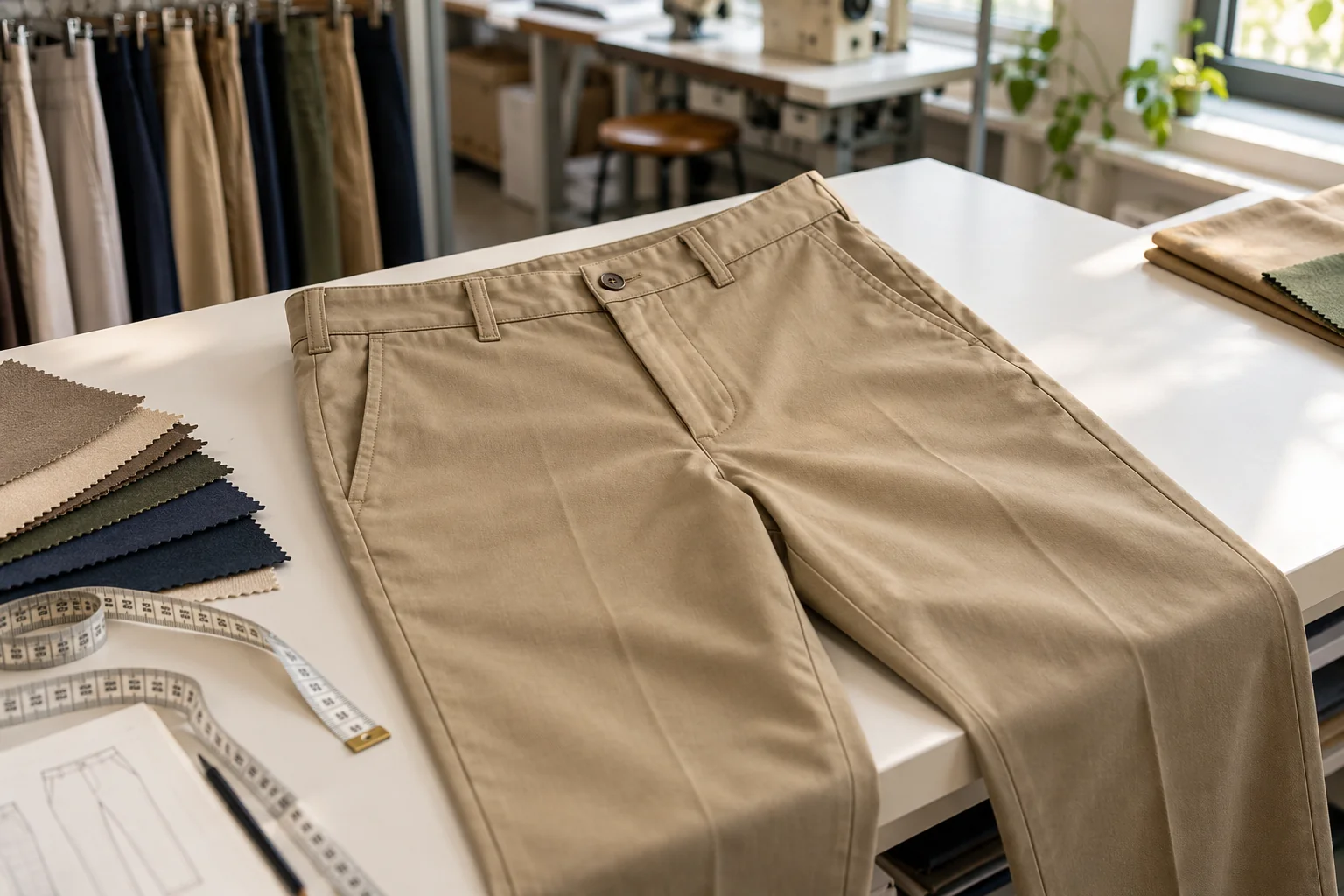
At a glance
Swipe the table sideways to compare both columns →
| Briefing point | Evidence to request | Production decision |
|---|---|---|
| Twill and handfeel | Identified fabric, GSM, usable width, composition, and washed swatch | Approve the material condition used for consumption and fit |
| Silhouette and rise | Measurement diagram, base-size specification, and fit comments | Resolve seat, thigh, knee, opening, and rise as one pattern |
| Pockets, waistband, and fly | Construction drawings, inside photographs, and component details | Control pocket gape, waistband stability, and closure alignment |
| Finishing and crease | Finished garment sample, wash reference, and pressing instructions | Separate wash effects from the required final presentation |
| Grading and release | Grade rules, size-set findings, approved sample, and inspection plan | Authorize bulk only after material and fit decisions are recorded |
1. Give the custom chino pants manufacturer a defined product brief
Start with a product description that distinguishes the chino from a generic twill trouser. State the intended wearer, use, selling size range, and whether the appearance should be casual, clean officewear, or deliberately relaxed. Supply front, back, and inside views, supported by drawings wherever a photograph leaves construction unclear. Identify the preferred silhouette as slim, straight, or relaxed, but treat that label as an introduction rather than a measurable specification. List slant front pockets, rear welt pockets, waistband treatment, fly closure, belt loops, and hem finish individually. If a physical reference is supplied, explain which features should be copied and which should change. Record the reference size and whether it has been worn or laundered, because an altered or washed garment may not represent the dimensions or handfeel originally intended for production.
Keep the chino brief separate from a cargo pants specification even when both programs use cotton twill. Cargo pockets, reinforcement, and extra seam intersections can change material consumption, sewing operations, and the way the leg hangs. Do not carry those details into the chino quotation unless they belong in the design. Prepare a versioned technical pack with drawings, a bill of materials, measurements, color references, labels, packing requirements, and an approval log. Ask the China OEM to identify missing information and proposed alternatives before sampling begins. Confirm MOQ 100 pcs per color per design, then show the size allocation within each color and design rather than combining unrelated styles into one total. Request separate confirmation of fabric, dyeing, trim, and label minimums. Assign one buyer contact to consolidate comments so that the pattern room does not receive conflicting instructions from different reviewers.
2. Specify twill weight, handfeel, and material behavior
Specify chino twill with its article number, fiber composition, weight in GSM, usable width, color reference, and supply condition. State whether the intended handfeel is crisp, smooth, dry, soft, or more substantial, then support that language with a labeled physical swatch. Agree a weight tolerance and clarify whether the quoted weight describes fabric before or after the mill finish. If stretch is required, identify its direction and ask how extension and recovery will be assessed against the intended fit. Elastane content alone does not establish how a slim chino will behave at the knee or seat. Request fabric suitable for both the silhouette and the pocket construction: a supple cloth may drape well but need different pocket support from a firmer twill. Review opacity, surface texture, and visible twill direction in each proposed color before approving the material article.
Ask the OEM to evaluate the selected fabric through the intended garment finishing route before fixing the production pattern. Record dimensional change in both directions, visible skew or twisting, shade movement, and any change in handfeel. Review pressing behavior as well, especially if the buyer expects a sharp presentation without a permanent crease. These observations should come from identified material, not an unrelated stock swatch with a similar composition. Confirm sample yardage, bulk availability, lot allocation, and whether the supplier can reserve the proposed article while approvals are pending. Have consumption estimated from usable width, size distribution, pattern layout, and agreed allowances, with any surplus fabric commitment shown separately. Require written approval for substitutions because a different twill can change pocket gape, seam appearance, shrinkage, and finished dimensions even when its listed GSM and fiber percentages look close to the original.
3. Translate silhouette and rise into measurable fit
Build the base-size measurement sheet around how the chino should sit and move on the body. Include waistband measurement, hip or seat, front rise, back rise, thigh, knee, leg opening, inseam, and outseam where useful. Define every measurement location with a diagram, including the distance below the crotch used for thigh measurement and the reference point used for the knee. State whether waistband dimensions are measured straight across or along the waistband edge, with the closure fastened and the garment relaxed. Distinguish garment dimensions from body measurements and identify whether each target applies before or after washing and pressing. Give separate tolerances where construction or fit risk requires them rather than applying one tolerance to every point. A slim, straight, or relaxed label cannot resolve whether the customer expects a higher waist position, extra seat room, or a narrower lower leg.
Assess the first fit sample as a connected pattern rather than correcting each measurement in isolation. Review the waist position, crotch comfort, seat shape, thigh clearance, side seam balance, and hem hang while standing and sitting. Check whether front pockets gape because of pocket geometry, insufficient hip room, or tension from the rise; narrowing the pocket opening alone may hide rather than solve the problem. Record the fit model's relevant body measurements and use consistent underlayers and footwear when those affect evaluation. Photograph front, side, and back views, with close views of specific defects and written instructions for the next pattern version. If the brief changes from slim to relaxed, request a coordinated pattern revision instead of simply adding width at the side seams. Recheck pocket placement, waistband shape, and leg balance after the revision so that the proportions remain intentional.
4. Detail slant pockets, rear welts, waistband, and fly
Specify front slant pocket angle, opening length, pocket bag depth, bag material, and the position of reinforcement at the opening ends. Include an inside drawing showing how the pocket bag attaches to the waistband or fly area where relevant. State whether the pocket should lie close to the body and whether its contents must remain concealed through the shell fabric. For rear pockets, distinguish single-welt and double-welt construction, record opening width and placement, and identify button, loop, or other closure requirements. Show whether one or both rear pockets are functional. Ask for sample photographs with the pockets empty and with a representative intended item to evaluate access and distortion, without treating this as a universal load test. Review welt symmetry, corner security, pocket bag visibility, and puckering after finishing, since a clean unwashed opening may behave differently after the approved wash.
Define waistband height, shape, interlining or other support, seam arrangement, belt loop count and placement, and the chosen top closure. Specify whether an internal curtain, extension, or additional fastening belongs in the design instead of leaving these details to the sample machinist. For the fly, identify zipper or button construction, opening length, overlap, fly shield, and the required topstitch shape. Review the closure components for compatibility with washing and pressing, including any risk of staining or visible impressions. Examine the closed waistband from the outside and inside to confirm alignment, bulk, and comfortable coverage. Ask the OEM to explain how waistband and pocket support will remain stable through the chosen finishing route. Retain approved construction details in the technical pack, including inside photographs, so that bulk inspection can compare hidden assembly features rather than relying only on the finished front appearance.
5. Separate garment finishing from crease and pressing requirements
Describe garment washing and softening as controlled processes with an approved result, not as general instructions to make the chino feel better. State whether the garment uses piece-dyed fabric followed by washing or another proposed color and finishing route, and require review if that route changes. Identify the desired level of softness, seam definition, surface cleanliness, and color character. Ask for a finished sample made from the proposed shell, pocketing, waistband support, thread, and closures so the evaluation includes interactions between components. Check shade at thick seams, pocket edges, and waistband folds, along with shrinkage, puckering, and leg twist. Where softener is proposed, review the resulting handfeel and appearance rather than assuming a treatment name defines the result. Keep the approved finished garment and a material reference together, labeled with the finishing version and sample date for later comparison.
State crease or no-crease explicitly and distinguish a shipping press from a crease intended to remain through use or laundering. If a durable crease is requested, ask the OEM to propose and validate a suitable process rather than assuming pressing alone will provide it. For a no-crease chino, show the desired leg presentation and identify unacceptable sharp fold marks, shine, or pocket and seam impressions. Agree when measurements will be taken after finishing and under what relaxation and conditioning arrangements, then use the same basis for sample review and bulk inspection. Check the garment again after the proposed consumer care procedure to assess whether appearance and dimensions remain acceptable. Confirm that care instructions reflect the evaluated fabric, components, and finishing route. Document folding and packing methods because transport presentation can introduce unwanted creases even when the garment leaves the pressing station in the approved condition.
6. Approve fit grading and release bulk through recorded gates
Approve the base fit before extending it across the size range, then request a grade rule table rather than a list of finished sizes without explanation. Review changes in waist, seat, front and back rise, thigh, knee, opening, and length separately. Decide whether inseam remains constant, changes by size, or belongs to a separate length offering. Confirm how pocket openings, rear pocket positions, belt loops, and fly length change across sizes; these details should not be enlarged automatically in the same proportion as body dimensions. Select size-set samples based on the range and fit risks, including edge sizes where proportions may become unsuitable. Measure and fit them after the agreed finishing process. Keep grading changes distinct from sewing variation, and require a revised specification when the intended target changes rather than accepting an out-of-tolerance sample as an informal new standard.
Set approval gates for material selection, first fit, revised fit where needed, size grading, and the preproduction sample representing bulk construction and finishing. Samples take approximately 7 days once the brief and materials are confirmed; allow separate time for unavailable fabric, special components, shipping, testing, and revisions. Bulk timing depends on quantity as well as material readiness, production capacity, and approval dates, so request a milestone schedule instead of assuming sample speed predicts delivery. Before cutting, record the authorized fabric article and lots, color approvals, pattern version, measurement sheet, construction details, and finishing reference. Agree inspection coverage for measurements, pocket symmetry, closure function, shade consistency, workmanship, labeling, and packing. Define defect handling, rework review, and shipment release responsibility in the order documents. Any change to the approved combination should return to the relevant approval gate before the affected bulk operation proceeds.
Send these details together
- Issue a versioned chino brief with front, back, and inside views, color references, and size allocation.
- Confirm MOQ 100 pcs per color per design separately from fabric, finishing, trim, and label minimums.
- Approve an identified twill article with GSM, usable width, handfeel, shade, and finishing behavior recorded.
- Define silhouette, rise, measurement methods, tolerances, and grading rules before bulk pattern release.
- Approve pocket geometry, waistband support, fly construction, wash result, and crease or no-crease presentation.
- Record sample gates, inspection criteria, change approval responsibilities, and the bulk milestone schedule.
This guide covers buyer-side briefing and approval planning for woven custom chino pants with a China clothing OEM, supporting the custom chino pants manufacturer product scope. MOQ 100 pcs per color per design is the garment planning requirement; confirm size allocation and separate material or process minimums for the proposed order. Samples take approximately 7 days once the brief and materials are confirmed. Bulk timing depends on quantity, materials, capacity, and approvals. Product-specific performance requirements and destination-market obligations should be agreed separately before production. Reprint attribution: clothingmanufacturerchina.com.
Prepare a quote briefThe RFQ form prepares a WhatsApp message for you to review. For files, email sales@clothingmanufacturerchina.com.
Questions before sampling
Can I brief chinos using an existing cargo pants specification?
Use it only as a starting document and remove assumptions that do not belong in the chino design. Shared twill does not mean shared fit, pocket construction, reinforcement, or consumption. Replace cargo pocket details with the intended slant and welt pockets, review waistband and fly construction, and approve chino-specific measurements and finishing before asking for a comparable quotation.
What fabric information does the manufacturer need before sampling?
Provide composition, GSM, usable width, color reference, stretch requirements if applicable, and a physical handfeel reference. Identify whether the fabric is supplied finished and what garment wash or softener treatment is planned. Ask the OEM to confirm sample yardage availability and evaluate dimensional change on the proposed article. A fabric description without an identified material leaves fit and consumption provisional.
Does the approximately 7-day sample timing include fit revisions?
Treat approximately 7 days as the sample-making allowance once the brief and materials are confirmed, not as the complete development calendar. Confirm what the quoted sample round includes. Fabric sourcing, custom components, dispatch, buyer review, wash development, and revised samples can require additional time. Record approval dates separately so bulk scheduling does not assume that the first sample will be accepted.
What should be approved before the factory cuts bulk chinos?
Approve the fabric article and color, finished fit, grade rules, pocket and waistband construction, fly components, and finishing reference. Connect these decisions to a versioned measurement sheet and a preproduction sample representing the intended bulk route. Confirm quantity allocation, inspection criteria, and responsibility for changes. Unresolved shrinkage or fit issues should return to development rather than being left for bulk sewing to correct.
What are your MOQ, sample time and bulk lead time?
MOQ is 100 pcs. Samples take 7 days. Bulk production lead time depends on order quantity.