How to Brief a Private Label Streetwear Manufacturer
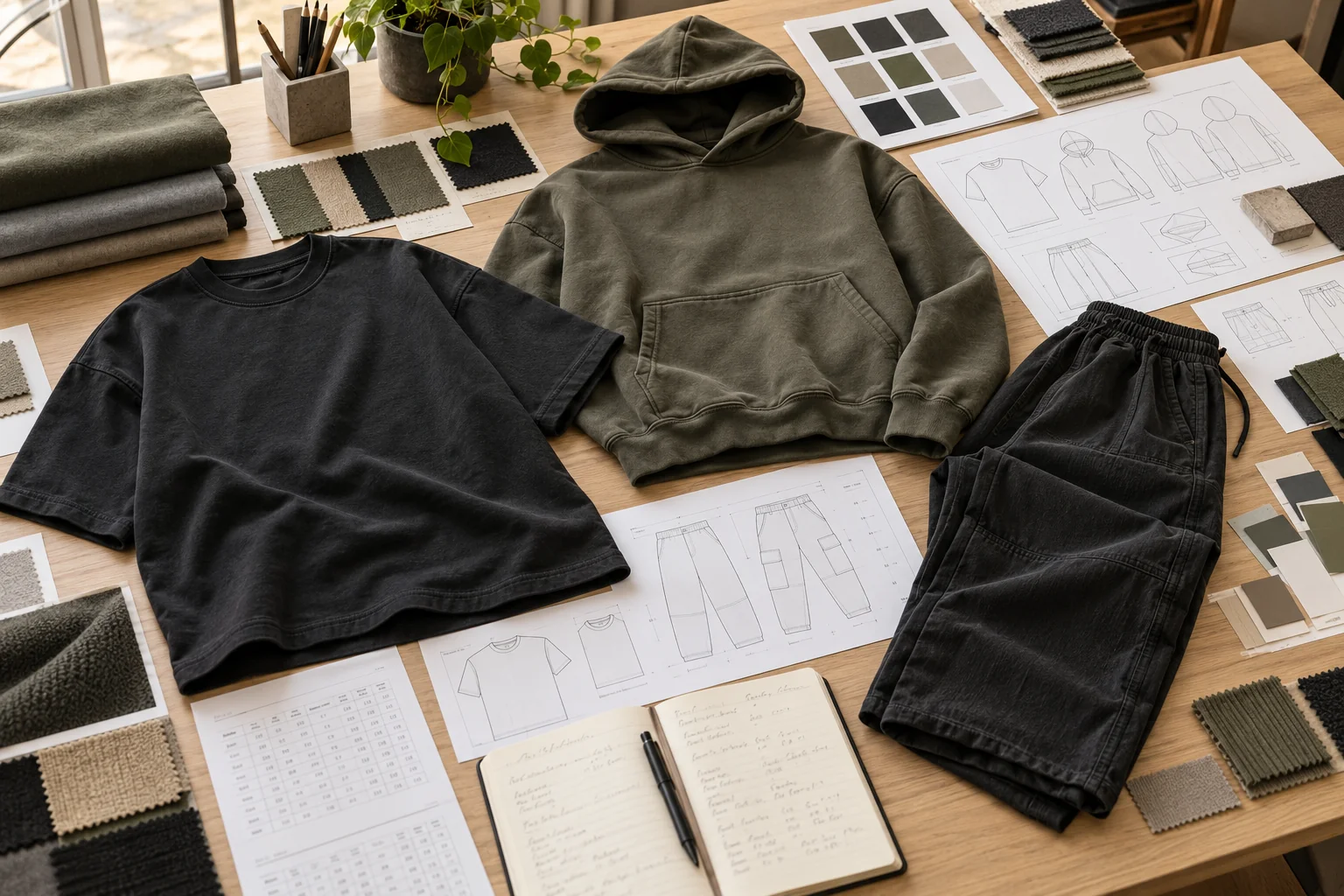
Briefing a private label streetwear manufacturer starts with translating a capsule concept into measurable silhouettes, identified fabrics, and approved decoration. Define how tees, hoodies, and bottoms should fit together without assuming that oversized means simply grading up. Connect colorways, handfeel, artwork rights, and size coverage to a version-controlled tech pack. Plan around MOQ 100 pcs per color per design, checking fabric and decoration minimums separately. Samples take approximately 7 days once the brief and materials are confirmed; bulk timing depends on quantity, material readiness, capacity, and approvals. Release production only against documented fit, decoration, and actual-material sample decisions.
At a glance
Swipe the table sideways to compare both columns →
| Briefing decision | Evidence to provide or request | Production control |
|---|---|---|
| Silhouette and proportion | Front, back, and side references with measurement diagrams and fit intent | Separate intentional volume from grading and construction errors |
| Fabric and handfeel | Identified articles, physical swatches, finishing route, and care trials | Approve each garment's behavior within the capsule |
| Colorways and quantities | Style-color-size matrix with fabric and decoration commitments | Check MOQ 100 pcs per color per design without pooling unrelated styles |
| Decoration and clearance | Authorized artwork, placement maps, technique trials, and vendor responsibilities | Clear usage rights and verify application on the intended substrate |
| Tech packs and sample gates | Versioned specifications, size-set reports, and actual-material references | Keep fit, appearance, and bulk release approvals separate |
1. Structure your private label streetwear manufacturer brief
Start with a capsule map that identifies the role of every garment rather than sending a folder of unrelated reference images. List the core tee, hoodie, and bottom shapes, their intended layering relationships, the selling season, and the colors that connect them. Explain whether the program uses existing factory blocks with buyer branding, modified blocks, or original patterns developed from your measurements. These routes require different development work even when the finished garments look similar. Mark references as evidence of proportion, texture, construction, or decoration placement, not as permission to copy the entire product. State which details are mandatory and which may be adjusted for production feasibility. Ask the supplier to return a responsibility matrix covering pattern development, material sourcing, cutting, sewing, decoration, finishing, and packing. Identify outside processors and the party responsible for communicating approved revisions to them.
Build the commercial brief around the same capsule map so the quotation reflects the actual product mix. Include style codes, expected order quantities, size ranges, destination markets, packaging requirements, and the requested delivery window. Distinguish a launch date from a factory dispatch date and allow separately for inspection, transport, and receiving. Define whether the supplier is providing a complete garment or excluding artwork preparation, branded components, testing, or special packing. A low unit quote is difficult to evaluate when those responsibilities remain open. Record ownership and permitted reuse of buyer artwork, commissioned patterns, development files, and leftover branded materials. If a house block is being adapted, identify which rights stay with the factory and which deliverables the buyer receives. Keep commercial assumptions in one revision-controlled document so a later change to a graphic, color, or silhouette also triggers review of cost and timing.
2. Translate boxy, oversized, and classic into measurable proportions
Do not use oversized as a substitute for a fit specification. A boxy tee may combine a wide chest with a shorter body, while another oversized style relies on additional length, a dropped shoulder, and a deeper armhole. Simply enlarging a classic block can produce an unintended neck opening, unstable shoulder line, or excessive sleeve length. Provide front, back, and side views with the intended hem position and shoulder placement marked. Specify chest width, body length, shoulder width, armhole depth, sleeve length, sleeve opening, and neck dimensions using defined measurement points. For hoodies, add hood shape, opening, depth, rib dimensions, and pocket position. For bottoms, define waist condition, rise, hip, thigh, knee, inseam, and leg opening. Explain how the pieces should layer so extra hoodie volume is not mistaken for a general instruction to enlarge every measurement.
Separate intended volume from functional fit requirements during sample review. A wide sleeve can be deliberate, but a cuff that prevents comfortable hand entry still needs correction. A relaxed trouser may require generous thigh room without allowing the waistband to rotate or the seat to collapse. State the intended wearer profile, fit model measurements, and evaluation size, then review movement and layering as well as still photographs. Record whether each measurement is taken flat, relaxed, extended, or after the specified care process. Set tolerances by measurement point rather than applying one broad allowance to the whole garment. Ask the pattern team to explain how grading preserves the approved proportions across sizes, especially for cropped bodies and dropped shoulders. Approve a defined size set before bulk release; acceptance of the base size alone does not establish that the smallest and largest sizes retain the intended silhouette.
3. Specify handfeel and fabric behavior across tees, hoodies, and bottoms
Describe handfeel through physical references and material specifications rather than relying on terms such as premium, heavy, or soft. For a tee, identify composition, knit structure, finished weight, surface finish, and the balance between drape and body. For a hoodie, distinguish loopback from brushed constructions and specify the face appearance, reverse texture, and rib behavior. For bottoms, explain whether the target is structured twill, fluid jersey, compact fleece, or another identified construction. Two fabrics with similar weights may differ substantially in bulk, stretch, opacity, and how they hold a boxy silhouette. Request labeled swatches linked to supplier article numbers and finishing conditions. Keep an approved physical reference for each garment family, with notes identifying the attributes that matter. Coordinate the capsule through a deliberate handfeel relationship rather than requiring every item to feel identical despite different functions and constructions.
Confirm which properties must be checked after finishing and care, because an appealing cutting-room swatch may not represent the delivered garment. Ask for dimensional change, twisting, surface appearance, color transfer, and recovery evaluations appropriate to the material and intended use. Establish methods and acceptance criteria with the supplier or a qualified laboratory rather than treating an unspecified test pass as sufficient. Review neck rib, cuffs, waistband elastic, pocketing, and drawcords with the main fabric; these components can shrink or recover differently. Record whether softening, brushing, garment washing, or another treatment occurs before or after decoration. Request trial garments through that sequence to assess the combined result. Identify stock availability, material lot reservations, and substitution rules before accepting a delivery plan. A replacement with the same composition and weight still needs review if its surface, stretch, shade response, or finishing behavior could change the approved streetwear proportions.
4. Plan capsule colorways against workable quantities
Create a style-color-size matrix that makes the seasonal offer visible without hiding production commitments inside a capsule total. Use MOQ 100 pcs per color per design as the garment planning basis. Three coordinated garments in one color do not automatically share a single minimum, and one tee offered in several colors does not automatically count as one production commitment. Ask how graphic variants, garment washes, and changes to construction are classified. Record the accepted size distribution for each line and identify any restrictions that affect extended sizes. Check fabric dyeing, rib, zipper, label, print setup, and embroidery minimums separately. A garment quantity may be workable while a custom material or branded component creates surplus inventory. Require the quotation to distinguish quantities used in garments from purchased excess, with ownership, storage, and disposal terms for the balance.
Define whether capsule colors must match closely across fabrics or intentionally coordinate with visible differences. The same color reference can appear different on smooth jersey, brushed fleece, rib, and woven bottoms because their surfaces reflect light differently. Review submissions together under agreed viewing conditions, using physical references rather than screen images as the final authority. Approve each substrate and its associated trims, then establish acceptable bulk shade limits and lot identification. If the capsule includes washed or faded effects, separate the base color approval from the finished appearance approval. State whether mixed shades may be packed together and how matching sets should be handled. For seasonal replenishment, ask whether the original material remains available and whether new dye lots require renewed comparison. Keep carryover colors and experimental colors distinct in the quantity plan so a delayed trial does not silently alter the release status of approved core styles.
5. Clear artwork rights and decoration before placement approval
Treat decoration clearance as both a rights decision and a production decision. Confirm that the buyer has permission to reproduce every supplied graphic, photograph, typeface, illustration, and licensed element for the intended products and markets. Record any restrictions on quantity, territory, duration, alteration, or subcontractor access. Factory acceptance of an artwork file does not establish those permissions. Provide production-ready files with version names, dimensions, color separations where relevant, and a clear indication of which elements may not be modified. Identify who can approve tracing, simplification, embroidery digitizing, or changes needed for reliable application. Define ownership and permitted reuse of screens, digitized files, and other buyer-funded setup materials. Ask how the decorator receives current artwork and withdraws obsolete versions. Keep approval records tied to the style and colorway so a cleared chest graphic is not automatically authorized for another garment or placement.
Map decoration from stable garment reference points and state whether artwork dimensions remain constant or change across sizes. A large back print that fits the base-size tee may interfere with armholes on a smaller size, while embroidery near a pocket can obstruct sewing or access. Check working clearance from seams, ribs, zippers, pocket edges, and drawcord openings. Request print strike-offs or embroidery sew-outs on the intended fabric and color, followed by a garment trial where placement or assembly affects the result. Review opacity, edge definition, handfeel, puckering, backing comfort, and appearance after the agreed care process. Assess risks such as dye migration or heat marking with the actual substrate and application route. Record the chosen technique, processor, application sequence, and approved reference. A clean artwork proof approves the image layout, not adhesion, durability, garment distortion, or the appearance of bulk decoration.
6. Connect tech packs, size sets, and samples to bulk release
Issue one controlled tech pack per design, supported by a capsule-level color and material register. Include technical drawings, construction details, bill of materials, measurement diagrams, graded specifications, tolerances, artwork placement, labeling, and packing instructions. Assign a revision number and date, and maintain a change log that identifies what changed and which approvals are affected. Separate unresolved items from approved requirements so production does not infer acceptance from a partly completed file. Define the first sample's purpose before ordering it: silhouette development, actual-material evaluation, decoration review, or a combined preproduction check. Samples take approximately 7 days once the brief and materials are confirmed, but this is a planning allowance for the agreed sample stage, not the whole development program. Custom materials, decoration experiments, shipping, buyer review, and revisions need separate allowances. Ask the supplier to confirm readiness and the sample dispatch target against those dependencies.
Approve fit, size coverage, materials, decoration, and packing through explicit gates rather than one general sample acceptance. Define which sizes require physical review and which measurements require full reporting, with particular attention to silhouette extremes and graphic clearance. A substitute-fabric fit sample cannot establish final drape, shrinkage, or print behavior. Before bulk release, require a garment representing the intended materials, construction, finishing, and decoration route, supported by the approved size-set findings. Retain matching references with the buyer and production team and list any accepted deviations in writing. Link release to the final tech pack, material articles, artwork versions, color approvals, and packing instructions. Bulk timing depends on quantity, material readiness, production and decoration capacity, and approval completion. Agree inspection coverage across styles, colors, sizes, and processing batches, plus hold and corrective-action procedures. Silence after sample delivery should not authorize cutting or unresolved component substitution.
Send these details together
- Map the capsule by garment role, layering intent, development route, production responsibility, and ownership requirements.
- Translate boxy, oversized, and classic fits into measurement diagrams, tolerances, grading instructions, and size-set expectations.
- Identify fabric articles and physical handfeel references, including finishing, care behavior, trims, and substitution controls.
- Confirm MOQ 100 pcs per color per design using a style-color-size matrix and separate material and decoration minimums.
- Clear artwork rights and approve decoration dimensions, seam clearance, actual-substrate trials, and processor responsibilities.
- Version the tech packs, confirm approximately 7-day sample-stage assumptions, and document actual-material bulk release gates.
This guide covers buyer-side briefing of China private label streetwear OEM programs involving tees, hoodies, and casual bottoms. It focuses on capsule coordination, measurable silhouettes, material handfeel, colorways, decoration clearance, tech packs, and size-set approval. MOQ 100 pcs per color per design is the garment planning basis; confirm size allocation and separate material, trim, and decoration minimums. Samples take approximately 7 days once the brief and materials are confirmed; bulk timing depends on quantity, material readiness, capacity, and approvals. Artwork permissions, contractual ownership, and destination-market labeling and product requirements need separate review. Reprint attribution: clothingmanufacturerchina.com.
Prepare a quote briefThe RFQ form prepares a WhatsApp message for you to review. For files, email sales@clothingmanufacturerchina.com.
Questions before sampling
Is an oversized streetwear fit just a larger classic size?
Not necessarily. Oversized and boxy silhouettes may change shoulder position, chest width, body length, armhole depth, and sleeve proportions independently. Enlarging a classic block can distort the neck or create unwanted length. Supply measurement diagrams and fit references, then review how grading preserves the intended shape. Confirm the base size and an agreed size set before releasing bulk.
Can tees, hoodies, and bottoms share one capsule minimum?
Plan on MOQ 100 pcs per color per design, not one combined minimum for the capsule. Ask the supplier to classify graphic variants, washes, and construction changes in writing. Shared fabric or labels may simplify purchasing without changing garment minimums. Submit a style-color-size matrix and reconcile separate fabric, trim, printing, and embroidery commitments before accepting the quotation.
What should a streetwear decoration approval include?
Include documented artwork authorization, the current production file, technique, dimensions, placement references, and size-specific clearance decisions. Review a strike-off or sew-out on the intended fabric and color, followed by a garment trial when assembly affects placement. Check appearance and behavior after the agreed care process. Approval of a digital layout alone does not establish application quality or permission to reproduce the artwork.
Does the approximately 7-day sample allowance include the full size set?
Do not assume it does. Samples take approximately 7 days once the brief and materials are confirmed, but the supplier should identify which sample stage and quantities that allowance covers. A full size set, custom material development, decoration trials, revisions, and shipping may require additional time. Agree the sample sequence, review owners, and outstanding bulk release conditions before development starts.
What are your MOQ, sample time and bulk lead time?
MOQ is 100 pcs. Samples take 7 days. Bulk production lead time depends on order quantity.