How to Brief a Custom Sweatshirt Manufacturer
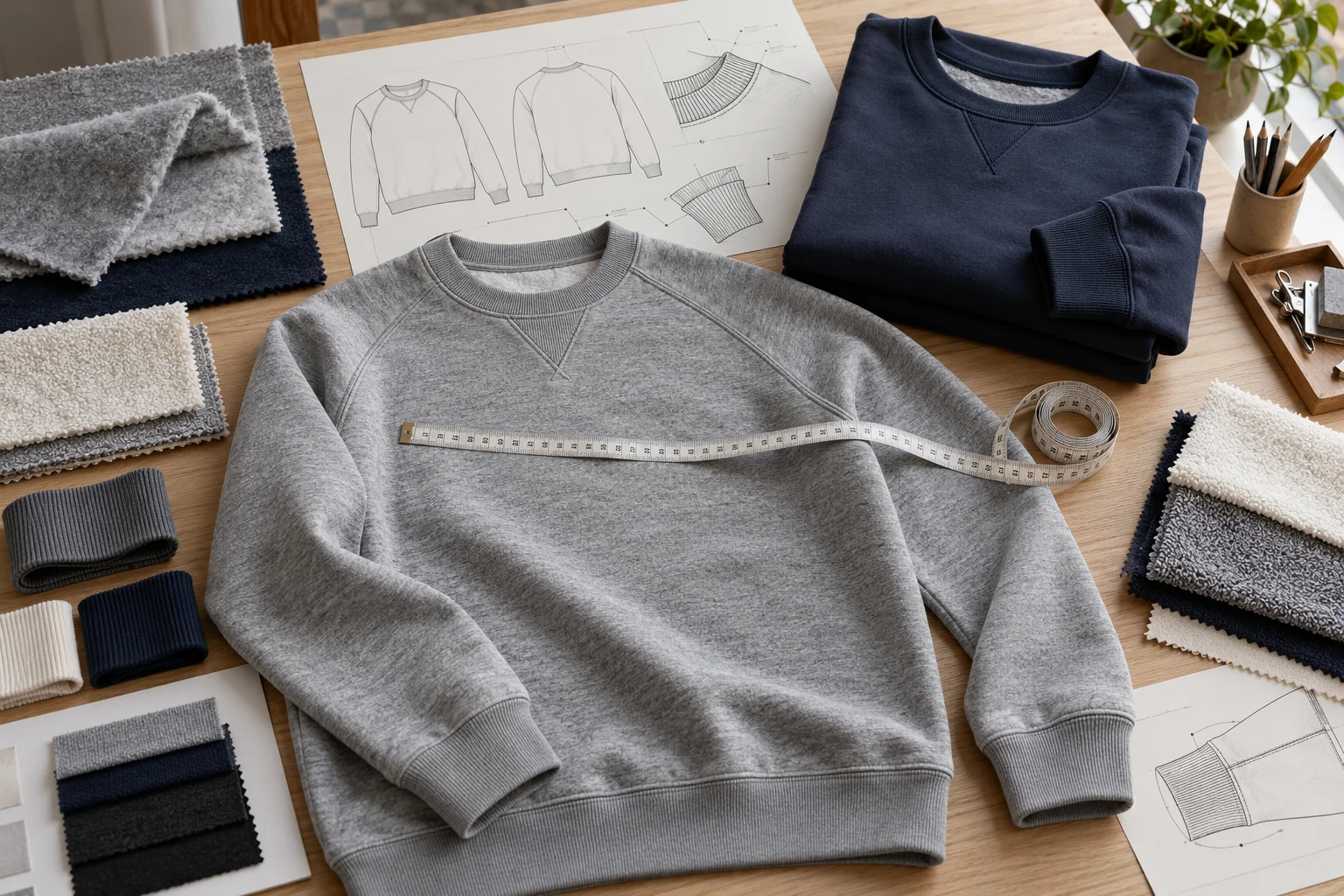
Brief a custom sweatshirt manufacturer with a connected specification for fabric, construction, decoration, and finished garment performance. For a pullover crewneck, define fleece or French terry, GSM and handfeel, neck rib, shoulder seams, cuffs, and hem before comparing quotations. Keep hoodie and half-zip requirements outside this brief unless separately specified. Plan around MOQ 100 pcs per color per design, while checking fabric, rib, and decoration minimums independently. Samples take approximately 7 days once the brief and materials are confirmed; bulk timing depends on quantity, material readiness, capacity, and approvals. Release production against an actual-material sample and documented care results.
At a glance
Swipe the table sideways to compare both columns →
| Brief element | Evidence to request | Buyer control |
|---|---|---|
| Fabric and handfeel | Identified fleece or French terry article, GSM condition, composition, and finish reference | Approve the actual material rather than a generic weight description |
| Neck and shoulders | Rib specification, seam detail, attachment method, and finished measurements | Review neckline shape, recovery, and shoulder balance together |
| Cuffs and hem | Rib article, opening dimensions, joining details, and laundering comparison | Control gathering, recovery, and body-to-rib compatibility |
| Decoration and care | Actual-fabric strike-off, placement diagram, process sequence, and care results | Release only a compatible decoration and finishing route |
| Quantities and approvals | Color and size matrix, separate minimums, sample plan, and production schedule | Confirm 100 pcs per color per design and written bulk release |
1. Give your custom sweatshirt manufacturer a bounded brief
Start with a product definition that the factory can translate into a bill of materials and operation sequence. This guide concerns a pullover sweatshirt with a closed crew neckline, long sleeves, and specified cuff and bottom finishes. It is not a hoodie brief: there is no hood pattern, drawcord route, or assumed kangaroo pocket. It also excludes half-zip and other zip-neck constructions, which introduce opening reinforcement, zipper behavior, and different collar decisions. If your range includes these products, issue separate style codes and approval records rather than treating them as interchangeable options. For an existing crewneck block, reference its approved pattern version instead of reopening the entire silhouette discussion. The purpose here is to connect that shape to fabric, rib, decoration, and care decisions. Include front and back technical drawings, intended wearer, target size range, intended layering, and the finished appearance the buyer expects.
Separate fixed requirements from proposals you want the supplier to develop. A fixed requirement might be a set-in sleeve, a stated finished chest measurement, or a particular graphic position; a proposal might be a suitable rib structure for the selected body fabric. Mark each unresolved item with a decision owner and approval deadline. Supply a measurement diagram defining garment condition, measuring method, tolerances, and the points needed to evaluate length, width, sleeve shape, and openings. Identify the legal seller, sewing site, decoration provider, and any garment washing or finishing subcontractor. Ask who consolidates their technical feedback before quotation and who must authorize substitutions. Attach a revision identifier to the specification and maintain one current file set. Photographs and reference garments can communicate appearance, but they should not silently override written measurements or construction instructions. Record any conflict explicitly before the supplier purchases materials or develops patterns.
2. Specify fleece or French terry beyond GSM
Choose the fabric structure according to the intended inside surface, warmth, drape, and care expectations. Brushed fleece has a raised inner surface, while French terry normally retains visible loops on the reverse. Neither name defines a complete quality level or guarantees a particular weight. Record fiber composition, knit structure, face appearance, reverse appearance, usable width, color reference, and finishing route. Define GSM as fabric mass per unit area and state whether the quoted value refers to the supplied finished cloth or another processing stage. Agree how samples will be conditioned and measured, with a tolerance appropriate to the purchase specification. Ask for an identified article and availability status rather than accepting descriptions such as premium heavyweight fleece. A stock swatch may support selection, but the factory should confirm that the quoted bulk article uses the same construction and finish. Any substitution needs renewed review.
Describe handfeel through observable characteristics and retained references instead of relying only on soft or substantial. State whether the face should feel smooth, dry, compact, or lightly brushed, and whether the garment should hold shape or fall loosely. Review body fabric and rib together because a dense rib can make a soft sweatshirt feel restricted at its openings. Ask which mechanical or chemical finishes create the submitted handle and whether laundering is expected to change it. Compare actual-material panels before and after the agreed care sequence for surface change, lint release, pilling tendency, twisting, and dimensional movement. Define the evaluation method and acceptance criteria with the supplier or testing provider rather than assuming one universal threshold. Check shade under agreed viewing conditions, including differences between body fabric and rib. Retain labeled references showing article, color, finish, and approval date so later discussions do not depend on memory.
3. Connect neck rib to shoulder construction
Treat the neckline as an assembly with interacting dimensions, not simply a rib width marked on a drawing. Specify the finished neck opening, front and back drop, exposed rib height, rib structure, composition, and joining position. Ask the factory to propose the rib-to-neck attachment relationship using the actual materials, then evaluate whether it produces the required shape without rippling or excessive gathering. Rib recovery and body fabric stability matter alongside stretch. A neckline can pull over the head comfortably yet remain enlarged afterward, or look neat flat while feeling restrictive in wear. Review both appearance and function on a complete sample. Define whether seam allowances are secured with topstitching, and show the intended stitch placement and visible finish. If neck tape is required, specify its coverage, material, attachment, and label interaction. Avoid approving a tape solely by color when its stiffness changes neckline behavior.
State whether the sweatshirt uses set-in, dropped-shoulder, or raglan construction, and keep that decision linked to the approved fit block. Shoulder location changes sleeve balance and decoration space, so a supplier should not substitute one construction to simplify sewing. Provide seam drawings for shoulder joins, armholes, and any reinforcement or cover stitching, including which details are functional and which are visual. Request a sample review for seam bulk, puckering, skipped stitches, uncomfortable intersections, and distortion when the garment is worn. For heavier fabric, check how seam allowances sit at the neck and underarm rather than assessing only the outside photograph. Compare shoulder balance after laundering, since uneven dimensional change can alter sleeve position or pull the neckline off center. If reinforcement is proposed, ask what problem it addresses and approve it in the assembled garment. Record corrections against the pattern and sewing specification separately so the production team knows what changed.
4. Match cuff and hem behavior to the care brief
Specify whether cuffs and the bottom opening use separate rib bands, self-fabric bands, or another agreed finish. For rib components, record finished height, relaxed opening measurement, structure, composition, seam position, and the intended degree of gathering into the body or sleeve. Do not assume that matching color means matching performance. Body and rib may come from different production lots or suppliers and can respond differently to finishing and washing. Ask for their article identities and a sample assembled from the proposed combination. Evaluate whether cuffs recover after normal handling and whether the hem sits at the intended position without riding upward or flaring. Review the transition between sleeve fabric and cuff for uneven fullness, and check side seam alignment through the bottom band. Include measurements for the openings as well as the main body; chest and length alone cannot establish that the assembled sweatshirt behaves as intended.
Write the care brief before approving shrinkage allowances or label wording. Identify the intended consumer washing and drying conditions, then agree a test sequence, number of cycles, conditioning method, measurement points, and acceptance limits. Separate fabric dimensional change from finished garment dimensional change: seams, rib, decoration, and assembly can influence the result. Measure matched points before and after the agreed sequence and record length, width, sleeve movement, twisting, neckline shape, and band appearance. Ask the supplier to distinguish pattern allowances from process corrections rather than enlarging every dimension to compensate for an unexplained result. Repeat the relevant checks when the material article, finish, rib, or decoration route changes. Care instructions should reflect the complete garment and destination-market requirements, not simply copy a fabric vendor's recommendation. If the desired care claim conflicts with the observed result, resolve the material or process issue, or revise the claim before bulk labeling is approved.
5. Prove decoration readiness on the actual sweatshirt
Supply production artwork with dimensions, color references, location, orientation, and a placement diagram tied to stable garment measurement points. State whether placement is constant across sizes or graded, and define acceptable movement relative to the neckline, center front, or another named reference. Keep screen printing, transfer application, embroidery, and appliquE as separate proposals because they place different demands on the fabric and production sequence. For each selected method, request a strike-off or trial on the actual body article in the intended color. A smooth substitute panel cannot establish the result on a brushed or textured sweatshirt fabric. Review coverage, edge definition, handle, stretch behavior, puckering, and visible backing where relevant. For embroidery, evaluate density and stabilization without assuming a larger backing will solve distortion. If decoration crosses a seam or approaches a rib join, require a garment-level trial rather than approving only a flat panel.
Document when decoration occurs relative to cutting, sewing, washing, pressing, and packing. The sequence affects registration, access, dimensional change, and the risk that heat or processing alters shade and handfeel. Ask the decoration provider to define compatible process conditions for the selected fabric and retain those settings in its production record. Evaluate the decorated sample after the agreed care sequence for cracking, lifting, bleeding, discoloration, distortion, and any other risks relevant to the chosen method. Approve labels and packaging separately, including artwork version, material, dimensions, placement, and attachment. Required fiber, care, origin, and other destination-market wording needs its own review; visual acceptance does not establish compliance. Record ownership and permitted reuse of artwork, screens, embroidery files, tooling, and surplus branded components. Confirm how rejected decorated garments will be controlled and who authorizes repair or disposal. Keep unresolved decoration performance separate from fit approval so one acceptance cannot be interpreted as approval of everything.
6. Reconcile quantities, sample gates, and bulk release
Use MOQ 100 pcs per color per design as the garment planning basis and submit a matrix showing style, body color, decoration version, and size allocation. Ask whether different artwork, rib colors, or finishing routes create separate design commitments instead of assuming all pieces can be combined. Confirm fabric, custom dyeing, rib, label, packaging, and decoration minimums independently. The sewing quantity may be feasible while one component creates excess inventory or additional setup work. Request a breakdown of included development, material commitments, expected surplus, and ownership of unused components. Ask which materials are reserved and which remain subject to availability at order confirmation. Bulk timing depends on quantity, but also on material readiness, cutting and sewing capacity, decoration scheduling, inspection, and buyer approvals. Require a dependency-based schedule with named release dates rather than an unconditional shipment promise. Record what happens if one color is delayed and whether split shipments require buyer authorization.
Samples take approximately 7 days once the brief and materials are confirmed, but that allowance is not the duration of a complete development program. Custom fabric, rib matching, decoration trials, transport, and revisions require separate planning. Assign a purpose to each submission: a fit sample can establish shape, a material trial can screen performance, and an actual-material preproduction garment can connect the approved decisions. Do not let a substitute-fabric sample authorize final shrinkage or decoration performance. Before cutting bulk, link written approval to the bill of materials, pattern version, measurements, construction details, decoration reference, care results, and packaging instructions. Retain matching production references and list any accepted deviations explicitly. Define inspection coverage across sizes, colors, and production batches, together with defect criteria and the response to failed checks. Require approval for substitutions and affected rework. A partial approval should state precisely which operations may proceed and which remain blocked.
Send these details together
- Define a pullover crewneck scope, separate hoodie and zip-neck styles, and issue controlled drawings and measurement instructions.
- Identify fleece or French terry, composition, GSM condition, handfeel reference, finishing route, and material availability.
- Approve neck rib, shoulder seams, cuff and hem construction, and body-to-rib compatibility on an assembled sample.
- Set care conditions, dimensional-change limits, surface checks, and destination-market label review before bulk approval.
- Approve actual-fabric decoration trials, placement rules, process sequence, artwork rights, and branded surplus controls.
- Confirm MOQ 100 pcs per color per design, separate component minimums, approximately 7-day sample assumptions, and written bulk release gates.
This guide covers the buyer brief for China OEM production of pullover crewneck sweatshirts, focusing on material selection, assembly, decoration compatibility, care performance, and production release rather than a full crewneck fit-block development process. Hoodies, half-zips, and other zip-neck variants require separate construction briefs. MOQ 100 pcs per color per design is the garment planning basis; confirm size allocation and independent material and component minimums. Samples take approximately 7 days once the brief and materials are confirmed; bulk timing depends on quantity, material readiness, capacity, and approvals. Contractual rights and destination-market labeling require separate review. Reprint attribution: clothingmanufacturerchina.com.
Prepare a quote briefThe RFQ form prepares a WhatsApp message for you to review. For files, email sales@clothingmanufacturerchina.com.
Questions before sampling
Should a buyer choose fleece or French terry for a custom sweatshirt?
Choose according to the intended inside surface, warmth, drape, and care behavior rather than assuming one structure is better. Fleece typically has a brushed reverse, while French terry normally has visible inner loops. Request identified articles and compare actual swatches and garments. GSM alone does not establish softness, recovery, surface durability, or how the sweatshirt will look after laundering.
Can a sweatshirt and hoodie share the same production brief?
They can share approved fabric references or selected construction details, but each needs its own style specification. A hoodie introduces hood fit, neckline attachment, and potentially drawcords and pockets. A half-zip adds opening reinforcement and zipper-related decisions. Keep separate bills of materials, patterns, measurements, and approval records so a shared fabric choice does not become unintended approval of a different garment.
Can multiple colors or graphics be combined to meet the sweatshirt MOQ?
Plan on MOQ 100 pcs per color per design and request written classification of every proposed combination. Different graphics, rib colors, or decoration methods may create separate commitments. Submit a quantity matrix with sizes and ask which minimums apply to fabric, rib, decoration, labels, and packaging. Do not assume that an accepted garment quantity also satisfies every component supplier's minimum.
What should the approximately 7-day sample allowance cover?
Samples take approximately 7 days once the brief and materials are confirmed, so establish the submission's purpose and material status first. The allowance should not be treated as a promise covering sourcing, multiple revisions, testing, and shipping. A fit sample in substitute fabric may support shape review, but final care behavior and decoration compatibility need the intended materials and production route.
What are your MOQ, sample time and bulk lead time?
MOQ is 100 pcs. Samples take 7 days. Bulk production lead time depends on order quantity.