How to Brief a Custom Sweatpants Manufacturer
Briefing a custom sweatpants manufacturer starts with fabric identity, finished garment measurements, and construction details rather than a silhouette reference alone. Specify fleece or French terry, rise, seat, thigh, leg opening, waistband behavior, pockets, and cuff or open-hem treatment. Keep decoration placement clear of seams and pocket bags, and separate standalone sweatpants requirements from jogger silhouettes or matching hoodie sets. Plan on MOQ 100 pcs per color per design. Samples take approximately 7 days once the brief and materials are confirmed; bulk timing depends on quantity, material readiness, capacity, and approvals. Use documented sample gates to connect the approved garment to bulk production.
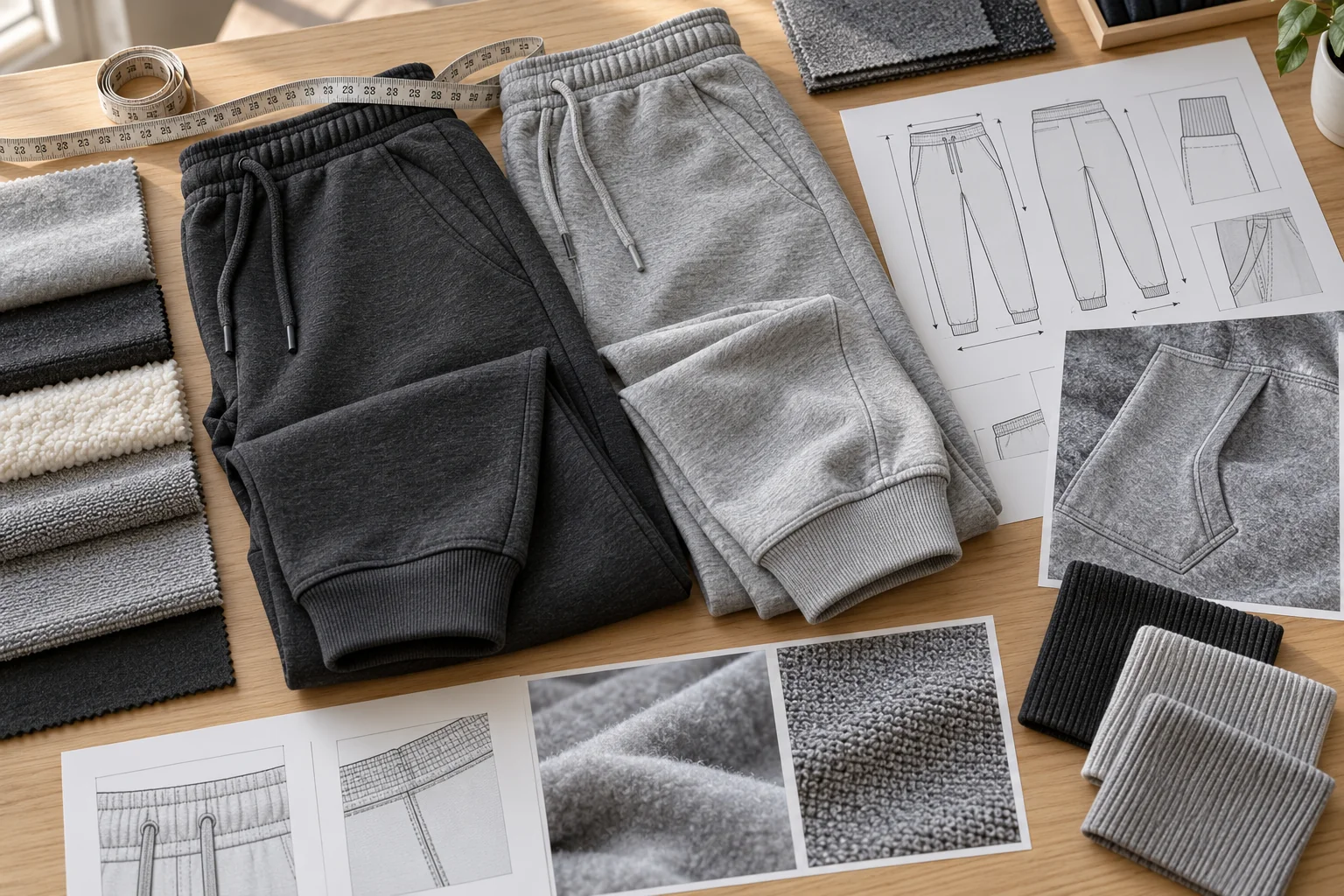
At a glance
Swipe the table sideways to compare both columns →
| Briefing point | Evidence to provide or request | Decision or control |
|---|---|---|
| Fabric selection | Article identity, face and back construction, composition, weight, finish, and care trial | Approve fleece or French terry by actual performance and handfeel |
| Fit and silhouette | Measurement diagram, rise, seat, thigh, inseam, and leg opening specifications | Separate body ease from taper and ankle treatment |
| Waistband, hems, and pockets | Construction drawings, elastic details, opening dimensions, and pocket bag specifications | Confirm comfort and function on a complete garment |
| Decoration clearance | Artwork size, placement datum, application method, and inside construction map | Keep application and wear clearances explicit across sizes |
| Quantities and release | Color and design matrix, component minimums, sample records, and approval register | Plan from 100 pcs per color per design and authorize bulk explicitly |
1. Give your custom sweatpants manufacturer a defined product brief
Start the brief with the intended wearer, use, selling market, size range, and silhouette, then describe the garment without relying on the word sweatpants to resolve construction. State whether the leg is straight, relaxed, wide, or tapered, and whether the ankle finishes with an open hem, rib cuff, or enclosed elastic. Joggers often imply a tapered leg and gathered ankle, but supplier terminology varies and does not replace measurements. A relaxed sweatpant can also have a cuff without sharing a jogger fit block. Provide front, back, and inside views with callouts for the waistband, drawcord, pockets, seams, and decoration. Mark reference photographs as silhouette, fabric, or detail references so the factory does not copy unintended features. List unresolved decisions separately and identify who can approve each one. This gives the quotation and first sample a defined scope rather than leaving interpretation to the sample room.
Clarify whether the order is for standalone sweatpants or a coordinated set before sourcing begins. A matching hoodie program introduces shared color, surface appearance, and replenishment decisions that a pants-only brief may not need. If a hoodie appears in a reference image only to show styling, say that its fabric, trims, and fit are outside the order. If matching is required, identify the companion style and define whether both garments must use the same article, dye lot, and finish. Do not assume identical color names will produce an acceptable set across different fabric constructions. Assign responsibility for pattern development, fabric purchasing, decoration, labeling, packing, and any subcontracted operations. Ask the supplier to quote the agreed scope and flag exclusions, including artwork preparation or special trim development. Keep one controlled brief with a revision date so the factory is not combining instructions from old images and later messages.
2. Specify fleece or French terry as an identified material
Choose between fleece and French terry by inspecting the actual construction rather than treating either name as a complete fabric specification. For this brief, describe whether the reverse is brushed to create a fleece surface or retains the visible loops associated with French terry. Record fiber composition, knit construction, face appearance, finished weight and measurement condition, usable width, color reference, and intended finishing route. Brushed fleece may provide the desired soft interior while introducing bulk at folded seams and pockets. French terry may suit a loopback interior, but its weight, loop structure, and finishing still affect drape and wear. Neither term guarantees warmth, stability, or durability. Ask for an identified article and representative swatch, then establish whether the offered fabric is reserved stock, repeatable stock, or a new production commitment. Any substitution should return for review even when its nominal composition and weight match.
Evaluate the selected article after the intended garment finishing and proposed care process. Request recorded observations for dimensional change, twisting, surface appearance, pilling, lint release where relevant, and color transfer using agreed evaluation methods. Set acceptance requirements appropriate to the product and selling market rather than accepting an unsupported claim that the fabric is premium. Compare handfeel before and after care because an initially soft finish may not represent later wear. Confirm whether fabric relaxation and shrinkage allowances are included in the cutting plan, and keep roll and lot identity available through production. Specify waistband and cuff materials separately; rib that looks close in color can recover differently or change shade after washing. If garment washing or another finishing treatment is planned, identify its sequence relative to decoration and drawcord installation. Preserve an approved fabric reference together with the finished sample so later comparisons do not depend on memory.
3. Define rise, seat, thigh, and leg opening independently
Build the measurement sheet around defined points of measure, a measurement diagram, tolerances, and the garment condition in which checks will occur. State whether the waistband is included in front and back rise measurements and where seat and thigh widths are taken. Include relaxed waist, a defined extended waist check, front rise, back rise, seat, thigh, knee where relevant, inseam, outseam, and finished leg opening. Specify whether widths are flat measurements or full circumferences. Rise controls alone do not establish seat volume, and a larger thigh does not necessarily correct a restrictive crotch shape. Explain the intended wearing position and ease through the hip and upper leg. For an open hem, define the finished opening without gathering; for a cuffed version, distinguish the leg width above the cuff from the cuff opening itself. These distinctions prevent ankle construction from masking an incorrect underlying leg shape.
Review fit on the intended body profile and through movements relevant to the product, including sitting, walking, and bending. Check whether the back waistband drops, the front rise folds excessively, the seat pulls, or the thigh restricts movement. Fabric weight and stretch can change how the same pattern hangs, so a substitute-material sample should receive only a limited fit decision. Ask the factory to record whether each correction changes the pattern, elastic length, construction, or finishing allowance. Avoid repeatedly adding width when the underlying issue is crotch shape or waistband tension. Review the base size and an agreed selection across the size range before releasing grading. Pocket placement, rise increments, and leg openings should be reviewed rather than assumed to scale acceptably. Retain measurement reports linked to pattern versions and fabric articles, and check the finished garment after the agreed care trial before treating fit approval as complete.
4. Detail waistband, cuff or hem, and pocket construction
Specify waistband construction with an inside drawing and material callouts. Identify self-fabric or rib, finished height, elastic width, joining method, casing construction, and the stitching intended to limit elastic rolling or twisting. Define how waist extension and recovery will be assessed without relying solely on an elastic supplier's description. State whether the drawcord is functional, internal or external, and continuous or otherwise constructed, with its material, exposed length, exit position, and end finish. Review destination-market safety requirements for the intended wearer rather than copying a reference cord arrangement without assessment. Confirm that cord exits and stitching do not create uncomfortable pressure points. For cuffs, identify material, finished height, relaxed opening, and attachment method. For open hems, specify turnback depth and stitch construction. An elasticated hem needs its own elastic and casing details; it should not be treated as equivalent to a rib cuff simply because both gather the ankle.
Define each pocket by opening shape, usable opening length, bag depth, bag width, material, and attachment points. Slanted side pockets, seam pockets, patch pockets, and zippered pockets create different bulk, access, and decoration constraints. If carrying a phone or other object is part of the use case, provide representative dimensions and review retention and movement on the sample rather than promising security from pocket depth alone. Check whether the bag hangs below a short top or becomes visible through the opening when seated. Specify reinforcement at stress points and confirm that the chosen method does not produce an uncomfortable hard area. Review pocket bag show-through, differential shrinkage, and the effect of thick fleece at stacked seams. For zippers, confirm tape, pull, opening direction, and any protective facing. Keep pocket symmetry and placement measurements in the specification, including back pocket position relative to the seat and waistband.
5. Set decoration clearance and component approvals
Supply production artwork with dimensions, colors, orientation, application method, and a placement diagram tied to stable garment reference points. A logo positioned below the waistband needs a stated measurement origin, not a visual estimate from a styled photograph. Map pocket bags, side seams, waistband folds, and reinforcement areas behind or beside the proposed decoration. Establish the clearance needed for the selected printing or embroidery process with the applicator, since there is no single spacing rule that suits every technique. Embroidery can unintentionally catch a pocket bag, while printing across bulky seams may create an uneven result. State whether decoration happens on panels or assembled garments and confirm that the sequence preserves alignment after sewing and finishing. Review the smallest and largest relevant sizes to decide whether artwork stays constant, changes size, or shifts position. Do not allow automatic scaling without a documented buyer decision.
Approve decoration on the intended fabric and color, using the planned backing, inks, thread, transfer, or other application materials. Evaluate appearance, handfeel, distortion, reverse-side comfort, and behavior after the agreed care process. A separate strike-off can establish color or surface quality, but it does not approve placement over a functioning pocket or prove the finished garment will hang correctly. Include a complete decorated garment at the appropriate sample gate. Build a component register covering main labels, size labels, care labels, drawcords, eyelets where used, elastic, zippers, and packaging. Record specifications, artwork revisions, approval owners, and purchasing minimums for each item. Keep legal labeling review separate from visual approval and confirm the requirements for the selling market. Agree ownership and handling of unused branded components and rejected decorated goods. Any material or application change that affects appearance, comfort, or care performance should trigger renewed review before production continues.
6. Reconcile quantities and release bulk through sample gates
Use MOQ 100 pcs per color per design as the garment planning basis and submit a matrix showing designs, colors, and quantities by size. Ask whether different leg finishes, pocket arrangements, or decoration versions constitute separate designs for the quotation. Do not assume that a cuffed option and an open-hem option can share one minimum because the upper block is similar. Reconcile garment quantities with fabric, rib, elastic, drawcord, label, and packaging minimums. Record development consumption, purchased surplus, ownership of leftovers, and storage or disposal terms. For coordinated sets, confirm whether each garment must meet its own minimum and how unequal hoodie and pants size allocations will be handled. Request a dependency-based schedule covering material availability, development, cutting, sewing, decoration, finishing, and inspection. Bulk timing depends on quantity as well as material readiness, capacity, and approvals, so a delivery date should identify the assumptions that must remain valid.
Samples take approximately 7 days once the brief and materials are confirmed, but clarify which sample stage that estimate covers. Material sourcing, transport, decoration trials, buyer review, and revisions need separate allowances. Define a fit sample gate, an actual-material construction and decoration review, and a preproduction release gate, combining stages only where the evidence remains complete. Label each submission with the pattern version, fabric article, component status, size, and unresolved points. Before authorizing cutting, approve the relevant measurement report, bill of materials, construction details, artwork placement, and packing instructions against matching retained references. If one item remains provisional, document exactly what work may proceed and what stays blocked. Agree inspection coverage across sizes, colors, and production batches, together with defect handling and reinspection responsibilities. Require written approval for substitutions or production-site changes. Silence after sample delivery is not approval, and approval of fit alone is not authorization to produce bulk.
Send these details together
- Define the sweatpants silhouette, intended wearer, size range, and whether matching hoodie requirements are included or excluded.
- Identify fleece or French terry by article, construction, composition, weight, finish, and agreed care evaluation.
- Issue measurement diagrams for rise, seat, thigh, waist, and leg opening, with tolerances and grading review.
- Specify waistband elastic, drawcords, cuffs or hems, pocket dimensions, reinforcement, and component approvals.
- Map decoration against seams and pocket bags, and approve its application on the intended fabric and finished garment.
- Confirm MOQ 100 pcs per color per design, separate component minimums, sample gates, inspection coverage, and written bulk release.
This guide covers buyer-side briefing of a China OEM supplier for custom men's sweatpants, including fleece and French terry selection, fit measurements, waistband and ankle construction, pockets, decoration, and production approvals. Jogger silhouettes and matching hoodie sets require additional product-specific decisions rather than automatic reuse of the sweatpants brief. MOQ 100 pcs per color per design is the garment planning basis; confirm size allocation and separate material and component minimums. Samples take approximately 7 days once the brief and materials are confirmed; bulk timing depends on quantity, material readiness, capacity, and approvals. Destination-market labeling and safety requirements need separate review. Reprint attribution: clothingmanufacturerchina.com.
Prepare a quote briefThe RFQ form prepares a WhatsApp message for you to review. For files, email sales@clothingmanufacturerchina.com.
Questions before sampling
Should custom sweatpants use fleece or French terry?
Choose using actual swatches and the intended garment behavior. Specify whether the interior is brushed fleece or loopback French terry, then compare weight, drape, bulk, surface appearance, and behavior after care. Neither name establishes performance by itself. Approve an identified fabric article and evaluate waistband, pocket, and hem construction in that material before releasing bulk.
How should a sweatpants brief differ from a jogger brief?
Define the silhouette and ankle construction rather than relying on either name. A jogger brief commonly emphasizes taper and a gathered ankle, while sweatpants may be straight, relaxed, wide, or tapered. Specify rise, seat, thigh, and finished openings independently. A cuff does not automatically make two garments share the same fit block, and changing the ankle finish can require pattern review.
Can colors or matching hoodie quantities be combined to reach the minimum?
Plan on MOQ 100 pcs per color per design and obtain written confirmation of how each variation is classified. Do not assume colors, different hem constructions, or companion hoodies can be pooled. Submit quantities by garment, design, color, and size. Fabric and component minimums may create additional commitments even when the proposed sewing quantity meets the garment minimum.
What does the approximately 7-day sample timing cover?
Samples take approximately 7 days once the brief and materials are confirmed, but the supplier should identify the submission covered by that estimate. It is not the duration of the entire approval program. Allow separately for unavailable materials, decoration development, shipping, review, and revisions. A substitute-fabric fit sample cannot approve actual-material appearance, care behavior, or final decoration performance.
What are your MOQ, sample time and bulk lead time?
MOQ is 100 pcs. Samples take 7 days. Bulk production lead time depends on order quantity.