How to Brief a Heavyweight T Shirt Manufacturer
Briefing a heavyweight t shirt manufacturer starts with defining finished fabric weight, measurement condition, and acceptable variation rather than requesting a thick blank. Specify fiber composition, opacity, handfeel, collar construction, dimensional stability, decoration, and size grading as connected requirements. Plan around MOQ 100 pcs per color per design, with fabric, rib, and decoration minimums checked separately. Samples take approximately 7 days once the brief and materials are confirmed; bulk timing depends on quantity, material readiness, processing capacity, and approvals. Use actual-material samples and written release gates to connect the approved garment to the fabric, pattern, finishing route, and decoration used in production.
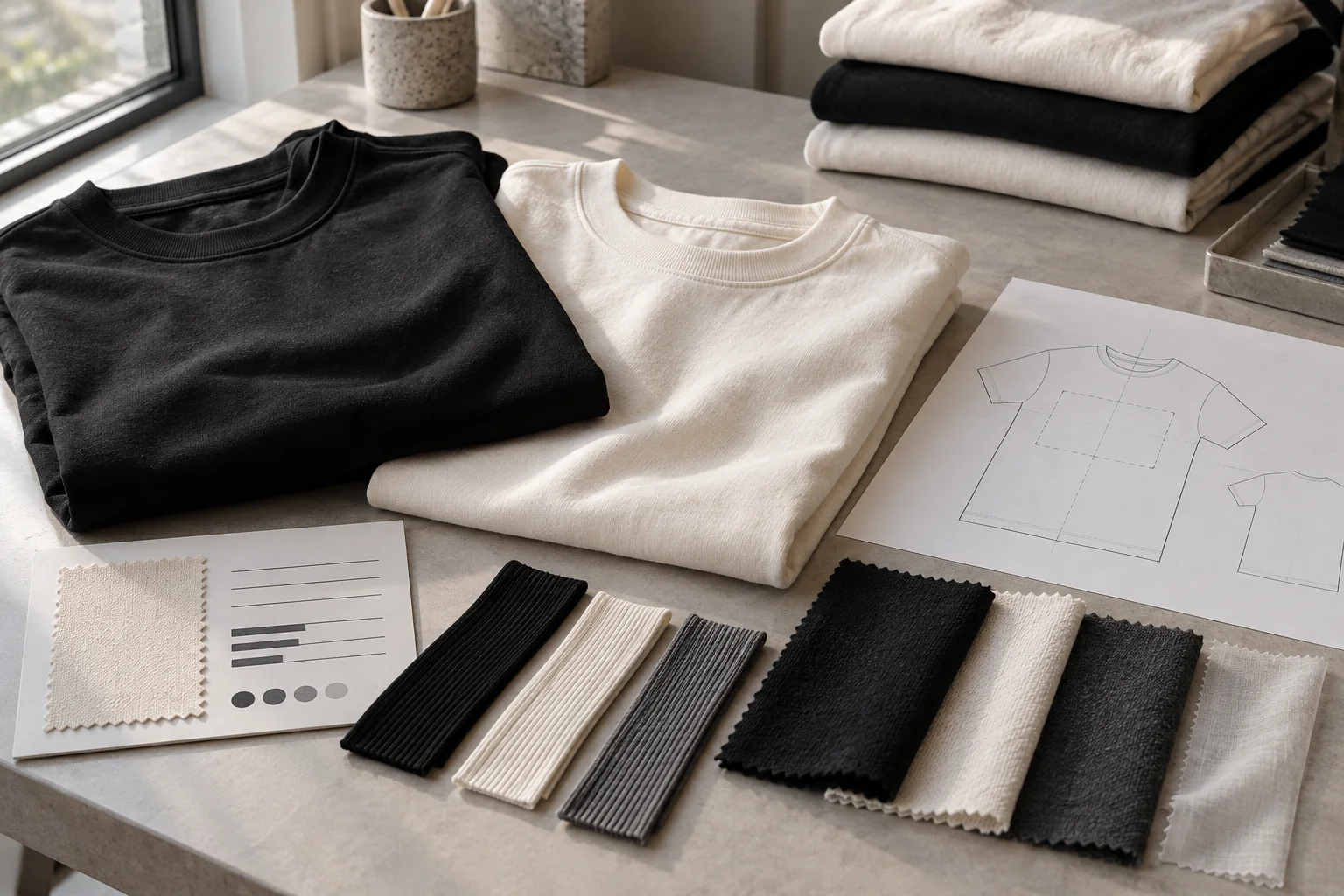
At a glance
Swipe the table sideways to compare both columns →
| Briefing point | Evidence to request | Decision or control |
|---|---|---|
| Finished fabric weight | Fabric article, GSM target and tolerance, measurement condition, and sampling plan | Separate finished fabric approval from garment weight and supplier category names |
| Composition and surface | Actual-color swatches, fiber specification, opacity review, and handfeel reference | Approve cotton or blends against intended wear and decoration requirements |
| Collar and construction | Rib specification, neckline measurements, seam details, and recovery assessment | Control collar behavior independently from body fabric weight |
| Shrinkage and graded fit | Before-and-after measurements, care procedure, pattern version, and size-set reports | Verify finished dimensions and size progression after the intended care process |
| Production release | Quantity matrix, actual-material samples, decoration trials, and signed approvals | Release only the identified material, construction, finishing, and artwork combination |
1. Give your heavyweight t shirt manufacturer a measurable brief
Start the brief with the intended garment: a structured everyday tee, an oversized graphic style, or a dense layering piece. Heavyweight is a commercial description, not a universal specification, and supplier categories can overlap. A midweight blank may look substantial because of a compact knit or firm finish, while a heavier fabric can feel soft and drape loosely. Ask for the proposed fabric article and a comparison with the supplier's midweight option, using the same finished measurement condition. Compare structure, opacity, drape, surface, and intended use rather than selecting the largest GSM number. State whether an existing blank is acceptable or whether the order requires a dedicated pattern, fabric, collar, and finishing route. An existing blank can support a straightforward program, but its stock construction and grading may restrict the changes that are practical for your design.
Define GSM as fabric mass per unit area, not the total weight of a finished T-shirt. State whether your target applies to finished fabric before cutting, fabric taken from a finished garment, or the garment fabric after a specified care procedure. These conditions are not interchangeable because processing and dimensional change can alter mass per unit area. Set a numerical target and an agreed tolerance, then identify the measurement method, conditioning procedure, sampling locations, and reporting responsibility. Avoid thick seams, rib, print deposits, and other unrepresentative areas when assessing body fabric. If destructive garment sampling is required, include the sample allowance in the inspection plan. Ask the supplier to report variation across relevant rolls and lots rather than submitting one favorable result. Record how an out-of-range lot will be held and reviewed before cutting or shipment.
2. Select composition, opacity, and handfeel together
Specify the fiber composition separately from weight and request the proposed knit structure, yarn details where relevant, and finishing route. Cotton can support an absorbent, familiar surface, but composition alone does not determine softness, stability, or print quality. Blends may change drying behavior, recovery, drape, and surface appearance; their suitability depends on the actual fibers, construction, and processing. Do not accept a substitution simply because it matches the quoted GSM. Compare candidate materials in actual colors whenever possible, since dyeing and finishing can change the result. Identify whether the fabric is stocked, reserved for the order, or requires new production, and ask what continuity can reasonably be expected for replenishment. Record the article, supplier reference, composition, usable width, and finish in the bill of materials. Any replacement should return for review before it becomes a purchasing decision.
Review opacity under agreed lighting with a consistent backing and with the fabric relaxed and stretched to represent wear. A dense dark swatch does not establish whether a light-colored garment will conceal an undershirt, pocket outline, or skin contrast. Evaluate complete garments where seams, body tension, and fit affect appearance. Define handfeel through retained physical references and practical descriptors such as dry, smooth, compact, brushed, or soft, rather than relying on premium or substantial. Ask which processing steps create the approved feel and whether it changes after laundering. Compare drape, surface fuzz, cling, and recovery alongside softness, since a pleasing swatch can still produce the wrong silhouette. Agree acceptable variation between colors without assuming every dye route will feel identical. Keep opacity and handfeel approvals separate from GSM acceptance so that one passing result cannot override another unresolved requirement.
3. Specify the collar as a separate engineered component
Do not describe the neckline only as a thick collar. Specify the rib composition, knit construction, finished height, seam arrangement, color relationship, and required recovery. Ask the factory to identify the rib article and explain how its stretch behavior suits the body fabric and neck opening. A heavier body does not automatically need a heavier rib; an unsuitable combination can create waviness, restriction, or a collar that stands away from the neck. Record neckline width and depth, the measurement method, and whether measurements apply before or after the intended finishing process. Include the collar attachment method and any back-neck tape or reinforcement. The factory should establish an attachment ratio through development rather than apply one universal ratio to every rib. Approve the resulting neckline on the actual garment and retain a reference showing its relaxed shape and acceptable appearance.
Assess the neckline after dressing, gentle extension, and the agreed care process, with a defined rest period before checking recovery. Record whether the collar returns to shape and whether the attachment seam remains flat without twisting or puckering. Review shoulder seams, armholes, sleeve hems, and the bottom hem with the same attention to fabric behavior. Specify seam and stitch construction, thread, reinforcement locations, and visible stitch appearance where these affect performance or design. Avoid asking for extra stitching everywhere without identifying the purpose; additional bulk can make a dense tee uncomfortable or distort small curves. Check seam extension during ordinary wear and examine the inside for rough edges or abrasive tape. If the style uses dropped shoulders or a wide neck opening, assess those features on the intended fit model. A flat tabletop sample cannot establish comfort or collar behavior in use.
4. Connect shrinkage allowances to size grading
Define two dimensional checkpoints: the garment after the factory's complete finishing route and the garment after the buyer's agreed care procedure. Set tolerances for delivered measurements separately from acceptable dimensional change after care. A statement such as preshrunk is incomplete without the process used and supporting results on the proposed material. Request before-and-after measurements for body length, chest, shoulder, sleeve, hem, and neckline where relevant, together with observations of twisting and seam distortion. State washing, drying, conditioning, and measurement procedures clearly enough for both parties to reproduce the review. Use the same identifiable garments for paired measurements. Ask the factory to distinguish fabric relaxation, finishing effects, and pattern allowances when proposing corrections. Increasing every pattern dimension is not an adequate response when length and width change differently or when the collar behaves differently from the body fabric.
Provide a measurement diagram and a size chart that describe the finished silhouette rather than a familiar fit name. Define the base size, intended fit model, chest ease, body length, shoulder position, sleeve opening, and hem shape. Specify how each point is measured, especially for dropped shoulders and curved or stepped hems. Ask for the proposed grade rules and review their effect across the size range instead of assuming uniform increments suit every dimension. Evaluate an agreed size set, including sizes that expose grading risks, on actual-material garments after finishing. Where care performance matters, include representative graded sizes in the laundering review. Keep the pattern version, grade rules, fabric article, and shrinkage evidence connected in the approval record. If a fabric change requires new allowances, reopen the affected fit decisions rather than preserving a previously approved chart on paper alone.
5. Validate print and embroidery on the production surface
Tell the supplier whether the garment will be decorated at its facility, by an identified subcontractor, or after shipment to your decorator. Supply artwork dimensions, placement references, colors, coverage, and the intended technique, while asking the decorator to confirm compatibility with the proposed surface. GSM alone does not establish print readiness. Surface fuzz, finishes, fabric texture, and fiber composition can affect edge definition, adhesion, feel, and processing behavior. Request trials on the actual fabric and color, using the planned preparation and curing route. For blends, ask the decorator to assess relevant heat and color migration risks rather than treating all cotton-rich materials alike. Review the trial after the agreed care procedure for cracking, lifting, unwanted color change, and loss of definition. Keep artwork approval separate from application approval: a correct digital file does not prove that its production execution is acceptable.
For embroidery, specify the design dimensions, placement, coverage, and the desired appearance on both the face and inside of the tee. Ask the supplier to propose backing, stitch approach, and processing settings suited to the fabric rather than assuming a heavyweight knit cannot pucker. Dense designs can pull the surface, alter drape, or create discomfort even when the base cloth is substantial. Review an actual-garment trial for distortion, placement, needle damage, backing visibility, and skin contact. Agree whether printing or embroidery occurs before or after garment washing, and evaluate the sample in that same sequence. Define placement tolerances from named reference points and decide whether artwork size or placement changes by garment size. Record the approved artwork version and application route. If undecorated tees will ship to another processor, confirm its requirements before releasing the blank garment specification.
6. Reconcile minimums and release samples in stages
Use MOQ 100 pcs per color per design as the garment planning basis and submit a matrix showing designs, colors, sizes, and decoration versions. Ask how different graphics, finishes, or fabric articles affect design classification rather than assuming they can share one commitment. Check fabric dye-lot requirements, rib minimums, labels, packaging, and decoration setup separately from sewing quantity. Request the purchasing quantities and responsibility for surplus materials where minimums exceed garment consumption. Samples take approximately 7 days once the brief and materials are confirmed, but this is a starting allowance for a defined sample, not a promise that all development will finish within one week. Custom knitting, dyeing, decoration trials, revisions, and transport need separate scheduling. Bulk timing depends on quantity, material readiness, processing capacity, and approvals. Obtain a schedule tied to those dependencies and identify which booking assumptions remain provisional.
Set explicit gates for material selection, fit, decoration, and preproduction release. A substitute-fabric fit sample can support silhouette decisions but cannot approve finished GSM, shrinkage, opacity, or print behavior on the final article. Before cutting bulk, approve a garment made with the intended body fabric, rib, construction, finishing, labels, and decoration where applicable. Attach measurement results, dimensional-change evidence, material references, artwork versions, and any accepted deviations to the approval. Keep matching retained references with the buyer and production team. Define which operations may proceed if one component is still pending, and do not treat silence as authorization. For bulk inspection, specify coverage across colors, sizes, material lots, and decoration batches, together with defect criteria and corrective-action responsibilities. Require written approval for substitutions or processing changes that could affect the approved result, including changes introduced to meet a delayed delivery date.
Send these details together
- Define the intended heavyweight silhouette and distinguish it from the supplier's midweight blank using actual-material comparisons.
- Set finished GSM, tolerance, measurement condition, sampling coverage, and the action required for out-of-range material.
- Approve composition, opacity, handfeel, rib construction, neckline recovery, and seam details as separate requirements.
- Connect delivered measurements, care-related dimensional change, pattern allowances, and grade rules through traceable sample reports.
- Validate print or embroidery on the actual fabric and color using the intended application and finishing sequence.
- Confirm MOQ 100 pcs per color per design, separate component minimums, sample purposes, and written preproduction release controls.
This guide covers buyer-side briefing of heavyweight men's T-shirt OEM production in China, including finished fabric weight, composition, appearance, collar construction, dimensional stability, decoration, grading, and production release. MOQ 100 pcs per color per design is the garment planning basis; confirm size allocations and separate fabric, rib, trim, and decoration minimums. Samples take approximately 7 days once the brief and materials are confirmed; bulk timing depends on quantity, material readiness, processing capacity, and approvals. Heavyweight is not a universal weight category, and this guide does not replace product-specific testing, destination-market labeling review, or agreed purchasing terms. Reprint attribution: clothingmanufacturerchina.com.
Prepare a quote briefThe RFQ form prepares a WhatsApp message for you to review. For files, email sales@clothingmanufacturerchina.com.
Questions before sampling
What GSM makes a T-shirt heavyweight rather than midweight?
There is no universal boundary that every supplier follows. Ask for the actual finished GSM, measurement condition, tolerance, and fabric article instead of accepting the category name alone. Compare the proposed heavyweight and midweight options for drape, opacity, structure, and intended use. Total garment weight is not a substitute for GSM because size, construction, rib, and decoration also contribute to it.
Is pure cotton always better than a blend for heavyweight tees?
No. The appropriate composition depends on the intended surface, drape, care behavior, decoration, and customer use. Cotton and blends can both produce substantial garments, but equal GSM does not mean equal performance. Review actual-color materials and finished samples, including laundering and decoration trials. Specify the approved composition and finish, and require renewed review before accepting an alternative fabric.
Can a stock blank approve the fit and print quality of a custom heavyweight tee?
A stock blank can communicate an intended silhouette or graphic placement, but it does not approve a different production fabric, pattern, rib, or finish. Treat it as a reference unless those specifications match the order. Confirm fit on actual-material samples and validate decoration through the intended process. Identify which decisions the blank supports and which remain open before bulk release.
Can several colors or graphics be combined to meet the minimum order?
Plan around MOQ 100 pcs per color per design rather than assuming mixed versions qualify together. Submit quantities by color, design, graphic, and size, then request written confirmation of how each version is classified. Fabric, rib, trims, and decoration may carry separate minimums or setup requirements. Reconcile those commitments before approving a purchase order or scheduling development.
What are your MOQ, sample time and bulk lead time?
MOQ is 100 pcs. Samples take 7 days. Bulk production lead time depends on order quantity.