How to Brief a Custom Windbreaker Manufacturer
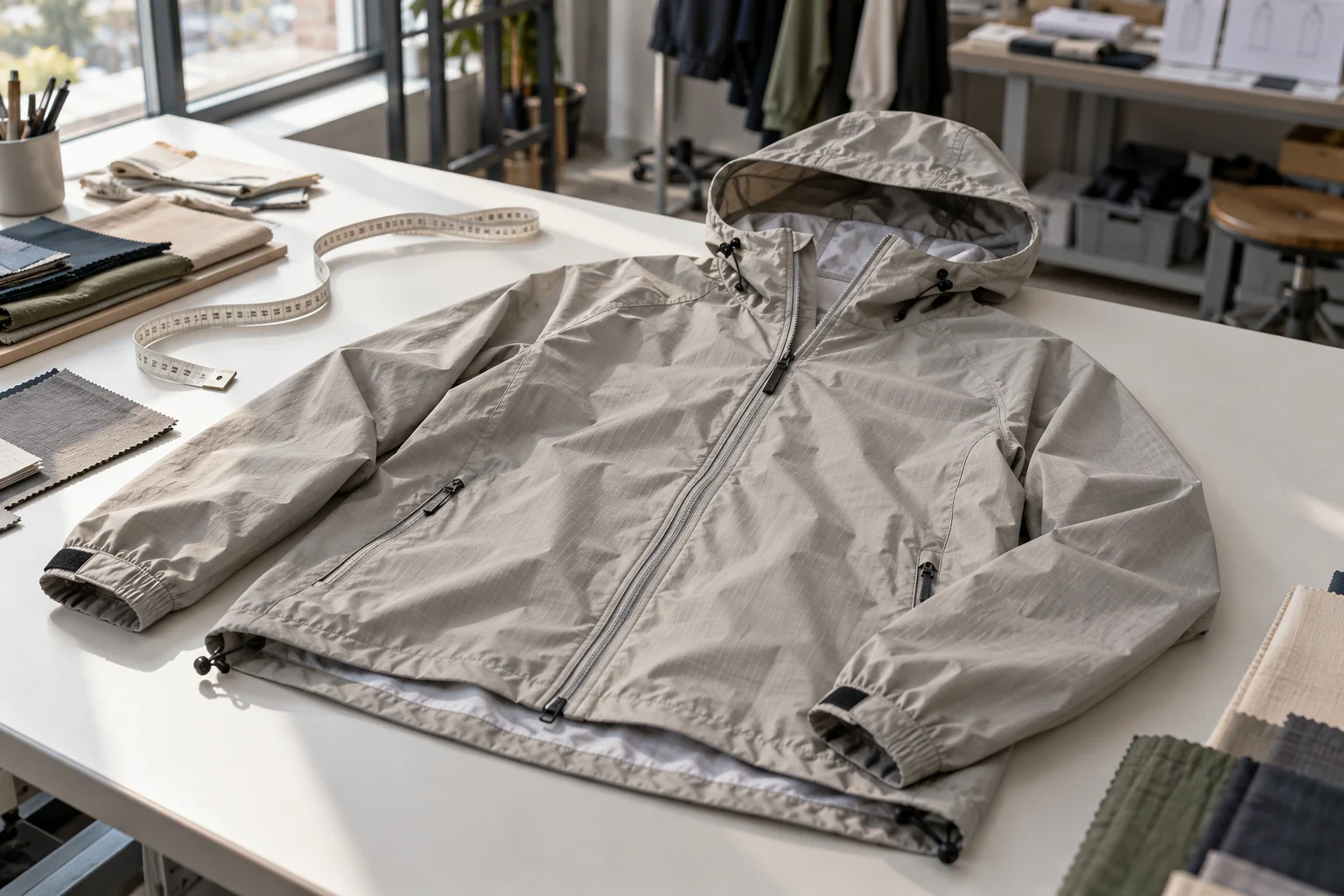
Briefing a custom windbreaker manufacturer starts with defining the intended use and construction rather than sending a reference image alone. Specify shell fabric, coating, lining, hood or collar, closures, adjusters, and packing method as one coordinated garment system. Separate a lightweight windbreaker from a rib-trim bomber or coach jacket, and distinguish water-repellent appearance from verified protective performance. Plan around MOQ 100 pcs per color per design. Samples take approximately 7 days once the brief and materials are confirmed; bulk timing depends on quantity, material readiness, capacity, and approvals. Approve decoration on the actual shell before releasing cutting and assembly.
At a glance
Swipe the table sideways to compare both columns →
| Briefing decision | Evidence to request | Release control |
|---|---|---|
| Shell and performance | Fabric article, composition, weight, finish, coating, and relevant test findings | Approve material identity and limit claims to supported performance |
| Lining and silhouette | Layer construction, measurement chart, mobility review, and inside photographs | Confirm fit and seam finishing in the intended garment layers |
| Hood and closures | Hood drawings, zipper specification, storm flap details, and adjuster samples | Check operation, coverage, and attachment strength on the garment |
| Packability and decoration | Packing demonstration and decoration trial on the actual shell | Approve packed form and decorated surface before bulk processing |
| Sample and bulk gates | Approved sample, revision log, material records, and inspection plan | Release each production stage against the same documented specification |
1. Give the custom windbreaker manufacturer a functional brief
Start with the wear situation, target customer, and intended layering rather than a collection of unrelated jacket photographs. State whether the garment is a casual lightweight shell, a travel layer, or an outdoor style with specific performance expectations. Describe the desired silhouette, body length, sleeve volume, and movement allowance over the intended shirt or midlayer. Mark reference images with the features to retain and those to exclude, then provide front, back, and interior drawings. A windbreaker brief should identify its lightweight shell construction and wind-blocking intent without implying that every version is waterproof. A bomber reference may introduce rib cuffs, a rib hem, and different body proportions; a coach jacket reference may introduce a shirt-style collar and snap front. Keep these neighboring styles as construction references only, unless their details are deliberately included in the approved design.
Build the initial request around one defined style and a clear color and size allocation. State MOQ 100 pcs per color per design, then ask the factory to confirm whether the selected shell, custom trims, and decoration introduce separate purchasing minimums. Include the destination market, planned sales descriptions, packaging requirements, and any buyer testing requirements so the supplier can identify unresolved decisions before quoting. Request separate assumptions for stock fabric and newly developed fabric rather than treating them as interchangeable routes. Identify who develops patterns, sources materials, applies decoration, and performs any specialized seam work. When comparing suppliers, use the same drawings and specification revision so differences reflect scope rather than missing details. Ask each supplier to list exclusions and proposed substitutions in writing. This makes the quotation a reviewable production proposal instead of an estimate based on a general jacket category.
2. Specify the shell article and qualify performance language
Define the shell by fabric article, fiber composition, construction, weight, usable width, color reference, and finish. Ripstop describes a reinforcing weave structure, not a fiber or an automatic performance grade; a ripstop shell may use nylon or polyester and still vary substantially in handfeel and behavior. Identify whether the material is uncoated, coated, laminated, or treated with a surface water-repellent finish. For coated options, record which face carries the coating and which side faces the wearer. Request swatches that show drape, opacity, surface noise, and the appearance of creases, especially for pale colors and compact packing. Agree acceptable variation and the condition in which weight and dimensions are assessed. Have the factory review the proposed fabric for sewing marks, seam puckering, edge fraying, and compatibility with the intended lining before the buyer commits to a bulk material reservation.
Write performance expectations separately from the fabric description. A shell can shed light surface moisture without the assembled jacket resisting water at seams, zipper openings, pockets, or hood joins. If the selling claim includes water resistance, waterproofness, wind resistance, or breathability, agree the assessment method, acceptance criteria, and whether evidence must cover fabric, finished garments, or both. Do not treat a coating name or supplier sales phrase as sufficient substantiation. Where sealed seams are required, confirm compatible tape or another agreed sealing method, the responsible facility, and trial results on the selected material. This can change cost, comfort, equipment requirements, and the production sequence. For a casual windbreaker without a protective claim, document that narrower scope explicitly. Retain identified swatches and relevant findings with the material approval, and require review before any change of article, finish, coating, or production source.
3. Resolve lining, fit, and packability as one construction
Choose unlined, mesh-lined, or lightweight woven-lined construction according to the intended feel and use, then specify exactly where each layer appears. A mesh body with lined sleeves is a different construction from a fully mesh-lined jacket, and either can affect transparency, ventilation, friction, and packed volume. For an unlined shell, define the inside seam finish, pocket bag appearance, exposed zipper tape, and treatment of rough edges against the wearer. For a lined shell, show attachment points, required movement allowance, and access for any later decoration operation. Include points of measure, measurement diagrams, size grading, and tolerances rather than relying on a labeled sample size. Review arm movement and reach while wearing the intended underlayer. Ask the factory to explain where its proposed seam construction may stiffen a very light shell or create visible ridges through the outer surface.
If the jacket must pack into its own pocket or a separate pouch, describe the packing method and the acceptable packed dimensions as buyer requirements rather than assumed features. Identify the receiving pocket, closure direction, any reversible zipper operation, and whether a hanging loop or carry attachment is needed. Ask for a demonstration using the completed garment with its actual lining, hood, cords, labels, and decoration. A shell swatch that folds easily does not establish that the finished jacket will fit its pouch. Review the effort needed to pack and unpack it, zipper access, bulk at hardware, and the resulting creases. Check whether compressed decorations stick, crack, distort, or mark adjacent surfaces. If the buyer also specifies a garment weight limit, define the size and included components for measurement. Record the approved packing sequence so inspection evaluates the intended feature consistently.
4. Detail the hood, front closure, cuffs, and hem
Choose a fixed hood, detachable hood, stowable hood, or collar-only construction and show the resulting neckline in both open and closed positions. Specify hood paneling, opening shape, depth, coverage, and any brim reinforcement. For a stowable version, draw the storage compartment and check collar bulk with the hood packed away. For a detachable version, define the attachment hardware and how exposed connection points are covered. Review head turning, forward vision, and the interaction between the hood edge and the top of the zipper on the actual sample. Do not assume that a larger hood automatically provides a better fit. Where adjustment is required, locate the channels, cord exits, stops, and reinforcement patches. Confirm that cords and components are appropriate for the stated wearer and destination market, and avoid loose arrangements that interfere with normal use or create foreseeable snagging concerns.
Specify the front zipper by type, size designation, opening arrangement, tape color, slider, and puller, with a physical reference where appearance matters. Show any outer storm flap, inner wind guard, top zipper cover, and lower-end reinforcement as separate details. A coated zipper appearance does not establish a waterproof closure. Review zipper operation while the jacket is worn, including whether lightweight fabric catches in the slider or folds into the opening. For cuffs, choose elastic, binding, tabs, or another defined construction and record both relaxed and extended measurements where relevant. For the hem, show the adjustment route, anchor points, and cord management rather than simply writing adjustable. Request attachment trials where hardware concentrates force on a thin shell. Include pocket closures in the same review, since their zipper weight, placement, and reinforcement can change drape, comfort, and the ability to pack the garment.
5. Clear printing and embroidery on the actual shell
Provide vector artwork or another agreed production file together with finished dimensions, colors, placement coordinates, and the intended decoration method. Measure positions from stable construction points, and show required clearance from seams, zipper openings, pocket bags, hood folds, and adjustment channels. Ask the factory to assess the actual shell rather than approve printing or embroidery from a fabric category alone. Coatings and surface finishes may affect ink adhesion, transfer bonding, heat tolerance, and the appearance of pressure marks. Embroidery introduces needle holes and may distort thin material or conflict with a water-resistance requirement. Define whether the decoration is applied to cut panels or finished garments, because the sequence affects backing access and the possibility of stitching through lining. Keep each proposed method as a separately reviewed option, with its own trial, appearance reference, and effect on the construction and intended claims.
Request a decoration trial on the approved fabric article and color before authorizing bulk application. Review edge definition, color, handfeel, puckering, show-through, backing visibility, and any change to the coating around the decorated area. Agree suitable checks for adhesion, rubbing, flexing, laundering, or other expected use conditions, with acceptance criteria linked to the intended care instructions. Inspect the trial after cooling or conditioning as appropriate, not only immediately after application. If packing is part of the product, fold the decorated area in the intended orientation and examine blocking or transfer onto adjacent fabric. A successful flat trial still needs confirmation on a finished garment when seams, layers, or limited machine access change the process. Retain the approved decorated reference and record processing responsibility. Require renewed approval if fabric finish, artwork size, backing, ink system, transfer, or decoration location changes.
6. Release samples and bulk through documented gates
Separate development approval from permission to begin bulk production. Samples take approximately 7 days once the brief and materials are confirmed; allow additional time for unavailable fabric, custom hardware, decoration trials, shipping, and revisions. Identify which materials in the first sample represent bulk and which are temporary substitutes. Review measurements, movement, hood fit, closures, inside finishing, decoration, and packing against the same specification revision. Record comments as measurable changes with photographs or marked drawings rather than broad instructions such as improve quality. If a sample uses substitute fabric, do not use it as final evidence for coating behavior, packability, or decorated appearance. Require a representative sample in the approved materials before the affected bulk operations are released. Keep a signed or otherwise clearly authorized reference with the factory and a matching buyer record, including the approved measurement chart and unresolved limitations.
Build the bulk schedule around quantity, material readiness, supplier capacity, and approval dates rather than quoting one universal delivery period. Confirm MOQ 100 pcs per color per design separately from fabric, trim, and decoration minimums, and record ownership of any excess materials. Establish gates for incoming shell identification, shade review, decoration clearance, cutting release, first assembled pieces, and final inspection. Agree inspection sampling, defect classifications, measurement checks, and any performance testing before production starts. Review early output while corrections remain practical, especially around zipper waviness, puckered seams, cord attachments, and lining tension. Final checks should include size and color allocation, closure function, packed configuration where specified, care labels, and carton records. Require written approval for substitutions or process changes that affect the reference. Document how nonconforming pieces will be isolated, assessed, corrected, and reinspected before shipment authorization is considered.
Send these details together
- Define intended use, layering, silhouette, destination market, and supported performance claims.
- Approve the identified shell article, composition, weight, finish, coating, color, and material minimums.
- Specify lining coverage, inside seam finishing, measurements, and the complete packing method.
- Document hood or collar construction, zipper and flap details, cuff treatment, and hem adjustment.
- Approve decoration trials on the actual shell and confirm placement clearance on a completed garment.
- Confirm MOQ 100 pcs per color per design and record sample, material, cutting, assembly, and shipment approval gates.
This guide covers buyer-side planning for custom windbreaker and light shell jacket OEM programs in China, including material selection, construction, decoration, and production approvals. It does not substitute for destination-market compliance review or testing needed to support protective performance claims. MOQ 100 pcs per color per design is the garment starting requirement; confirm separate material and trim minimums. Samples take approximately 7 days once the brief and materials are confirmed; bulk timing depends on quantity, materials, capacity, and approvals. Reprint attribution: clothingmanufacturerchina.com.
Prepare a quote briefThe RFQ form prepares a WhatsApp message for you to review. For files, email sales@clothingmanufacturerchina.com.
Questions before sampling
Is a custom windbreaker automatically waterproof?
No. A lightweight shell, surface water-repellent finish, or coating does not establish waterproof performance for the complete garment. Seams, front closures, pockets, and hood connections can provide entry points. Specify the intended claim, assessment method, and acceptance criteria, then confirm whether fabric evidence and finished-garment testing are needed. Keep unsupported protective language out of the approved product description.
Should I choose nylon, polyester, or ripstop for the shell?
Nylon and polyester identify fibers, while ripstop identifies a fabric construction, so these are not three equivalent alternatives. Compare actual articles for weight, drape, opacity, surface noise, finish, sewing behavior, and decoration compatibility. Ask for representative swatches and garment trials where needed. Select the article that suits the intended use rather than assuming one fiber or weave always performs better.
Can a coated windbreaker shell be printed or embroidered?
Possibly, but approve the method through trials on the actual fabric and finish. Printing or transfers may have adhesion or heat-related limitations, while embroidery can create holes, puckering, and visible backing. Define placement clearance and the production sequence. Review the decorated garment against its intended care, packing method, and performance claims before releasing bulk decoration.
What should be confirmed before the sample schedule starts?
Confirm the drawings, measurement chart, shell article, lining, trims, artwork, and sample objectives. Samples take approximately 7 days once the brief and materials are confirmed, not automatically from the first inquiry. Unavailable materials, custom components, testing, shipping, and revisions need separate allowances. Identify temporary substitutions so the buyer knows which decisions the first sample can and cannot support.
What are your MOQ, sample time and bulk lead time?
MOQ is 100 pcs. Samples take 7 days. Bulk production lead time depends on order quantity.