How to Vet an OEM Clothing Manufacturer in China
Vetting an OEM clothing manufacturer in China means checking who will develop, make, finish, and release each category in your menswear program. Review woven and knit capability separately, map subcontracted operations, and test whether sampling records connect to bulk production instructions. Confirm MOQ 100 pcs per color per design rather than assuming quantities can be pooled across styles. Samples take approximately 7 days once the brief and materials are confirmed; allow separately for sourcing, revisions, and delivery. Bulk timing depends on quantity, material readiness, category capacity, and approvals. Assign communication ownership and written QC gates before placing the order.
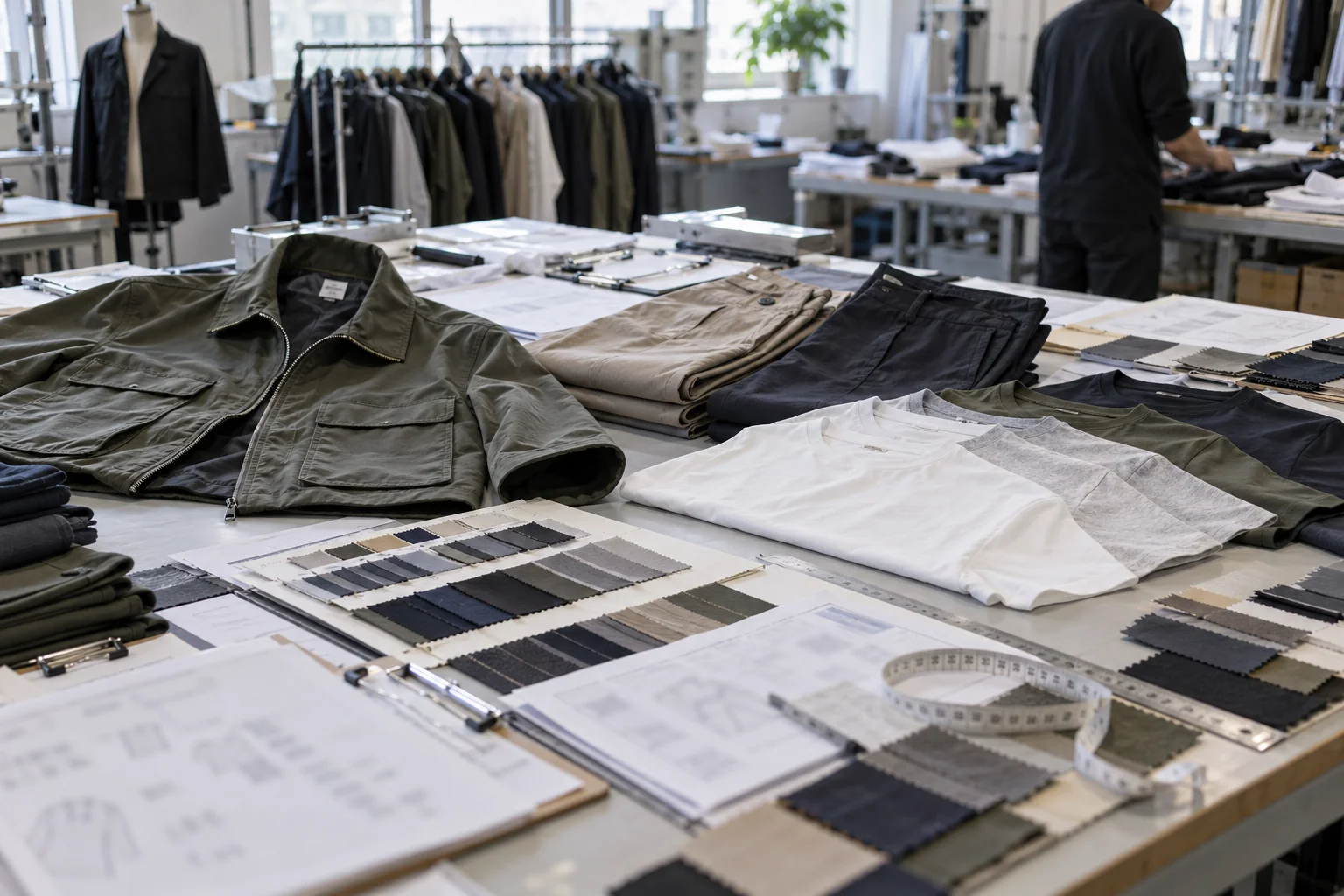
At a glance
Swipe the table sideways to compare both columns →
| Evaluation point | Evidence to request | Decision or control |
|---|---|---|
| OEM production scope | Operation map naming cutting, sewing, finishing, packing, and outside processors | Approve production locations and retain one accountable contractual supplier |
| Woven and knit capacity | Relevant construction examples, proposed line allocation, and category-specific constraints | Qualify each category rather than transferring approval across the entire range |
| Sampling discipline | Brief revision, material identity, measurement report, and consolidated comment history | Approve a reproducible reference linked to bulk instructions |
| Quality control gates | Incoming, first-output, inline, finishing, and final inspection records | Define hold points, corrective actions, and release authority |
| Program ownership | Named coordinator, technical owners, allocation sheet, and milestone dependencies | Confirm minimums, escalation routes, and realistic category schedules |
1. Define the scope of an OEM clothing manufacturer in China
Start with an operation map for the proposed order, not a broad statement that the supplier offers OEM manufacturing. List pattern development, grading, fabric purchasing, incoming inspection, spreading, cutting, sewing, decoration, washing or other finishing, pressing, labeling, and packing. Ask the supplier to mark which operations occur at its own facility, which use outside processors, and which remain the buyer's responsibility. Record the legal contracting party and the locations intended for each category. A shirt, jersey top, and lined jacket may follow different routes even when they appear on one purchase order. Request evidence tied to those routes, such as relevant production records or a walkthrough of the proposed work areas. The purpose is to establish what the supplier will actually control, rather than treating every service listed in a presentation as an in-house capability.
Subcontracting is not automatically a reason to reject an OEM partner, but undisclosed subcontracting makes responsibility difficult to enforce. Ask who selects outside processors, issues their instructions, checks their output, and handles rework or material losses. Require notification and written approval before an agreed production location changes, including temporary overflow arrangements. Clarify whether the contracting supplier remains responsible for the finished garments when another workshop performs an operation. For buyer-nominated processors, document any limits to that responsibility instead of leaving them implicit. Request a practical handoff example: how cut panels are counted, how shade groups stay identified, and how finished pieces are reconciled on return. Keep these controls in the order documentation. An operation map is useful only if it governs the proposed bulk route and is updated when the supplier requests a change.
2. Qualify woven and knit categories separately
Build a capability matrix around the garments you intend to buy. For woven shirts, review collar and cuff construction, placket consistency, seam appearance, and pressing. For trousers, examine waistband execution, pocket construction, fly alignment, and reinforcement at stress points. For knit tops, assess neckline shape, seam extensibility, puckering, twisting, and dimensional behavior after the intended care process. These are different production demands, so a strong example in one category should not qualify the supplier for all menswear. Ask to see representative construction on garments comparable in fabric behavior and complexity, not merely similar in appearance. Establish whether those examples were made by the proposed bulk team and location. When confidential customer work cannot be shared, request a neutral construction sample or a demonstration using your own development brief rather than pressing for another buyer's proprietary documents.
Capacity should be reviewed as available capability for your order window, not as a single factory-wide output claim. Ask which lines or work groups are proposed for each category, what equipment or specialist operations constrain them, and how current commitments affect your requested dates. A shared cutting room, embroidery resource, or finishing area can delay several categories even when sewing teams are separate. Discuss whether categories will run concurrently or sequentially and identify the dependencies behind that plan. For a smaller program, confirm whether your order will use a dedicated run, a scheduled small-order team, or gaps between larger commitments. None of these arrangements should be assumed from the minimum quantity alone. Request a provisional loading plan and revisit it after sample approval, when garment complexity and material availability are clearer. Treat unresolved capacity assumptions as scheduling risks requiring explicit follow-up.
3. Use sampling to test development discipline
Submit a controlled development brief with a style identifier, technical drawings, measurement points, size information, construction notes, material requirements, trims, and intended care instructions. Ask the supplier to return a consolidated question list before cutting rather than silently filling gaps with its usual practices. Confirm whether the first sample is intended to check silhouette, construction, material performance, or all three. Record any substitute fabric or temporary trim and state what that sample cannot approve. Samples take approximately 7 days once the brief and materials are confirmed, so identify the confirmation date and what must be available at that point. Material sourcing, unresolved technical questions, dispatch, and buyer review should remain visible as separate activities. This makes the sampling estimate usable without suggesting that every new fabric, decoration process, or complex garment can be developed within the same elapsed period.
Evaluate how the sample arrives, not only how it looks. Request its brief revision, fabric and trim identification, measurement report, and a list of intentional deviations or unresolved points. Review the garment against named measurement points and issue one consolidated set of comments with annotated photographs where useful. Ask the supplier to acknowledge each change and explain any consequences for construction, consumption, or timing. On the next submission, check that corrected details remain correct and that unrelated features have not changed without permission. Before bulk release, connect the approved reference to the final pattern, grading instructions, bill of materials, and workmanship requirements. If the sample room differs from the bulk production team, require a documented transfer review. A polished sample has limited purchasing value when the supplier cannot show how its decisions will be reproduced by the people making the order.
4. Establish QC gates across the actual production route
Ask for an order-specific quality plan that names the inspection stage, responsible person, record produced, and condition for moving forward. Incoming checks should confirm material identity, quantity, visible defects, shade grouping, and relevant behavior before cutting. For fabric behavior, agree the procedure and acceptance criteria appropriate to the garment and intended care, rather than relying on an unexplained pass statement. At cutting, verify pattern revision, size identification, panel direction where relevant, and bundle traceability. At sewing startup, compare initial output with the approved construction and measurement requirements before substantial quantities accumulate. Inline checks should address category-specific risks, such as shirt collar symmetry, trouser pocket placement, or knit neckline distortion. Ask the supplier to show how a failed check creates a hold, a correction, and a recorded recheck instead of becoming a note that production can ignore.
Include outside finishing and decoration in the same quality plan. Establish how the supplier checks quantities and identification before dispatch, verifies returned goods, and separates rejected pieces from accepted stock. Garment measurements and appearance may change after washing, printing, pressing, or other processing, so place relevant checks after the operation that can cause the change. Agree final inspection coverage, defect definitions, measurement tolerances, packing checks, and the reporting format before production starts. If a buyer-appointed inspector will attend, confirm access, readiness criteria, and who can authorize shipment after findings are resolved. Final inspection is a release checkpoint, not a substitute for earlier controls. Ask how repairable defects, replacements, and quantity shortfalls will be handled, including who bears associated costs under the contract. Keep the accepted shipment quantity distinct from the original order quantity until reconciliation is complete.
5. Assign technical and commercial communication ownership
A multi-category OEM program needs one coordinating contact, but that person should not become a substitute for technical ownership. Ask who resolves pattern questions, approves material purchasing internally, plans each category, oversees outside processing, and releases quality records. Record the backup contact and escalation route when an issue threatens a milestone. Test the arrangement during development by asking a specific cross-functional question, such as whether a fabric change affects shirt measurements, consumption, and the planned cutting date. Assess whether the response joins those consequences into one decision or arrives as disconnected messages from different departments. Agree a communication format that identifies the style, color, size scope, document revision, required decision, and due date. The useful measure is not message volume or constant availability, but whether the supplier can surface a problem early and obtain a clear, traceable resolution.
Use a shared issue log and a category-level status report rather than relying on a single statement that the order is on schedule. Each open issue should show its owner, proposed action, approval dependency, and effect on quantity or timing. Separate information updates from requests requiring buyer authorization. For example, reporting a delayed trim is different from requesting approval to use an alternative, and silence should not count as consent to substitute. Maintain a current approved document set and identify how superseded files are withdrawn from production use. Agree which instructions must be confirmed in writing after a call and who can authorize scope changes. During vetting, request a neutral example of this workflow or run it on your sample order. Clear communication ownership reduces ambiguity, but it still depends on accurate records from the actual production teams.
6. Reconcile minimums, schedule dependencies, and release decisions
Build an allocation sheet showing every design, color, size distribution, and planned delivery group. The starting garment requirement is MOQ 100 pcs per color per design; do not assume several colors or unrelated styles can be pooled to meet it. Confirm the proposed size allocation and any restrictions before commissioning development. Separate garment quantities from fabric, dyeing, decoration, label, and trim minimums, since these may create commitments beyond the finished units requested. Ask who owns unused material and whether it can realistically support a repeat order in the same specification. For multi-category programs, identify shared materials without assuming that apparent similarity permits substitution across garments. A common color name does not establish matching shade on woven and knit fabrics. Resolve these dependencies before release so that a small category does not unexpectedly create excess purchasing or delay the complete program.
Make the supplier decision against documented readiness rather than the lowest quotation or the fastest verbal promise. Bulk timing depends on quantity, as well as material readiness, approved construction, category loading, outside processing, and buyer decision dates. Ask for a milestone plan that distinguishes material booking, sample approval, cutting authorization, sewing, finishing, final inspection, and shipment readiness. Show whether a delay in one category holds the entire program or permits an agreed partial shipment, with commercial implications reviewed separately. For an unfamiliar category, consider qualifying that route through a limited initial program before expanding its scope; the result still needs inspection and does not guarantee later performance. Release production only when responsibilities, approved references, open exceptions, and QC gates are clear. Keep unresolved questions visible as conditions to close, and require renewed review when the proposed materials, locations, or production route change.
Send these details together
- Map in-house and subcontracted operations by category, with locations, handoff controls, and contractual responsibility.
- Qualify woven and knit construction separately and review available capacity for the proposed production window.
- Confirm the sample brief, material readiness date, revision records, and transfer from sample room to bulk team.
- Agree incoming, startup, inline, post-finishing, and final QC gates with hold and release authority.
- Name the program coordinator, technical owners, backup contacts, and written change-approval process.
- Confirm MOQ 100 pcs per color per design, separate material commitments, and category-level milestone dependencies.
This guide covers buyer-side vetting of China menswear OEM partners for multi-category apparel programs, focusing on production scope, woven and knit capability, sampling controls, quality gates, and communication ownership. It complements supplier identity checks and quotation comparison rather than replacing them. MOQ 100 pcs per color per design is the starting garment requirement; confirm size allocation and separate material minimums. Samples take approximately 7 days once the brief and materials are confirmed; bulk timing depends on quantity, materials, capacity, and approvals. Reprint attribution: clothingmanufacturerchina.com.
Prepare a quote briefThe RFQ form prepares a WhatsApp message for you to review. For files, email sales@clothingmanufacturerchina.com.
Questions before sampling
Should an OEM supplier be rejected if it subcontracts some operations?
Not automatically. Assess whether the outside operation is disclosed, suitable for the category, and controlled through documented instructions and inspection. Identify the processing location, material handoff records, rework responsibility, and approval process for location changes. The contracting supplier's responsibility should be explicit. Undisclosed transfers or unclear accountability are more concerning than a transparent, managed specialist processing arrangement.
Can one approved sample qualify a supplier for woven and knit garments?
No. A sample demonstrates only the construction and material route it represents, and even that needs a credible transfer to bulk production. Review woven and knit categories separately, including relevant machinery, operator skills, finishing behavior, and available capacity. Request category-specific development evidence and identify whether different teams or locations will make the garments in your program.
How does MOQ 100 pcs per color per design affect a mixed apparel order?
Apply the minimum to each design and color combination rather than the combined order total. A shirt and a knit top are separate designs, and different colors within either design need separate allocation review. Confirm the size breakdown with the supplier. Fabric, dyeing, decoration, and trim minimums may create additional commitments, so reconcile those before approving material purchasing.
What should a buyer confirm before accepting the sample and bulk schedule?
Confirm when the brief and materials are ready, what the sample will demonstrate, and which approvals remain outstanding. Samples take approximately 7 days once those inputs are confirmed, with sourcing, shipping, and revisions considered separately. Bulk timing depends on quantity and the actual category route. Request milestones covering material readiness, approvals, production, finishing, inspection, and shipment readiness rather than one unsupported completion date.
What are your MOQ, sample time and bulk lead time?
MOQ is 100 pcs. Samples take 7 days. Bulk production lead time depends on order quantity.