How to Brief a Custom Coach Jacket Manufacturer
Briefing a custom coach jacket manufacturer starts with defining the garment construction and decoration route together, rather than sending a silhouette reference alone. Specify nylon or polyester shell, snap or zipper front, stand collar dimensions, cuff and hem treatment, and whether the jacket is lined. Establish chest and back print clearance before approving pockets, seams, or lining assembly. Separate classic cropped and longer fits through measured specifications. MOQ 100 pcs per color per design is the starting requirement. Samples take approximately 7 days once the brief and materials are confirmed; bulk timing depends on quantity, material readiness, capacity, and approvals.
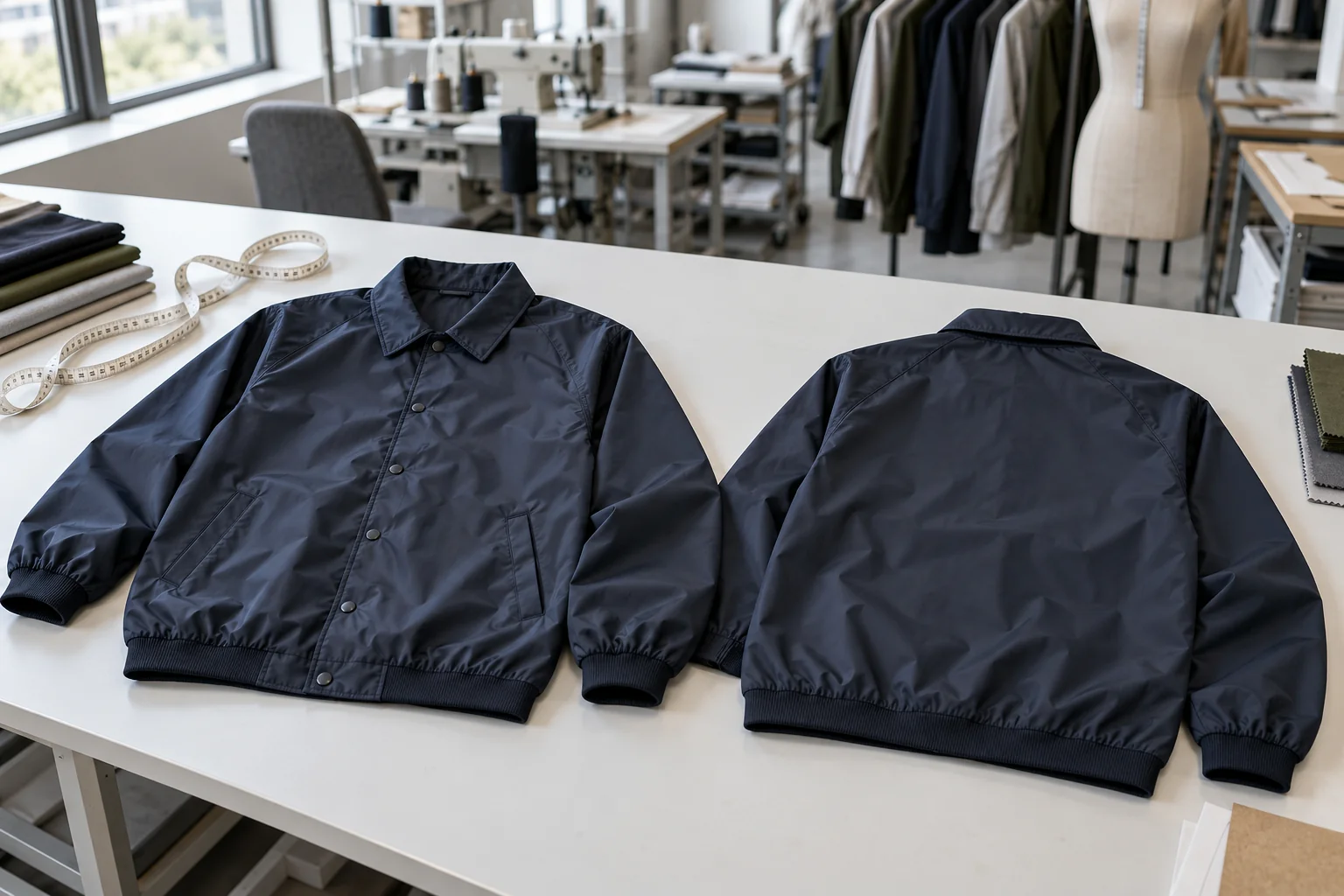
At a glance
Swipe the table sideways to compare both columns →
| Briefing point | Evidence to request | Decision or control |
|---|---|---|
| Shell and lining | Identified fabric articles, finish details, swatches, and lining construction | Approve the material combination and decoration compatibility |
| Front and collar | Closure specification, reinforcement details, and collar measurements | Resolve fastening behavior and neck shape before bulk cutting |
| Cuffs, hem, and fit | Opening measurements, elastic or rib references, and graded specification | Separate silhouette targets from stretch and recovery requirements |
| Print clearance | Dimensioned artwork placement and actual-shell decoration trial | Keep graphics clear of pockets, seams, folds, and access restrictions |
| Production release | Approved sample, material records, size checks, and inspection plan | Release bulk only after documented deviations are closed |
1. Give the custom coach jacket manufacturer a controlled brief
Start with a technical drawing that identifies the front, back, interior, and important construction details, supported by a measurement sheet and bill of materials. State whether the reference represents a classic cropped coach jacket or a longer interpretation, and mark which visual features are mandatory. A photograph can explain proportion, but it cannot establish body length, pocket position, collar height, or internal finishing. List the intended wearer, size range, layering allowance, and expected use without treating those descriptions as measurable specifications. For a China OEM program, identify who owns pattern development, material sourcing, decoration, assembly, and final inspection, including any subcontracted processes. Ask the factory to return a written list of assumptions and unresolved details before preparing the sample. This creates a shared development baseline and makes later changes traceable rather than leaving the sample room to decide unspecified features.
Build the order matrix alongside the garment brief, showing design, shell color, size allocation, artwork version, and decoration color for each proposed variant. MOQ 100 pcs per color per design applies to the garment program; ask separately about shell dyeing, lining, rib, elastic, zipper, and custom snap minimums. A shared silhouette does not automatically make different graphics or construction options one design, so obtain written confirmation of how the allocation is counted. Request a quotation that identifies included development work, decoration, labels, packing, and any separately charged material commitment. Specify who owns surplus fabric and unused trims if purchasing quantities exceed consumption. Record the technical package revision on the quotation and sample request. When the buyer changes a closure, lining, or fit after costing, require the factory to update the assumptions before treating the original commercial offer as still valid.
2. Select nylon or polyester shell with the lining route
Specify the shell by identified article rather than by nylon or polyester alone. Include fiber composition, construction, weight with its unit and tolerance, usable width, surface appearance, handfeel, color reference, and any coating or finish. Similar-looking fabrics can differ in stiffness, noise, seam puckering, and response to printing heat or adhesive. Ask for labeled swatches and enough actual material to evaluate the complete jacket, not only a color cutting. If a water-repellent finish is requested, distinguish that surface treatment from a claim that the assembled garment is waterproof. Any performance claim needs an agreed evaluation method and supporting evidence for the relevant material or garment. Have the factory flag implications for seam construction, pressing, decoration, and care instructions before approval. Record substitutes as separate proposals with their own properties; do not permit an equivalent-material description to authorize an unreviewed bulk substitution.
Choose unlined, partially lined, or fully lined construction explicitly, then describe the interior that the wearer will see. An unlined shell still needs decisions on seam finishing, pocket bags, facing edges, and the visibility of decoration backing. For a lined jacket, identify lining composition, weight, color, attachment points, sleeve treatment, and the allowance needed for movement. Check that the lining does not pull the shell upward, restrict reaching, or hang below the hem. Ask how shell and lining dimensional behavior will be assessed under the intended care instructions, especially when the materials differ. If mesh is proposed, review snagging exposure and the appearance of seam allowances through the openings. Confirm the assembly sequence with the decoration team because lining can obstruct access to a chest or back panel. Approve the combined shell and lining sample rather than treating each swatch approval as proof of garment compatibility.
3. Resolve snap or zipper front and stand collar construction
Define the front closure as a construction decision, not merely a hardware preference. For snaps, specify quantity, spacing, visible cap appearance, finish, placement from the front edge, and the reinforcement beneath each attachment. Ask the factory to demonstrate opening and closing on the actual shell and facing combination, checking for distortion, tearing, or difficult operation. For a zipper, identify type, gauge or supplier size designation, length, color, slider configuration, and whether the front requires a guard or covering placket. Review bottom alignment and how the closure meets the hem and collar. A snap-front pattern should not be converted to a zipper front without reviewing overlap, finished chest measurement, and front balance. Require hardware identification in the bill of materials and an agreed assessment of attachment and operation. Confirm replacement approval rules if the original trim becomes unavailable during bulk purchasing.
Draw the stand collar in both open and fastened positions and state its finished height, top-edge shape, neckline seam length, and intended clearance around the neck. If the visual reference has a fold-down coach collar instead, resolve that conflict before pattern development; the two constructions should not be treated as interchangeable. Specify collar layers, interfacing where used, edge stitching, and how the ends meet the front closure. Evaluate stiffness on the actual shell because a collar that stands neatly in a photograph may press uncomfortably against the wearer or collapse after handling. Check left-to-right symmetry, edge rolling, and the transition into the shoulder and front facing. Ask for interior photographs where the collar attachment is hidden by lining. Review the neckline while the wearer turns and reaches, and document any agreed adjustment to height or circumference in the revised pattern record.
4. Measure cropped or longer fit and specify cuff and hem behavior
Translate classic cropped or longer fit into a complete measurement set with defined measuring points. Include chest, body length, shoulder width or raglan reference, sleeve length, upper arm, armhole, hem opening, and the relevant collar dimensions. State whether each measurement is taken flat, relaxed, or under an agreed extension condition, and set tolerances appropriate to its function. Identify the base size and provide grading instructions rather than assuming the factory's existing size chart matches the intended customer. Compare the jacket over the planned layer and check reaching, sitting, and fastening, not just a static front view. A longer body can require changes to pocket height, hem clearance, and closure length even when the chest remains unchanged. Review at least the agreed size checkpoints before bulk release, with particular attention to how the shortest and longest sizes preserve the intended silhouette and usable decoration space.
Specify each opening separately: an elastic cuff with a straight hem is different from rib cuffs and a rib hem, and neither should be inferred from a reference image. For enclosed elastic, identify finished channel construction, elastic width, relaxed opening, and the agreed stretch and recovery checks. For rib, record composition, structure, color, finished height, attachment seam, and relaxed opening, then assess how it behaves against the shell weight. Check whether the wearer can pass a hand through the cuff comfortably and whether the sleeve remains at the intended position during movement. At the hem, evaluate ride-up, blousing, and access to trouser pockets. If adjusters or cords replace a fixed opening, document their routing, attachment, and exposed ends as a separate option. Confirm that cuff and hem materials are included in color approval, since a visually close trim may contrast noticeably with the finished shell.
5. Reserve chest and back print clearance before assembly
Provide production artwork together with dimensions, color references, orientation, and placement coordinates measured from stable garment landmarks. Do not specify centered back or left chest as the only instruction. Mark the usable decoration area on the pattern or a scaled drawing, showing clearance from armholes, collar seams, front closures, pockets, hem channels, and any back seam or yoke. Ask the factory and decorator to confirm access for their proposed equipment and process. A nominally large back panel may still be difficult to decorate after lining and sleeve assembly. For chest artwork, check that pocket bags, facing layers, and snap reinforcement will not create an uneven working surface. State whether graphic size stays constant across the size range or changes by size, then review the smallest garment for crowding. Keep artwork revision and placement revision linked so a revised logo does not silently invalidate previously approved clearance.
Require a decoration trial on the intended shell article and finish before approving the production method. Ask the decorator to identify the process and explain any restrictions involving heat, pressure, pretreatment, curing, or access to the reverse side. Depending on the material combination, review adhesion, color migration, surface marking, puckering, and changes in handfeel using an agreed evaluation and care procedure. Do not infer compatibility from a print on an untreated fabric swatch if bulk shell has a different finish. Decide whether decoration occurs on cut panels or assembled garments and assign responsibility for positioning, rejected panels, and replacement material. For lined construction, document how access openings are closed and inspected. Retain the approved trial and decorated garment as separate references when useful. Any later change to shell, finish, artwork size, or decoration process should trigger a compatibility review before the affected bulk pieces are processed.
6. Set sample approvals and bulk release gates
Plan sampling around confirmed inputs rather than the date of the first inquiry. Samples take approximately 7 days once the brief and materials are confirmed; allow separate time for sourcing unavailable materials, shipping, decoration trials, and revisions. Identify whether the first sample uses intended bulk materials or temporary substitutes, and label every unresolved difference. Review finished measurements, layering fit, collar behavior, closure operation, pocket access, cuff and hem recovery, lining balance, and artwork placement in one recorded assessment. Ask for the measurement report and clear interior and exterior photographs, but use the physical sample when handfeel, movement, or fastening behavior drives approval. Return consolidated comments against numbered specifications instead of scattered image annotations. Each correction should have an owner and disposition, including whether a revised sample is required. Keep the final approved garment, technical package, and material references under the same revision before authorizing production preparation.
Separate material booking, bulk cutting, decoration, assembly, and shipment release into explicit approval gates. Before cutting, confirm the approved shell and lining articles, available quantities, color lots, trim identities, pattern revision, and size allocation. Review agreed size-set or preproduction evidence and close sample deviations that could affect the full order. Before decoration, verify the artwork file, placement reference, process settings under factory control, and first-piece approval responsibilities. During assembly, check closure alignment, collar symmetry, seam appearance, lining attachment, and opening measurements against the documented reference. Agree defect definitions, inspection coverage, measurement tolerances, and the handling of nonconforming goods before final inspection rather than at shipment. Bulk timing depends on quantity as well as material readiness, decoration workload, capacity, and approval speed. Request a schedule that shows these dependencies and require notification when a missed gate changes the expected completion date or necessitates a revised production sequence.
Send these details together
- Issue a revision-controlled technical package with design, color, size allocation, and MOQ 100 pcs per color per design confirmed.
- Identify nylon or polyester shell, finish, lining route, material minimums, and substitution approval requirements.
- Specify snap or zipper construction, reinforcement, stand collar dimensions, and fastening checks.
- Define cropped or longer fit through measurements, grading, and separate cuff and hem requirements.
- Approve chest and back clearance, artwork placement, decoration access, and an actual-shell compatibility trial.
- Close sample deviations and document material, cutting, decoration, assembly, and shipment release gates.
This guide covers buyer-side briefing and production planning for custom coach jackets with a China menswear OEM. MOQ 100 pcs per color per design is the starting garment requirement; confirm size allocation and separate fabric, trim, and decoration minimums for the proposed program. Samples take approximately 7 days once the brief and materials are confirmed. Bulk timing depends on quantity, materials, capacity, and approvals. Performance claims and destination-market requirements need separate verification for the intended product and use. Reprint attribution: clothingmanufacturerchina.com.
Prepare a quote briefThe RFQ form prepares a WhatsApp message for you to review. For files, email sales@clothingmanufacturerchina.com.
Questions before sampling
Should I choose nylon or polyester for a custom coach jacket?
Choose the identified fabric article rather than the fiber name alone. Compare weight, handfeel, surface appearance, finish, seam behavior, and compatibility with the proposed decoration process. Request actual-shell trials when printing or heat application is involved. Nylon and polyester options can both vary substantially, so approve the material with the intended lining, construction, and care instructions before bulk purchasing.
Can a coach jacket use a zipper and stand collar instead of snaps?
Yes, but specify that combination explicitly rather than expecting a standard coach jacket pattern to cover it. Changing the closure can alter front overlap, chest measurement, facing construction, and collar alignment. Provide zipper details and stand collar dimensions, then review fastening, neck clearance, and front balance on the sample. Record the revised pattern and trim requirements before confirming bulk production.
When should chest and back artwork be approved?
Approve the usable decoration area during pattern and construction development, then approve appearance and compatibility through an actual-shell trial. Final placement should be checked on the garment before bulk decoration. Pockets, facings, lining, seams, and closure reinforcement can restrict access or affect the surface. Confirm how artwork fits the smallest size and whether decoration happens before or after assembly.
How do minimum quantities and sample timing affect the order plan?
Plan from MOQ 100 pcs per color per design, with separate confirmation of material and trim minimums. Samples take approximately 7 days once the brief and materials are confirmed; shipping, sourcing delays, trials, and revisions need additional allowance. Bulk timing depends on quantity and the approved production route. Request a schedule tied to material readiness and approval gates rather than an unconditional completion date.
What are your MOQ, sample time and bulk lead time?
MOQ is 100 pcs. Samples take 7 days. Bulk production lead time depends on order quantity.