How to Brief a Custom Bomber Jacket Manufacturer
Briefing a custom bomber jacket manufacturer starts with defining the silhouette and material system, not selecting a reference photograph alone. Specify shell fabric, lining, padding level, rib composition and recovery, zipper details, sleeve pocket construction, and decoration clearances in one controlled tech pack. Confirm MOQ 100 pcs per color per design separately from fabric, rib, and hardware minimums. Samples take approximately 7 days once the brief and materials are confirmed; bulk timing depends on quantity, material readiness, capacity, and approvals. Connect each sample decision to a measurable requirement before authorizing material purchasing, cutting, decoration, or final assembly.
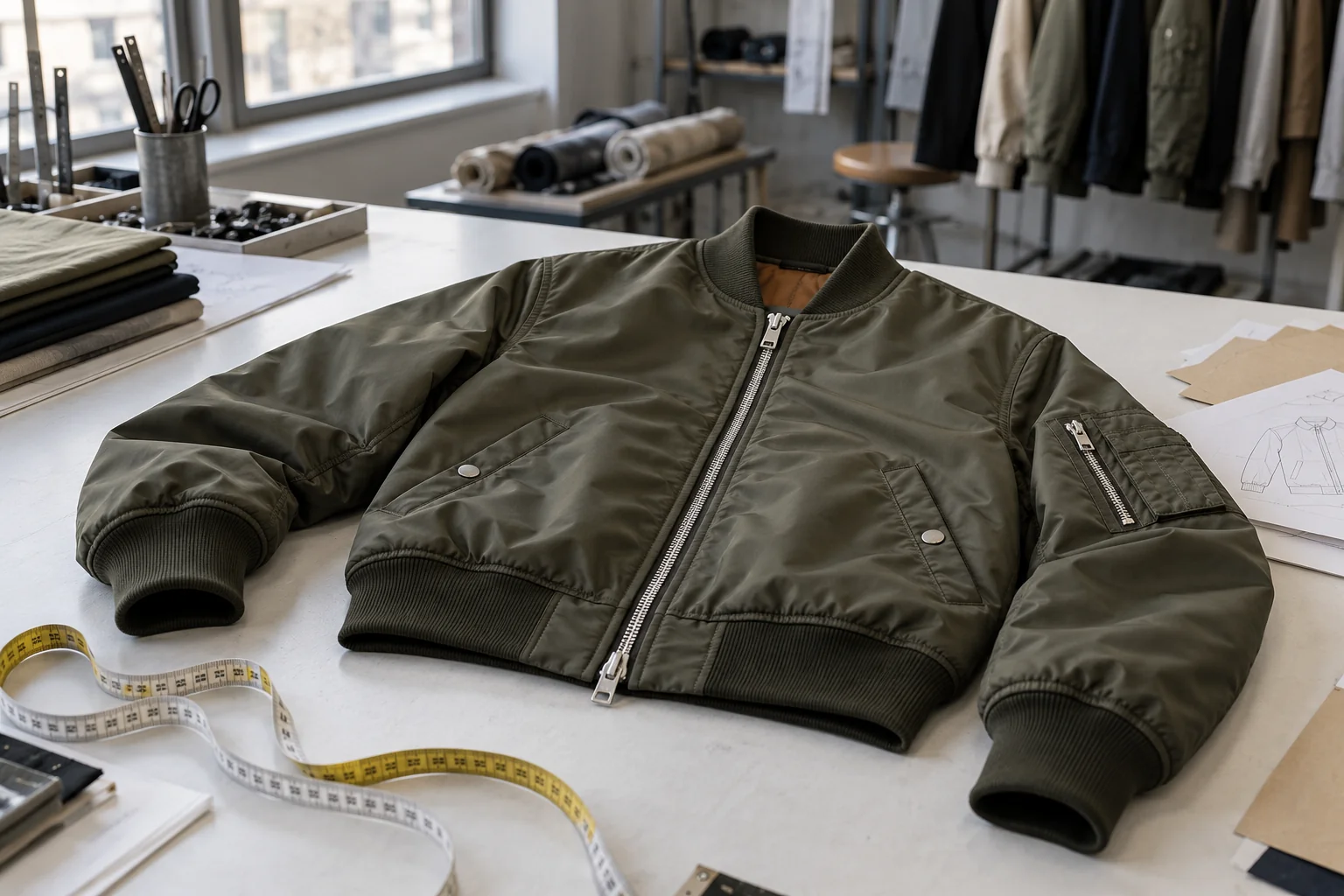
At a glance
Swipe the table sideways to compare both columns →
| Briefing point | Evidence to request | Approval control |
|---|---|---|
| Shell and interior | Identified shell article, lining swatch, padding specification, and assembled trial | Approve weight, handfeel, coverage, and construction together |
| Rib components | Fiber composition, dimensions, attachment ratio, and recovery findings | Control neckline, wrist opening, and hem tension separately |
| Zipper and sleeve pocket | Hardware references, installation details, pocket layout, and operating sample | Check closure alignment, access, reinforcement, and puller clearance |
| Fit and decoration | Measurement chart, layered fit review, artwork files, and placement trials | Approve silhouette and process clearances on actual materials |
| Production release | Signed sample record, final bill of materials, size allocation, and inspection plan | Release purchasing and production only against documented approvals |
1. Give the custom bomber jacket manufacturer a controlled brief
Start with a product definition that distinguishes the intended bomber from a general zip jacket. State the target wearer, sales market, season, intended layering, and whether the silhouette is a classic cropped bomber or a longer street bomber. Supply front, back, and interior drawings with reference photographs annotated for specific features rather than treated as a complete specification. Identify the collar shape, shoulder construction, sleeve volume, body fullness, pocket arrangement, and hem position. Mark which details are fixed and which the factory may propose. A longer body with the same tight rib hem can gather differently from a cropped version, so describe the desired worn shape as well as the flat measurements. Give every drawing and measurement chart a revision date, and identify who can approve changes when the factory finds a conflict between appearance, construction, and material behavior.
Separate the supplier's service scope from the product specification before requesting comparable quotations. Confirm who develops the pattern, sources shell and rib, purchases hardware, applies decoration, assembles the jacket, and conducts final inspection. A general custom jacket offer or a coach jacket sample may show relevant sewing capability, but neither establishes experience with the proposed bomber's rib attachment, padded assembly, or sleeve pocket. Request evidence from comparable construction details without assuming that a portfolio image identifies the actual production site. State MOQ 100 pcs per color per design and provide the intended size breakdown for each allocation. Ask which custom materials or components create separate minimums and how unused stock will be handled. Record quotation assumptions for labels, packaging, sample revisions, and delivery terms so that a lower offer is not simply omitting parts of the required production route.
2. Specify the shell, lining, and padding as one material system
Describe the shell by fiber composition, construction, weight with units, usable width, color reference, surface finish, and intended handfeel. Nylon, polyester, and cotton twill are starting categories, not interchangeable specifications. Ask for identified articles and labeled swatches showing the proposed bulk condition. A lightweight synthetic shell may reveal seam puckering or padding shadows, while cotton twill can produce a different drape and pressing response. Record any coating or backing and clarify whether water resistance is a requested performance characteristic or only an appearance reference. If performance matters, agree the evaluation method and acceptance criteria rather than accepting an unsupported descriptive label. Have the OEM review the selected shell for sewing, pressing, decoration, and cleaning compatibility. Keep alternatives on separate material records because a similar color or weight does not establish equivalent behavior in the finished bomber.
Define the interior independently of the shell, then review the assembled combination. State whether the jacket is unlined, lined without padding, or padded, and identify lining composition, weight, surface, color, and coverage. For padding, record material type, nominal mass per area with units, placement, and the agreed method of holding it in position. Specify whether sleeves and body use the same padding level, and provide quilting or securing details where required. Avoid relying on labels such as lightweight or winter weight without an approved physical reference. Ask how lining ease, turning openings, seam bulk, and pocket bags will be managed within the construction. Review an assembled trial for drag, visible stitching, migration, and uneven loft after the intended care process. Approve the care instructions against the complete garment system rather than copying them from the shell fabric supplier's recommendation.
3. Control rib composition, attachment tension, and recovery
Specify the collar, cuffs, and waistband as separate components even when they share a color and knit construction. Record fiber composition, elastane content where used, rib structure, finished dimensions, folded height, and color reference for each part. Identify whether the factory proposes stock rib, custom knitted yardage, or shaped components, and request the corresponding minimums and availability. Composition alone does not establish recovery, so agree how extension, relaxation, and retained shape will be assessed on the actual rib. Include the expected care exposure and the condition in which dimensions are checked. Ask for physical swatches large enough to assess stretch direction and handle, not only small color chips. Compare rib and shell under agreed viewing conditions, recognizing that different textures may appear different even when intended to match. Define whether the design requires a close match or a deliberate contrast.
Document the relationship between the rib length and the shell opening rather than leaving attachment tension to operator judgment. Request the proposed attachment ratio for the neckline, cuff, and hem, with the pattern and finished dimensions that support it. These ratios may differ because each opening has a different function and desired gathering effect. Review whether the collar sits against the neck without excessive standing, whether cuffs pass over the hand comfortably, and whether the waistband holds the intended position without pulling the body upward. Check the seam joining rib to shell for skipped stitches, distortion, and excessive bulk through all layers. Ask the sample room to record any ratio changes made during development. A revised rib can alter sleeve appearance and body blousing even when shell measurements remain unchanged, so require renewed fit review before substituting another rib article in bulk.
4. Resolve the front zipper, puller, and sleeve pocket
Specify the front zipper by construction, material, size designation, opening arrangement, tape color, exposed finish, and finished length between agreed endpoints. State whether the jacket needs a one-way or two-way separating zipper and identify the required slider and puller appearance. Ask the factory to confirm availability before treating a customized puller as part of the normal sample schedule. Include drawings of the zipper top and bottom positions relative to the collar, waistband, and seam lines. Define any zipper guard, facing, or internal wind flap, including its width and attachment. Review the actual installation for smooth operation, shell waviness, tape visibility, and alignment when closed. Test operation while worn with the intended layer because a zipper that runs freely on a table may catch lining or become awkward under body tension. Record the approved component reference in the bill of materials.
Treat the sleeve pocket as a small assembly requiring its own specification. Show which sleeve carries it, its orientation, finished dimensions, opening length, distance from defined seams, and position across the size range. Identify whether the pocket is functional, decorative, zippered, or combined with narrow utility compartments. Specify pocket bag material, reinforcement locations, visible stitch lines, and how the pocket is attached before the sleeve is closed. Confirm that the bag and hardware do not interfere with elbow movement, sleeve lining, or padding distribution. Review puller movement and clearance from nearby decoration and seam intersections. If the design includes extra loops or attachments, define their purpose and construction rather than assuming a reference photograph provides enough detail. Have the factory assess placement on the smallest and largest ordered sizes, since a pocket that looks balanced on the base size may crowd a smaller sleeve.
5. Review silhouette and decoration on the assembled jacket
Build the measurement chart around the intended silhouette and define every measurement method with a drawing or clear instruction. Include body length with its start and end points, chest, shoulder, sleeve length, upper sleeve, cuff opening, hem opening, and collar dimensions. State whether measurements include rib and whether elasticated openings are measured relaxed or extended. Establish tolerances by point of measure and confirm the grading rules rather than applying one increment everywhere. For a classic cropped bomber, review where the waistband sits during standing, reaching, and sitting. For a longer street bomber, check whether extra length produces the intended drape or unwanted bunching above the rib. Conduct fitting with the planned underlayer and the zipper both open and closed. Record front, side, and back observations alongside measurements so that numerical compliance does not replace approval of balance, mobility, and appearance.
Issue decoration files with artwork dimensions, colors, technique, placement coordinates, and a reference point that remains identifiable during production. Specify clearance from the front zipper, pockets, armholes, rib joining seams, and lining attachments. Ask the decorator to confirm its required working space and process limits on the proposed shell rather than inventing a universal safe distance. Embroidery may need backing and an assembly sequence that keeps the lining clean; heat-applied decoration may change a coated shell's appearance or surface. Decoration on rib requires separate review because stretching can distort artwork and affect recovery. Approve trials on actual materials and inspect the result both relaxed and under the expected extension. Confirm whether decoration occurs on cut panels or assembled garments and how placement will be checked across sizes. Freeze artwork only after the fit and pocket positions are stable enough to support repeatable placement.
6. Link sample approval to purchasing and bulk release
Use a development schedule with explicit entry conditions for each sample instead of treating the first dispatch date as the whole project timeline. Samples take approximately 7 days once the brief and materials are confirmed; custom rib, unavailable zippers, padding trials, shipping, and revisions may require additional time. Identify whether the first sample uses intended bulk materials or substitutes, and label every unresolved item. Review construction, fit, rib behavior, hardware operation, decoration, and care findings against a written comment sheet. Separate approval of a feature from approval of the complete garment when some parts remain provisional. Before bulk release, require a representative preproduction sample with the final material and component references, approved artwork, labels, and packaging details. Retain a sealed or otherwise controlled reference and matching approval record with the buyer and factory so later comparisons use the same documented basis.
Confirm the purchase order allocation at MOQ 100 pcs per color per design and reconcile it with shell, lining, padding, rib, and hardware commitments. Document who authorizes material booking, who owns surplus components, and whether any early purchasing occurs at the buyer's risk before full garment approval. Bulk timing depends on quantity as well as material readiness, production capacity, decoration sequencing, and approval turnaround. Request milestones for incoming material checks, cutting release, first production review, inline inspection, and final inspection rather than one unsupported completion date. Agree the inspection method and acceptance criteria, including measurements, shade grouping, zipper function, rib condition, pocket placement, and decoration defects. Require written approval for substitutions or construction changes after signoff. Define how nonconforming pieces will be segregated, corrected, and reinspected, and ensure packing records preserve the agreed color and size allocation before shipment authorization.
Send these details together
- Issue a revision-controlled brief defining the bomber silhouette, intended layering, measurements, and size allocation.
- Identify shell, lining, and padding articles, coverage, care requirements, and any separate material minimums.
- Approve collar, cuff, and waistband composition, dimensions, attachment ratios, and recovery evaluation.
- Specify front zipper operation, puller details, sleeve pocket construction, and placement across sizes.
- Validate fit and decoration clearances using actual materials and the intended assembly sequence.
- Link sample signoff, purchasing authorization, bulk inspection, and substitution controls to one approved record.
This guide covers buyer-side China menswear OEM planning for custom bomber jackets, including shell selection, lining and padding, rib components, hardware, fit, decoration, and production approvals. MOQ 100 pcs per color per design is the starting garment requirement; confirm size allocation and separate material or component minimums. Samples take approximately 7 days once the brief and materials are confirmed; bulk timing depends on quantity, materials, capacity, and approvals. Performance claims require agreed evidence for the proposed construction and intended market. Reprint attribution: clothingmanufacturerchina.com.
Prepare a quote briefThe RFQ form prepares a WhatsApp message for you to review. For files, email sales@clothingmanufacturerchina.com.
Questions before sampling
What should I send a custom bomber jacket manufacturer for the first quotation?
Send technical drawings, the intended silhouette, a measurement chart, shell and interior requirements, rib details, zipper and pocket specifications, decoration files, and quantities by color and size. Identify fixed requirements and acceptable alternatives. Ask the supplier to list unresolved assumptions and separate material minimums so the quotation describes a defined garment rather than an interpretation of a reference photograph.
Can nylon, polyester, and cotton twill use the same bomber pattern?
A common base pattern may support development, but do not assume the approved fit transfers unchanged. Shell drape, thickness, dimensional change, padding bulk, and rib tension influence the finished shape. Ask the OEM to review the proposed replacement material, then check an assembled sample. Record any pattern, pressing, seam, or decoration changes before approving the alternative for production.
Does MOQ 100 pcs per color per design cover custom rib and pullers?
That is the starting garment requirement, not a promise that every component can be customized at the same quantity. Rib knitting, special colors, zipper lengths, and custom pullers may carry separate minimums or development requirements. Request stock and custom options with availability, surplus ownership, and purchasing commitments shown separately before selecting components for the approved bill of materials.
What must be approved before bulk bomber jacket production starts?
Approve a representative sample, final measurements and tolerances, material and component references, rib attachment details, decoration placement, labels, and packaging. Close or explicitly document any remaining exceptions. Confirm the inspection plan and substitution approval process, then authorize the relevant production stage in writing. Early material purchasing should have its own authorization if it occurs before complete garment signoff.
What are your MOQ, sample time and bulk lead time?
MOQ is 100 pcs. Samples take 7 days. Bulk production lead time depends on order quantity.