How to Brief a Custom Flannel Shirt Manufacturer
Briefing a custom flannel shirt manufacturer starts with defining the brushed woven fabric, check construction, finished fit, and sewing details as one production specification. Separate yarn-dyed checks from printed alternatives on piece-dyed cloth, and connect fabric weight and brushing to shrinkage, handfeel, and decoration suitability. Set collar, placket, pocket, cuff, and hem requirements before requesting comparable quotations. MOQ 100 pcs per color per design is the garment starting point; material minimums need separate confirmation. Samples take approximately 7 days once the brief and materials are confirmed, while bulk timing depends on quantity, material readiness, capacity, and approval progress.
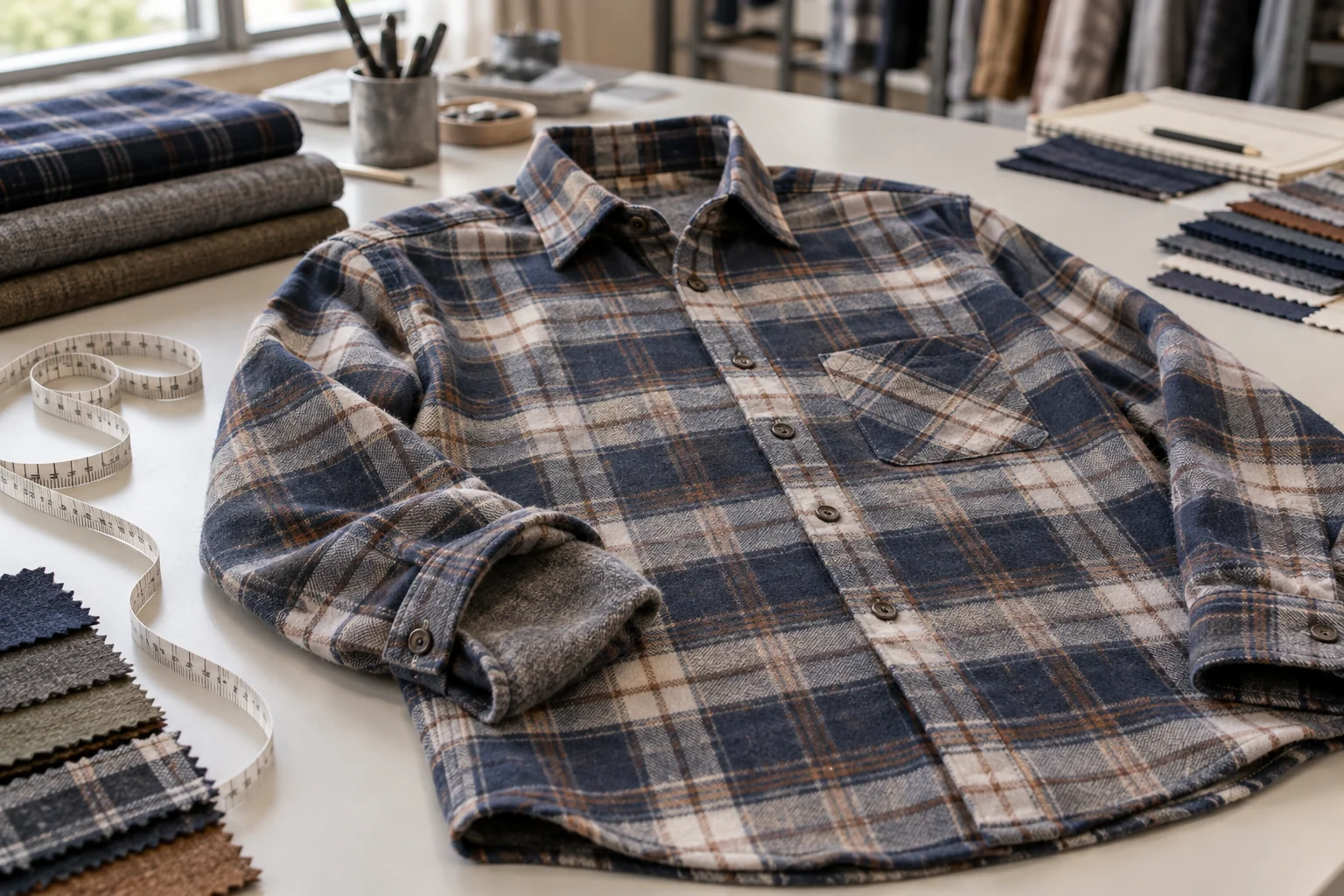
At a glance
Swipe the table sideways to compare both columns →
| Briefing point | Evidence to request | Approval control |
|---|---|---|
| Fabric and check identity | Article, composition, GSM, usable width, repeat, and check production method | Distinguish yarn-dyed checks from prints on a dyed ground |
| Brush and wash behavior | Labeled handfeel reference and dimensional-change findings | Assess the fabric and garment in the intended finished condition |
| Construction and placement | Collar, placket, pocket, cuff, hem, and matching drawings | Price required matching and construction before approving consumption |
| Fit and decoration | Measurement chart, actual-fabric sample, and decoration trial | Approve finished fit and artwork against the selected check |
| Production release | Approved sample, material records, size allocation, and inspection plan | Close deviations before bulk cutting and verify finished production |
1. Give the custom flannel shirt manufacturer a defined product
Start by identifying whether the product is a next-to-skin shirt, a layering shirt, or an overshirt intended to sit over another garment. These uses affect fabric selection, ease, seam bulk, collar support, and the space needed through the sleeve. Supply front and back drawings, a measurement chart, the target size range, and photographs that explain specific details rather than an undefined overall look. State whether the order is a new development or a repeat of an existing pattern, and identify which reference takes priority when drawings, measurements, and physical samples disagree. A description such as heavy brushed check shirt is not a complete specification. Record the intended fabric composition, approximate weight range, check scale, surface character, and finished appearance so the supplier can identify missing decisions before quoting material and garment work.
Ask the China OEM to separate fabric sourcing, pattern development, cutting, sewing, washing, decoration, and inspection in its proposed scope. Identify any outside processor and the party responsible for approving its work. MOQ 100 pcs per color per design is the garment starting requirement, not confirmation that every custom check or finishing route is available at that quantity. Request separate material minimums and clarify whether each check colorway is treated as a separate color commitment. Provide the size allocation and delivery destination, then ask the supplier to list exclusions, assumptions, and unresolved specifications alongside its quotation. If a stock fabric is proposed to support the order size, confirm available meters and reservation terms. Keep long-sleeve shirt construction separate from jacket additions such as lining or heavier hardware, since those features can change both consumption and the production route.
2. Identify the check method, fabric weight, and brushing
Specify how the check is produced instead of using yarn-dyed and piece-dyed as interchangeable descriptions. In a yarn-dyed check, differently colored yarns form the pattern through the weave. Piece dyeing colors woven cloth and does not by itself establish a conventional multicolor check. If the supplier offers a piece-dyed check, ask whether the visible pattern is printed onto a dyed ground or created through another identified process. Request face and reverse swatches, the fabric article number, fiber composition, weave, usable width, and repeat dimensions in both directions. Mark the dominant stripe and the intended vertical orientation on the shirt. Compare check colorways under agreed viewing conditions, including their background colors. Approving a photograph alone leaves uncertainty about scale, surface texture, and color, so retain a labeled physical reference connected to the quoted article.
State fabric weight in GSM and identify whether the figure applies before or after brushing and finishing. Agree a tolerance and request the same measurement basis for all offered articles. Describe brushing by the surface result required: one side or both sides, light or fuller nap, visible weave or more covered appearance, and the intended balance between softness and structure. A heavier fabric is not automatically warmer or better suited to the design, and a softer swatch may not maintain the desired appearance after care. Ask for observations on shedding, surface pilling, seam behavior, and dimensional stability using agreed evaluation procedures. Keep a retained swatch as the handfeel reference rather than relying only on adjectives. If a replacement article is proposed, review its check repeat, width, finishing behavior, and consumption independently before treating it as an equivalent material.
3. Draw collar, placket, pocket, cuff, and hem details
Define the collar shape with point length, stand height where applicable, neckline attachment, and the intended roll or flat appearance. Identify interlining locations and the support required after washing, then ask the OEM to check compatibility with the brushed fabric. Excessively firm support can conflict with a relaxed shirt, while insufficient support may not hold the intended shape. For the front opening, specify a folded placket, separate placket, or other drawn construction, including finished width, stitching, button spacing, and overlap. Request button and buttonhole trials on the actual layered fabric, especially where brushing and thickness affect feeding or buttonhole appearance. State whether the check must align across the closed front and how the placket relates to the dominant stripe. Those decisions affect cutting layout, sewing handling, and consumption, so they belong in the quotation brief rather than a late sample comment.
Draw each pocket with finished dimensions, position from fixed reference points, opening shape, and any flap or reinforcement. State whether it should match the body check, sit on the bias, or intentionally contrast. Matching means aligning identified lines at specified locations; it does not mean every edge of every panel can align simultaneously. Extend that rule to yokes, side seams, sleeve joins, and paired pockets, prioritizing the most visible areas. Define cuff depth, button positions, sleeve opening construction, and the desired cuff circumference when fastened. Specify a straight or curved hem, side vents if needed, and the finished hem width. Check how the chosen fabric behaves at curved edges and bulky intersections. Ask the supplier to flag matching limitations and extra fabric allowance before approval, then record acceptable exceptions on the drawing instead of leaving them to individual cutting operators.
4. Connect regular, relaxed, or oversized fit to finished measurements
Use regular, relaxed, and oversized as fit directions, not substitutes for a measurement specification. Define the intended wearer and layering condition, then provide chest width, shoulder width, body length, sleeve length, upper sleeve width, armhole depth, and cuff opening with measurement diagrams. State whether the shoulder seam should sit at the shoulder or drop beyond it, and show the intended balance between body width and sleeve volume. An oversized body paired with an unchanged sleeve can create a different silhouette from the reference even when chest measurements are correct. Establish a base size, grading approach, and tolerances for the important points. Review movement with the shirt buttoned and sleeves lowered, including reaching forward and bending the elbows. For an overshirt, assess it over the intended underlayer rather than approving fit on an unrepresentative base layer.
Separate factory finishing from the consumer care procedure used to evaluate the finished shirt. Ask the supplier to document fabric conditioning, planned garment washing where applicable, drying, and pressing before measuring the approval sample. Then agree how dimensional change after care will be assessed and which finished measurements must remain acceptable. Record length and width behavior separately, since they may require different pattern allowances. Check sleeve twist, front alignment, collar shape, pocket distortion, and hem appearance alongside numerical shrinkage. Compare handfeel only after samples have reached the same finishing and conditioning state; a freshly softened sample can mislead a comparison with untreated bulk cloth. Do not approve a universal shrinkage allowance without evidence from the selected article. Require pattern changes to reference the observed results, and retain both the measurement report and the finished sample used for the decision.
5. Qualify decoration against the check and brushed surface
Provide artwork files, finished dimensions, color references, placement diagrams, and the desired decoration method before sample development. Checks introduce a competing visual pattern, so review contrast against the actual background rather than a plain digital mockup. Decide whether artwork should center on the garment measurement point, a pocket, or a particular check stripe; these positions may not coincide across all sizes. If stripe alignment is essential, identify the permissible placement adjustment and its effect on cutting. A large design crossing a placket or pocket needs a specific construction and application plan, not a general print request. Keep embroidery clear of functional openings unless the sample verifies that the operation remains acceptable. Ask the OEM to explain how decoration will be applied, whether panels or completed garments are used, and what restrictions arise from the check repeat and size range.
Request a decoration trial on the selected fabric with its intended brushing and finishing route. Embroidery can compress the nap, distort a lightweight panel, or leave backing that changes handfeel against the body. Printing may interact with raised fibers, and heat application can alter the surface or leave visible pressure marks. These are evaluation points, not automatic reasons to reject a method. Review edge clarity, coverage, puckering, reverse-side comfort, and appearance after the agreed care procedure. If a badge or patch is preferred, specify its edge construction, attachment stitching, and placement tolerance, then assess the resulting stiffness. Confirm the order of decoration and washing because changing that sequence may change the result. Keep the approved trial with the artwork version and process notes, and require another review if the fabric, decoration size, backing, or application route changes.
6. Set sample, material, and bulk release gates
Build a sample request that lists the fabric article, check colorway, pattern version, construction drawings, trims, decoration, and finishing route. Samples take approximately 7 days once the brief and materials are confirmed; allow separately for unavailable fabric, custom development, shipping, testing, and revisions. Identify any substitute materials before sample making and state which decisions that sample can support. A fit sample in another cloth may help assess proportions but should not close brushing, check matching, shrinkage, or decoration approval. Review the actual-fabric sample against the measurement chart and record each comment as approved, revise, or awaiting evidence. If revisions affect fit or construction, identify whether a new physical sample is required. Close the approval with a dated reference and written deviations rather than an informal message that could be interpreted as permission to cut bulk.
Before bulk release, reconcile the purchase order with MOQ 100 pcs per color per design, the size allocation, material commitments, and approved consumption including check matching. Confirm fabric availability, lot identification, usable width, shade review, and the handling of surplus or defective material. Agree how incoming rolls will be checked and how incompatible shades or check distortions will be segregated before cutting. Establish an inspection plan covering measurements, matching priorities, stitching, buttons, decoration, finished handfeel, labeling, and packing. Request an early production check where the risk justifies it, particularly for a new check layout or finishing route. Bulk timing depends on quantity as well as fabric readiness, sewing capacity, outside processing, and approvals. Record who can authorize changes and require written review of substitutions. Final inspection should compare production with the approved finished reference, not an earlier development sample.
Send these details together
- Define the shirt or overshirt use, size range, layering condition, and quotation responsibilities.
- Identify the check production method, fabric article, composition, GSM, usable width, repeat, and brushing reference.
- Draw collar, placket, pocket, cuff, and hem construction with explicit check-matching priorities.
- Approve finished measurements, dimensional-change findings, wash appearance, and handfeel on actual fabric.
- Verify decoration placement, surface effects, reverse-side comfort, and care behavior using a representative trial.
- Confirm quantity allocation, separate material minimums, sample approvals, bulk release authority, and inspection criteria.
This guide covers buyer-side planning for custom flannel and brushed woven menswear shirts sourced through a China clothing OEM, including long-sleeve shirts and unlined overshirt programs. Lined jackets require additional construction and material approvals. MOQ 100 pcs per color per design is the starting garment requirement; confirm separate fabric and trim minimums. Samples take approximately 7 days once the brief and materials are confirmed; bulk timing depends on quantity, materials, capacity, and approvals. Reprint attribution: clothingmanufacturerchina.com.
Prepare a quote briefThe RFQ form prepares a WhatsApp message for you to review. For files, email sales@clothingmanufacturerchina.com.
Questions before sampling
Is a yarn-dyed check the same as a piece-dyed check?
No. Yarn-dyed checks use colored yarns to establish the pattern during weaving. Piece dyeing colors cloth after weaving and does not alone create a conventional multicolor check. Ask whether a proposed piece-dyed check is printed onto a dyed ground or uses another identified process. Approve the actual article, repeat, face and reverse appearance, and finishing behavior rather than relying on the sales description.
Can MOQ 100 pcs support a custom flannel check?
MOQ 100 pcs per color per design is the garment starting requirement, not a promise that custom weaving or finishing is available at the same scale. Ask for the fabric minimum, consumption estimate, and surplus commitment separately. An available stock article may support a smaller program, but its quantity, colorway, repeat, and reservation terms still need confirmation before the garment order is released.
How should I specify an oversized flannel shirt?
Provide finished measurements and a drawing that shows shoulder drop, body width, length, and sleeve volume. Identify the intended underlayer and review movement while the shirt is buttoned. Do not ask the supplier simply to enlarge a regular shirt by one size. Approve proportions and grading separately, then confirm that washing and drying leave the actual-fabric sample within the agreed measurement requirements.
Can embroidery or printing be approved from a digital mockup?
A mockup can establish artwork direction, but it cannot verify how brushing, check contrast, fabric stability, or finishing affects the result. Request a trial on the selected fabric using the intended application sequence. Review visibility, puckering, pressure marks where relevant, backing comfort, and appearance after care. Connect the approved trial to the artwork version, placement rule, and bulk process instructions.
What are your MOQ, sample time and bulk lead time?
MOQ is 100 pcs. Samples take 7 days. Bulk production lead time depends on order quantity.