How to Evaluate Private Label Clothing Factories
Understanding how to evaluate private label clothing factories means checking whether production evidence supports the proposed menswear program. Review the actual manufacturing site, follow material and pattern records through production, and test whether quality controls work beyond a prepared sample. Use MOQ 100 pcs per color per design as the garment planning basis while checking separate material and component minimums. Samples take approximately 7 days once the brief and materials are confirmed; bulk timing depends on quantity, material readiness, capacity, and approvals. Document findings, unresolved risks, and release conditions rather than treating a factory tour or completed questionnaire as proof of readiness.
At a glance
Swipe the table sideways to compare both columns →
| Evaluation area | Evidence to examine | Release condition |
|---|---|---|
| Site and operation capability | Order-relevant equipment, operator demonstrations, site identity, and subcontractor records | Confirm where each required operation will run and who controls changes |
| Material and specification control | Receiving records, lot identification, current patterns, and issued work instructions | Trace approved inputs and versions into a production bundle |
| Capacity at opening quantities | Quantity matrix, material minimums, line allocation, and bottleneck schedule | Validate feasibility at MOQ 100 pcs per color per design |
| Sample discipline | Sample register, material status, measurement reports, and revision history | Separate development approval from authorization to cut bulk |
| QC and corrective action | Inspection records, held goods, defect investigation, and reinspection evidence | Verify that failures trigger containment and documented closure |
1. Establish how to evaluate private label clothing factories
Begin with an evaluation brief that names the menswear products, construction demands, materials, size range, and intended order structure. A factory capable of making basic jersey tops may not have the same control over structured overshirts, tailored waistbands, or lined jackets. Convert your specification into operations that can be observed: cutting slippery fabrics, matching stripes, attaching collars, setting sleeves, securing buttons, or pressing finished garments. Request the legal seller, manufacturing address, sample room location, and any outside processing sites before arranging the review. State whether evidence will be collected through an on-site visit, a live remote walkthrough, document review, or a combination. Each method has limits. A remote review can show selected processes but may not establish the completeness of inventory or reveal unshown production areas. Record those limitations rather than giving every checked box equal evidential weight.
Keep this evaluation separate from the commercial decisions around it. Use /how-to-shortlist-private-label-clothing-manufacturers to narrow the initial supplier pool, then investigate whether the remaining candidates can execute the proposed work. Use /how-to-compare-private-label-clothing-manufacturers when you need to compare offers and decide how verified strengths and remaining risks affect an award. The broader sourcing decision belongs alongside /how-to-choose-private-label-apparel-manufacturer. During evaluation, classify each finding as observed, supported by records, claimed but unverified, or not applicable. Ask for recent examples relevant to your product rather than large collections of unrelated certificates or presentation slides. Other customers' confidential details can be removed while preserving dates, process steps, and issue histories. Your report should explain what evidence supports the finding, which production scope it covers, and what must happen before release. This prevents a persuasive presentation from becoming an undocumented capability approval.
2. Verify the site and the operations your order needs
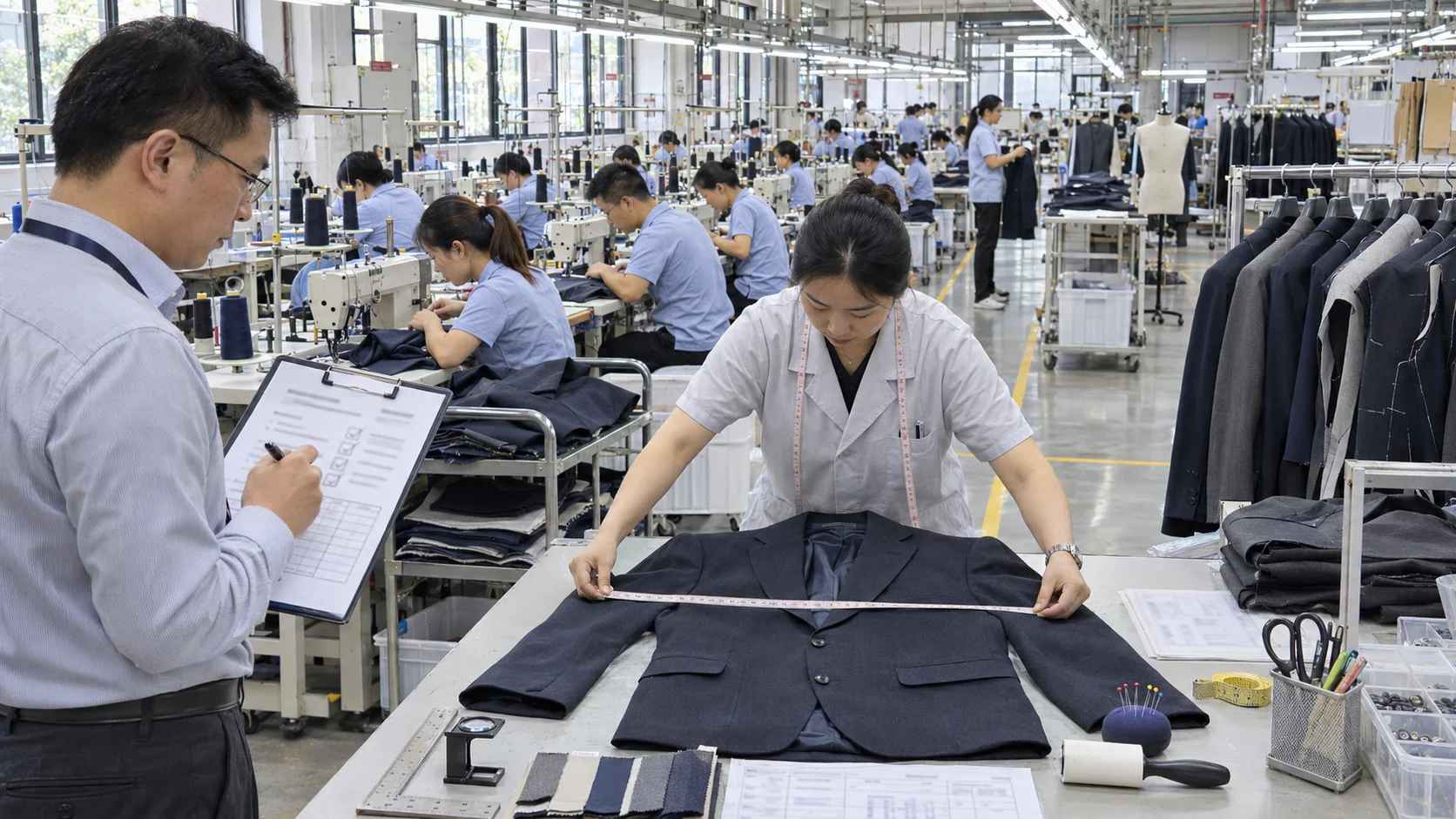
Walk the proposed route from material receiving through cutting, sewing, finishing, inspection, and packing. Compare the observed site with the address and responsibility matrix supplied before the visit. Ask the production manager to explain where your garment would enter the schedule and which operations would leave the premises. Equipment lists are useful starting points, but machine ownership alone does not establish operator skill, maintenance condition, or availability for your order. Request demonstrations on comparable materials and construction, with attention to difficult seams, attachment points, and pressing requirements. Check whether workstations have the necessary guides, folders, lighting, and current instructions. Where an operation is not running during the visit, record it as unobserved and request another form of evidence. Do not turn an idle machine into a positive capability finding simply because the factory says it is available.
For subcontracted embroidery, printing, washing, specialized sewing, or finishing, identify the processor and examine how work is issued and received back. Request a job record showing quantities sent, material or bundle identity, approved references, returned quantities, and acceptance checks. A competent outside processor can be part of a controlled production route; the concern is unapproved substitution or work that disappears from the main factory's records. Ask who can authorize a site change and whether the buyer is notified before goods move. Also review working conditions, emergency access, material storage, and any buyer-required labor or environmental checks within the evaluator's competence. A short production visit does not establish full legal or social compliance. Note where qualified independent review is needed. The report should distinguish observed operating conditions from specialist conclusions and should not imply that a clean sample room represents every production location.
3. Trace materials and specifications into work in progress
Select a current production bundle and ask the factory to trace it backward to the fabric receipt, approved article, cutting record, and issued specification. Then follow the same identity forward into inspection and packing records where available. This exercise tests whether documents describe a working system rather than a collection prepared for the visit. Review fabric lot separation, shade grouping, storage protection, trim identification, and the handling of short deliveries or damaged goods. For stretch fabrics, brushed surfaces, or materials sensitive to heat, ask how the factory establishes relevant cutting, sewing, and finishing conditions. Examine actual records rather than accepting a generic statement that all fabric is inspected. The depth of receiving checks should match the product risk and purchasing agreement. If identity is lost after cutting, record the gap and assess how affected garments would be located if a material problem emerged.
Check how the approved tech pack, bill of materials, pattern version, measurement method, and label artwork reach the people doing the work. Ask an operator or line supervisor to show the current instruction and explain what happens when a revision arrives. Compare that version with the sample room and quality department copies. Private label clothing manufacturers may maintain several similar styles at once, so handwritten style names without revision identifiers are weak protection against mix-ups. Review access to buyer artwork and the process for withdrawing obsolete labels or packaging. Ownership, confidentiality, and permitted reuse still require contractual terms; file control does not settle those rights. For care, fiber, origin, and other required label content, identify the buyer's compliance reviewer and the supplier's implementation responsibility. A placement check verifies execution, not whether the wording is legally sufficient for the destination market.
4. Test capacity realism at MOQ 100
Use MOQ 100 pcs per color per design as the garment planning basis, then submit the actual style, color, and size matrix for review. Ask the factory to show how that mix would move through purchasing, cutting, line setup, sewing, finishing, and packing. A small order can involve substantial setup work when it contains several constructions, material types, or branded components. Separate garment minimums from fabric dyeing, custom labels, buttons, printing, and packaging commitments. Request the quantities that must be purchased, the portion expected to enter garments, and responsibility for unused stock. Check whether the quotation depends on shared materials or existing components and how availability is confirmed. Do not assume that several designs can share one minimum because they use the same fabric. Feasibility should be demonstrated for the proposed matrix, including sizes and any finishing variants, before accepting an order schedule.
Ask the planner to explain capacity using the proposed line, operator skills, competing bookings, and the slowest required operations. Factory-wide monthly output is not a reliable schedule for a mixed menswear order. Request a dependency-based plan showing material arrival, sample approval, cutting release, sewing allocation, outside processing, inspection, and packing. Check whether the same people or equipment are counted across simultaneous commitments, particularly in sample rooms and specialized operations. Where the schedule relies on overtime, temporary labor, or another site, record that assumption and the buyer approval needed. Bulk timing depends on quantity as well as material readiness, capacity, and approval speed. Ask what changes if one fabric lot arrives late or a preproduction sample fails. A credible planner should identify which milestones move and which work can safely continue, rather than offering an unconditional completion date unsupported by resource allocation.
5. Audit sample discipline and approval boundaries
Review a sample register covering request receipt, specification status, material availability, assigned maker, submission, comments, and revisions. Samples take approximately 7 days once the brief and materials are confirmed, but that allowance is not a promise for an entire development cycle. Custom fabric, unavailable trims, outside processing, shipping, and buyer revisions need separate time. Ask the factory to identify what starts its sample clock and what pauses it. Inspect whether each sample carries a style identifier, size, pattern version, material status, and submission purpose. A substitute-fabric fit sample can support selected shape decisions without approving final shrinkage, drape, or pressing behavior. Compare sample measurements with the submitted report and check that both use the same measurement conditions. If the report cannot be reproduced, investigate the method before treating it as evidence of fit control or consistent development work.
Follow one revised style from buyer comments to the next submission. Look for a clear record of the requested change, the responsible person, the updated pattern or instruction, and verification that the correction was made without introducing another problem. Ask how the factory transfers sample-room knowledge to the bulk line, especially when highly skilled sample makers use methods that production operators cannot repeat at the planned pace. Before bulk cutting, require an approved preproduction reference using the intended materials and manufacturing route wherever their behavior matters. Connect approval to the current bill of materials, measurements, construction details, labels, and packing instructions. Keep fit, appearance, performance, and packaging decisions explicit. An unresolved trim should have a named hold point rather than disappearing into a general approval email. Silence after a submission is not authorization to cut, and a successful first sample does not establish production readiness.
6. Verify QC systems and close findings before release
Evaluate quality control as a sequence of decisions, not just a final inspection station. Ask how incoming checks, first-piece review, in-line inspection, finishing checks, and final inspection relate to the product's known risks. Review records across different dates, sizes, and operations rather than one completed form. Check measurement methods, instrument condition, defect descriptions, escalation rules, and identification of goods awaiting a decision. Request an example where production was stopped or affected goods were held, then follow the investigation, correction, and reinspection. Repeated defects with no change to instructions or process settings suggest that inspection is detecting problems without preventing recurrence. Agree product-specific acceptance criteria and any sampling plan before production. A passing final inspection applies to the defined inspection scope; it is not proof that every garment is defect-free or that untested performance and labeling requirements have been satisfied.
Close the review with a finding register that names the evidence, affected process, risk, responsible owner, due date, and required closure proof. Separate conditions that must be resolved before cutting from checks that belong at sewing start, finishing, or shipment release. For example, an unidentified fabric lot may block cutting, while an incomplete carton marking approval can block packing without necessarily stopping approved sewing. Verify corrective actions through records, repeat demonstrations, or follow-up inspection appropriate to the issue. Do not close a finding solely because a manager promises improvement. Preserve unresolved limitations in the purchasing documents and require written approval for material, site, and process substitutions. When the evidence supports proceeding, use /private-label-clothing-manufacturer to submit the defined menswear program with its quantity matrix and approval requirements. The next step should be a controlled production discussion, not an assumption that evaluation removes all manufacturing risk.
Send these details together
- Define the menswear program, review methods, production sites, and limits of the evidence collected.
- Observe order-relevant operations and document the identity, responsibilities, and change controls of subcontractors.
- Trace a production bundle to approved materials, current specifications, and downstream inspection records.
- Validate MOQ 100 pcs per color per design against size allocations, component minimums, resource bookings, and bottlenecks.
- Check approximately 7-day sample assumptions, revision records, measurement methods, and explicit preproduction release gates.
- Verify defect containment and corrective-action closure, then assign unresolved findings to specific production hold points.
This guide covers buyer-side evidence review of China private label clothing factories for menswear programs, including site capability, traceability, capacity planning, sample discipline, and quality control. It supports operational evaluation rather than initial supplier filtering or commercial award scoring. MOQ 100 pcs per color per design is the garment planning basis; confirm size allocations and separate material and component minimums. Samples take approximately 7 days once the brief and materials are confirmed; bulk timing depends on quantity, material readiness, capacity, and approvals. A production review does not replace contractual, destination-market compliance, or specialist labor and environmental review. Reprint attribution: clothingmanufacturerchina.com.
Prepare a quote briefThe RFQ form prepares a WhatsApp message for you to review. For files, email sales@clothingmanufacturerchina.com.
Questions before sampling
Can a remote factory evaluation replace an on-site visit?
A remote evaluation can verify selected operations, review records, and test whether staff can trace an order through production. It offers less visibility into unshown areas, total inventory, and daily working conditions. Record what was observed live, what was supplied as a document, and what remains unverified. Use an on-site or independent follow-up where the unresolved risk could affect production release.
What evidence shows that a factory can handle MOQ 100?
Request a plan for your actual designs, colors, and sizes rather than a general statement about small orders. The plan should reconcile MOQ 100 pcs per color per design with fabric and trim minimums, setup requirements, line allocation, and outside processing. Ask who owns surplus components and what happens if one input is delayed. Feasibility depends on the complete order structure.
Does an approximately 7-day sample prove bulk capability?
No. Samples take approximately 7 days once the brief and materials are confirmed, but speed alone does not establish repeatability. Check material identity, measurements, revision history, and whether the sample method can transfer to the bulk line. A sample room may use different operators or techniques. Bulk readiness requires approved specifications, available inputs, realistic capacity, and a documented production release decision.
Which factory findings should block production release?
Block the affected stage when an unresolved issue prevents controlled execution or meaningful acceptance. Examples include unidentified fabric before cutting, an unapproved pattern version, missing authority for subcontracting, or no method to isolate defective goods. Not every finding must stop every operation. Assign stage-specific hold points, owners, and closure evidence, and document which unaffected work the buyer has explicitly authorized to continue.
What are your MOQ, sample time and bulk lead time?
MOQ is 100 pcs. Samples take 7 days. Bulk production lead time depends on order quantity.