How to Shortlist Private Label Clothing Manufacturers
How to shortlist private label clothing manufacturers starts with a consistent request for information and evidence tied to your actual menswear program. Establish who sells, manufactures, sources trims, and approves changes before paying for development. Use MOQ 100 pcs per color per design as the garment planning basis, then check size allocation and branding readiness. Samples take approximately 7 days once the brief and materials are confirmed; bulk timing depends on quantity. Release only a controlled shortlist, then move those factories into a compare scorecard or open the private label clothing manufacturer lander.
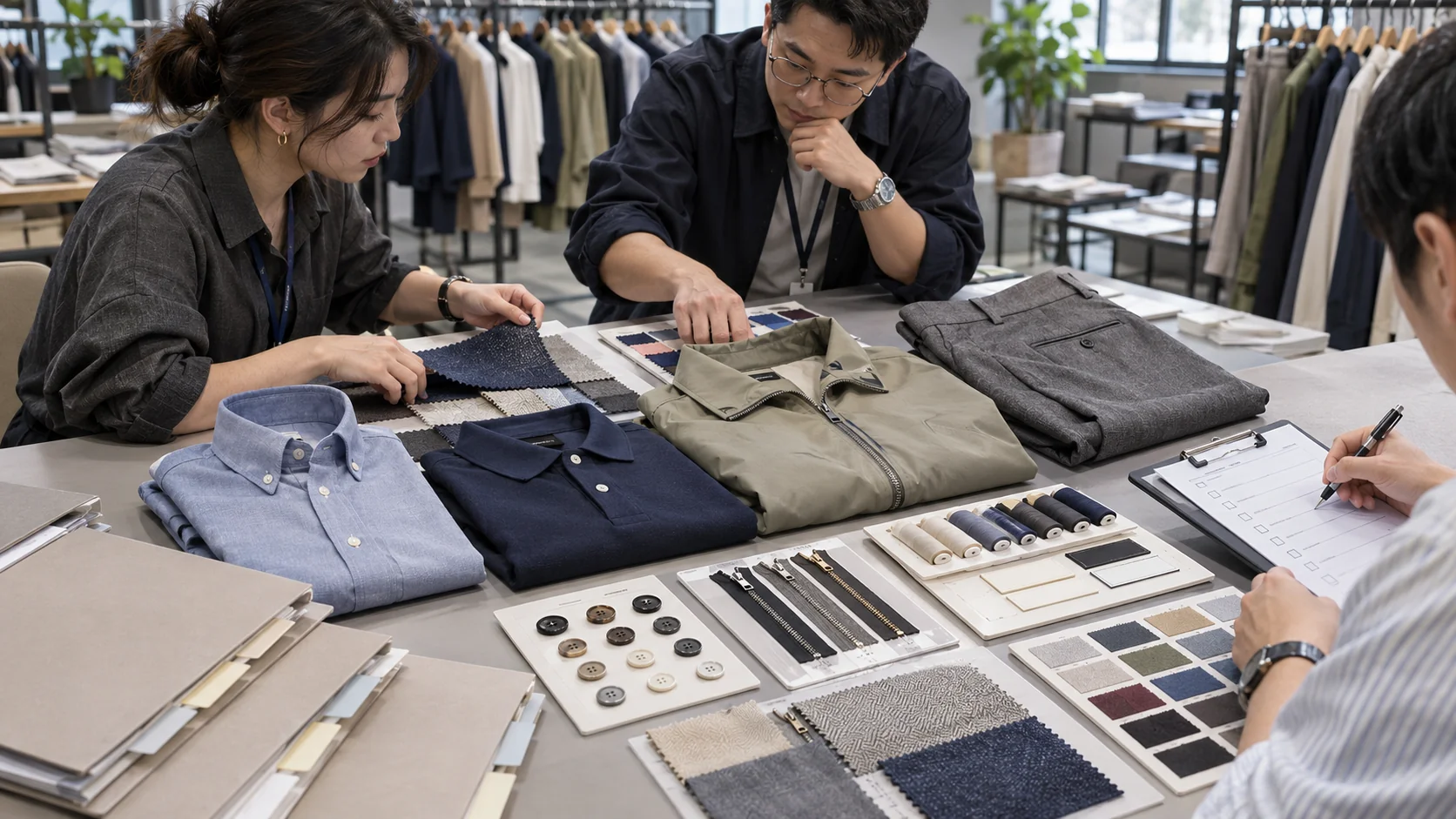
At a glance
Swipe the table sideways to compare both columns →
| Shortlist gate | Evidence to request | Decision or control |
|---|---|---|
| Business and production roles | Legal seller details, named production sites, subcontracting scope, and approval responsibilities | Distinguish factory, trader, and mixed models without assuming any model proves capability |
| Relevant garment capability | Comparable construction samples, operation details, and sample-to-site traceability | Advance evidence relevant to the proposed menswear category |
| Branding and trim readiness | Component register, artwork requirements, vendor status, minimums, and approval route | Separate available components from unconfirmed sourcing promises |
| Quantity and size-run feasibility | Style-color-size matrix, fabric allocation, trim minimums, and grading coverage | Confirm feasibility at MOQ 100 pcs per color per design |
| Development readiness | RFI responses, unresolved-item register, sample purpose, and approval dependencies | Assign advance, hold, or decline status before commissioning samples |
1. How to shortlist private label clothing manufacturers with one RFI
Begin with a request for information that makes suppliers answer the same production questions against the same brief. State the menswear categories, intended selling market, construction features, branding scope, quantity matrix, and target delivery window. Identify whether you need development from a sketch, adaptation of an existing block, or execution of supplied patterns. Attach a controlled reference pack rather than sending different photos to each contact. Ask respondents to identify what they can confirm now, what requires a sample, and what depends on another vendor. Request the legal seller, production locations, proposed sourcing route, and the person responsible for technical responses. Keep the initial exercise focused on eligibility rather than negotiating the lowest unit price. A supplier that has misunderstood the product or excluded essential operations cannot provide a useful quotation, even when its response arrives quickly and looks complete.
Structure the RFI so every material answer has an evidence field, an owner, and a status. For example, ask which site will sew the proposed shirt, what comparable construction it currently handles, and what record or sample supports that answer. Ask whether labels are stocked, purchased against artwork, or dependent on an unconfirmed vendor. Separate statements such as available in principle from commitments backed by an identified material or component. Give suppliers a response date, but allow them to flag genuine dependencies instead of encouraging unsupported promises. Collect missing information in one follow-up request so the process does not become an indefinite exchange of messages. Use the /private-label-clothing-manufacturer page to frame the service scope, then verify the proposed arrangement through the RFI. A service description helps orient the inquiry; it does not establish capacity, ownership rights, or readiness for your specific order.
2. Filter factory and trader claims through responsibility records
Ask who will sign the sales contract, receive payment, develop samples, purchase materials, cut and sew garments, and resolve quality claims. A trading business may coordinate capable factories, while a manufacturer may subcontract particular operations or use a separate export entity. Neither arrangement should be accepted or rejected solely because of its label. The shortlist question is whether the proposed structure is visible, accountable, and suitable for your controls. Request the legal business name and registration information, then reconcile those details with the quotation, payment instructions, and named production sites. Where entities differ, ask for the commercial relationship and each party's responsibility in writing. Do not treat a workshop photograph or a factory address as proof that the seller controls that site. Record who can authorize substitutions, change subcontractors, and stop production when the approved specification is not being followed.
Use a targeted site discussion to test the claimed arrangement rather than requesting a generic company tour. Ask the supplier to walk through the operations relevant to your product, identify which equipment and teams will be used, and explain where outsourced work leaves and returns. A live walkthrough or visit can support this review, but it is not a substitute for records connecting your project to the proposed site. Ask how sample instructions reach bulk production and who retains the approved reference. If the seller declines to disclose a subcontractor, establish whether an acceptable confidential verification route is possible before advancing it. Place unresolved site identity, unexplained payment changes, or conflicting responsibility statements on hold. The aim is not to exclude every intermediary; it is to avoid commissioning development through a party that cannot establish who will execute the work or enforce agreed changes.
3. Build an evidence matrix around the proposed garments
Translate the brief into a small set of capability gates before reviewing supplier presentations. For woven shirts, relevant evidence might include collar construction, placket consistency, seam appearance, and control of checks or stripes when applicable. For knit tops, focus on fabric behavior, neckline stability, seam stretch, and dimensional control. For trousers, examine waistband construction, pocket assembly, fastening attachment, and the proposed fit development route. Do not assume strength in one category establishes competence across all menswear. Ask for comparable samples with enough context to identify the material, construction, development purpose, and production site. Suppliers should remove other customers' confidential information rather than disclose protected files to satisfy your request. Where photographs are the only available evidence, record their limits explicitly. They may demonstrate an operation's appearance but cannot establish handfeel, internal workmanship, measurement consistency, or repeatability across a production run.
Give each matrix entry a requirement, evidence reference, review date, reviewer, and disposition. Use clear statuses such as verified for shortlisting, clarification required, and not demonstrated. Keep essential gates separate from preferences so a polished presentation cannot compensate for an unidentified production site or an infeasible quantity. Record contradictions as well as missing answers: a claimed in-house process that later appears on a subcontractor list needs reconciliation. Check whether the sample evidence actually relates to the quoted service, rather than a different facility or a discontinued product route. This matrix is an eligibility tool, not a final commercial ranking or an inspection report. Its purpose is to decide which suppliers deserve further technical review and development spending. Preserve the original response alongside subsequent clarifications so the buyer can see when a proposal changed and whether that change affects any earlier shortlist decision.
4. Check branding readiness beyond logo application
Create a component register covering main labels, size labels, care labels, hangtags, closures, drawcords, packaging, and any decorative branding required by the design. For each component, request the proposed material, dimensions, attachment method, artwork format, sourcing status, minimum quantity, and approval owner. Separate stock items that can be identified now from custom components that still need vendor confirmation. A supplier may be ready to sew a garment while its branding route remains unresolved. Ask which components affect construction sequence, finishing, skin contact, or garment care so those items enter development early. Review destination-market labeling requirements separately from visual branding approval, using qualified advice where needed. A correct logo does not validate fiber content, care wording, origin statements, or other required information. Mark components as provisional until the underlying specification and purchasing responsibility are clear enough to support a meaningful development plan.
Ask how the supplier controls artwork versions and prevents obsolete components from entering samples or bulk goods. Request a named approval route from buyer artwork through vendor proof, physical submission, purchasing release, and incoming checks. Establish ownership and permitted reuse of graphics, tooling, unused labels, and rejected branded goods before commissioning custom items. A sample payment should not be treated as an automatic transfer of every associated right. Check whether custom closures or packaging create commitments above the opening garment quantity, and ask who pays for, stores, and disposes of the balance. If the supplier proposes generic trims for the first sample, specify what that sample can prove and what remains unapproved. Keep a supplier on hold when branding feasibility depends on unnamed vendors, unknown minimums, or open-ended substitution rights. These gaps can change both the economics and the identity of the finished product.
5. Validate the size run at the garment minimum
Use MOQ 100 pcs per color per design as the starting garment commitment, then submit a complete size allocation for each style and color. Do not assume quantities can be pooled across silhouettes, fabrics, or finishes merely because they share a brand label. Ask the supplier to confirm how it classifies each variation and whether any size has an additional production constraint. For example, a proposed 100-piece allocation could distribute 10, 25, 30, 25, and 10 garments across five sizes, but that is only an illustration until the supplier accepts it. Request confirmation that the pattern and grading scope covers every ordered size, including any extended sizes. Identify size-specific trims, labels, or construction changes that could create separate purchasing requirements. A garment-level minimum is useful only when the complete size run can be cut, assembled, labeled, and packed as specified without undisclosed exceptions.
Reconcile the accepted size matrix with fabric consumption, usable width, available stock, cutting arrangements, and component purchases. Ask whether the proposed cloth is reserved inventory, shared stock, or made to order, and what evidence supports availability for development and bulk. Include sampling consumption and anticipated material loss in the discussion without imposing an invented universal allowance. Request a clear account of surplus materials and any commitment required to secure them. Also ask how the supplier will review grading before bulk: an approved base-size sample alone does not demonstrate the fit of every size. Establish which additional sizes will be sampled or measured and why they are informative for the proposed range. Place the supplier on hold if feasibility rests on changing the size allocation, substituting fabric, or dropping custom trims without buyer approval. Confirm these constraints before treating the opening-order quantity as commercially workable.
6. Release a shortlist with explicit next-step conditions
Close the RFI by assigning each candidate an advance, hold, or decline status with a short evidence-based reason. Advance means the supplier has cleared the defined eligibility gates and may proceed to a controlled development step. Hold means a specific question remains unresolved, with an owner and a deadline for the missing evidence. Decline means the current proposal does not meet an essential requirement; it need not imply that the supplier is unsuitable for every other program. Share the relevant unresolved points with each candidate rather than asking for another general presentation. Internally, preserve the matrix, supporting files, and decision record so another buyer can understand why the shortlist was formed. Avoid turning this stage into a full price comparison or launch plan. Those tasks follow once the remaining candidates are responding to a sufficiently consistent and feasible production scope.
For each advancing supplier, issue a sample brief that states the purpose, material condition, size, branding status, deliverables, and review owner. Samples take approximately 7 days once the brief and materials are confirmed, but custom sourcing, transit, testing, and revisions require separate allowances. Ask when those starting conditions will actually be satisfied rather than counting from the first inquiry. Bulk timing depends on quantity as well as material readiness, capacity, and approvals, so request a dependency-based schedule instead of an unconditional shipment date. Define what the next decision will require, such as a measurement report, construction review, trim confirmation, or an actual-material sample. Make clear that shortlist acceptance and sample approval do not themselves authorize bulk cutting. The final shortlist should leave the buyer with a manageable set of accountable candidates and a precise plan for resolving the remaining technical and commercial uncertainties. Next action: move the 2-3 remaining factories into a compare scorecard, or submit a sample brief through /private-label-clothing-manufacturer.
Send these details together
- Issue the same controlled RFI, product references, quantity matrix, and evidence requests to every candidate.
- Reconcile the legal seller, payment entity, sample room, manufacturing sites, and subcontractor responsibilities.
- Record relevant construction evidence against essential gates, with review dates and unresolved claims.
- Confirm branding specifications, vendor readiness, component minimums, artwork controls, and ownership terms.
- Validate MOQ 100 pcs per color per design against the full size allocation, grading scope, and material commitments.
- Assign advance, hold, or decline status and define a limited sample brief before spending on development.
This guide covers initial buyer-side shortlisting of China private label menswear suppliers through RFIs, production-role verification, evidence screening, branding readiness, and size-run checks. It prepares a controlled shortlist for later comparison and does not replace the private label clothing manufacturer lander. Reprint attribution: clothingmanufacturerchina.com.
Prepare a quote briefThe RFQ form prepares a WhatsApp message for you to review. For files, email sales@clothingmanufacturerchina.com.
Questions before sampling
What should an initial RFI ask when you shortlist private label clothing manufacturers?
Ask for the legal seller, proposed production sites, subcontracting scope, relevant garment capability, material sourcing route, branding services, and quantity constraints. Supply the same product brief and size matrix to each candidate. Require evidence references and distinguish confirmed answers from assumptions. The objective is to establish eligibility for further review, not to obtain a final price from an incomplete specification.
Should a buyer exclude traders from the shortlist?
Not automatically. A trader may provide useful coordination, while a factory may also outsource operations. Verify who performs the work, who controls changes, and who accepts contractual responsibility. Request a clear relationship between the seller and production sites. Keep the candidate on hold if site identity, payment arrangements, or authority to resolve quality issues remains unexplained.
Can an order of 100 pieces include multiple sizes?
Use MOQ 100 pcs per color per design as the planning basis, then request written acceptance of the proposed size allocation. Do not assume every distribution is feasible or that different designs can share one minimum. Check grading coverage, size-specific components, fabric consumption, and separate material minimums. The accepted matrix should identify any exceptions before sampling or purchasing commitments begin.
Does being shortlisted mean a supplier is approved for bulk production?
No. Shortlisting means the supplier has met initial eligibility requirements and can proceed to a defined development or verification step. Bulk approval requires additional decisions tied to the agreed specification, materials, fit, branding, production route, and purchasing terms. State the limits of each approval explicitly. Neither an RFI acceptance nor payment for a sample should authorize bulk cutting by implication.
When should a shortlist move into a compare scorecard?
After roles, relevant evidence, branding readiness, and size-run feasibility are documented for a small set of factories. Comparing then scores ownership, fit rights, category routes, sample gates, and QC on matched packs. Do not score every RFI respondent.
What are your MOQ, sample time and bulk lead time?
MOQ is 100 pcs. Samples take 7 days. Bulk production lead time depends on order quantity.