Private Label Clothing Sample Approval Checklist
A private label clothing sample approval checklist should connect the finished garment to controlled fit, branded components, care information, and packing instructions before bulk production starts. Separate a visual review from authorization to purchase components, cut fabric, or ship goods. Plan around MOQ 100 pcs per color per design, with fabric and component lead times confirmed before approval. Samples take approximately 7 days once the brief and materials are confirmed; bulk timing depends on quantity. When a gate fails, return to the brief or open /private-label-clothing-manufacturer with the blocked sample record.
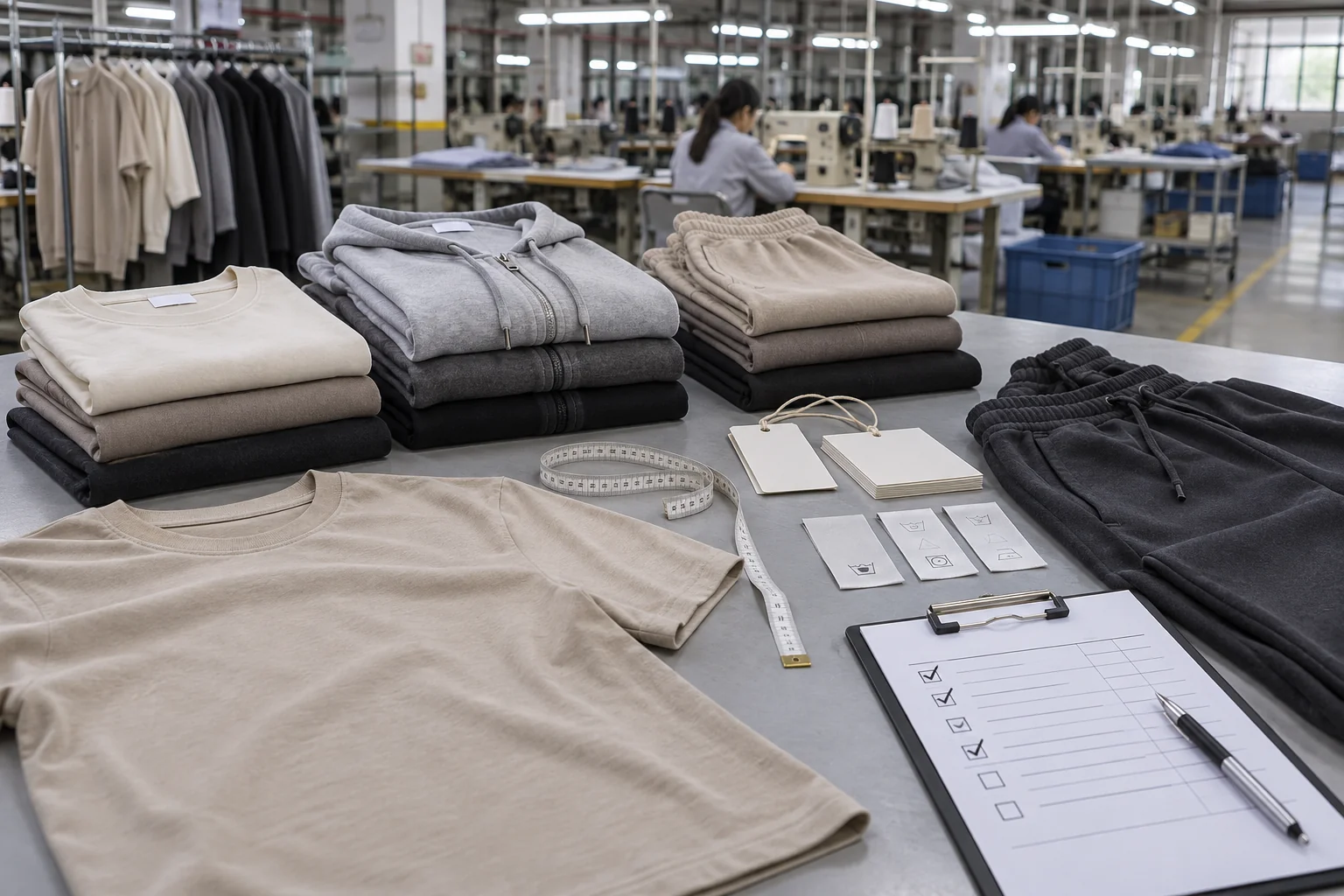
At a glance
Swipe the table sideways to compare both columns →
| Approval area | Evidence to review | Release condition |
|---|---|---|
| Sample identity and fit | Sample register, pattern revision, measurement report, and fitting notes | Approve the stated material, finished condition, and reviewed size scope |
| Branding components | Actual labels, artwork revisions, placement diagrams, and attachment samples | Resolve appearance, attachment, substitution, and reuse permissions |
| Care and product information | Fiber records, care rationale, destination requirements, and label proofs | Obtain content approval separately from visual label approval |
| Retail and transit packing | Packed garment, SKU mapping, barcode checks, and carton instructions | Confirm garment protection and accurate product identification |
| Preproduction release | Actual-material sample, closed comments, current specification, and signed release | State what may proceed and what remains on hold |
1. Define the private label clothing sample approval checklist record
Start with a sample register that identifies what has arrived and what decision the supplier is requesting. Record the style code, color, size, sample stage, fabric article, pattern revision, component versions, and finishing condition. Include photographs of the garment and its identifying tags, but do not use photographs as a replacement for physical examination. A sample carrying your logo may still use substitute fabric, temporary labels, or a provisional pattern. Require those exceptions to appear in the register before review begins. Assign separate decision owners for fit, branding, label content, and packing so that one approval cannot silently close another team's concerns. For service boundaries, refer to /private-label-clothing-manufacturer, then define the actual deliverables in the purchase documents. This checklist concerns acceptance of those deliverables, rather than preparation of the initial OEM brief or a general review of sewing workmanship.
Set approval statuses that distinguish accepted, accepted for a limited purpose, revise and resubmit, and rejected. Each status should name the affected item and the work it permits. For example, accepting a woven label's color does not authorize its wording, garment placement, or bulk purchase quantity. Keep comments in one controlled record rather than scattering final decisions across messages and annotated photographs. Number each issue, identify the required correction, assign an owner, and state what evidence will close it. Where several reviewers disagree, the buyer should issue one consolidated instruction instead of asking production staff to choose between comments. Retain superseded records for traceability, but mark them clearly as obsolete. Do not treat sample delivery, payment of a development charge, or a buyer's silence as approval. The supplier should acknowledge the current record and confirm which activities remain blocked.
2. Approve fit in the intended finished condition
Measure the garment against the current specification after the intended washing, pressing, or other finishing process. State how the garment should be conditioned, laid out, and measured, including whether elasticated areas are relaxed or extended. Check the points that control the intended menswear silhouette rather than relying only on chest and length. Depending on the product, these may include shoulder position, armhole depth, sleeve shape, collar opening, rise, seat, thigh, and leg opening. Record actual measurements beside tolerances and distinguish a measurement failure from a fit preference. A garment can measure within tolerance yet restrict movement or hang incorrectly. Conduct a fitting on the agreed body reference and review sitting, reaching, fastening, and pocket access where relevant. Record the sample size and wearer reference so later reviewers can understand the basis of the decision without assuming every size was examined.
Separate pattern corrections from fabric or finishing problems before requesting another sample. If a knit top twists after washing or a trouser waistband changes dimensions, ask whether the cause is material behavior, cutting direction, construction, or finishing before changing the pattern. A correction made in the wrong place can create a new defect when production conditions change. Record the approved pattern revision, measurement specification, and any shrinkage allowances used by the factory. Review an agreed selection of sizes to assess grading, especially where the range includes materially different proportions. Approval of the base size alone should not imply approval of the entire size range. A substitute-material fitting sample can support a limited silhouette decision, but it cannot establish final drape, recovery, shrinkage, or comfort. Keep those items open until an actual-material garment has completed the intended production route and been reviewed.
3. Check actual branding components and attachment
Review branded components as physical production items, not only as artwork files. List neck labels, size tabs, patches, prints, embroidery, buttons, zipper pulls, hangtags, and packaging marks that apply to the style. Match each item to its approved artwork revision, dimensions, colors, material, and supplier reference where available. Examine small lettering, logo proportions, edge finishing, and the visibility of any backing or adhesive. Check the component on the garment because a satisfactory loose label may feel uncomfortable at the neck or distort a lightweight seam. Record placement from defined garment reference points rather than using instructions such as center neatly. For prints and embroidery, confirm scale and placement across the agreed size range. Identify any decoration process that changes the fabric's appearance, handfeel, or dimensions, and review its result after the intended care process before closing approval of that item.
Confirm how each component is attached and when that operation occurs. A patch added before garment washing may behave differently from one applied afterward, while a label trapped in a seam may require a construction change to move. Ask the supplier to demonstrate the intended attachment method on the preproduction garment, including reinforcement, thread, backing, and any visible stitch pattern. Where attachment security or repeated-care performance matters, agree an appropriate evaluation method and acceptance criteria instead of relying on a hand pull or appearance alone. Keep physical approval separate from permissions to use the brand asset. Document whether rejected components, surplus labels, and decorated overruns must be returned, destroyed, or held for an authorized repeat order. Prohibit unapproved substitutions and define who can release replacement components. A visually similar label should not become an automatic alternative when the approved version is unavailable.
4. Verify care labels and product information
Treat care and product information as a content approval stream with its own evidence and reviewer. Collect the intended selling markets, fiber composition records, origin information, responsible business details where required, and the proposed care instructions. Requirements vary by destination and product, so ask a qualified compliance reviewer to determine which statements, languages, symbols, and placement rules apply. Do not approve a familiar-looking label simply because it resembles one used on another order. Check consistency between the main fabric, relevant secondary materials, supplier declarations, and any supporting test reports. If a claim cannot be supported, leave it unresolved rather than allowing the label vendor to fill the gap. Assign responsibility for final wording to a named party and record the approved text separately from the artwork proof. This makes later content changes visible even when the label layout appears unchanged.
Evaluate whether the proposed care instructions suit the complete garment, including decoration, interlinings, elastic, trims, and color combinations. A fabric supplier's recommendation alone may not address an assembled product with multiple components. Use appropriate garment evaluations to investigate dimensional change, appearance, color transfer, or component damage under the proposed care route, with methods and acceptance criteria agreed for the program. Then review the physical label for legibility, comfort, attachment, placement, and durability appropriate to its purpose. Verify size markings against the buyer's size system and check that label variants map correctly to each style, color, and size. Keep market-specific versions identifiable to prevent mixed packing. If testing or legal review is still pending, a layout approval may proceed only with explicit limits. Do not authorize printing or sewing in final labels until the relevant content dependencies have been closed in writing.
5. Approve packing and quantity mapping
Request one fully packed sample that shows the garment exactly as the receiving warehouse or retail customer will encounter it. Review folding dimensions, tissue or inserts where specified, protective measures for hardware, hangtag position, fasteners, bag dimensions, and visible product identification. Check whether the packing method creases the garment, compresses decoration, or allows trims to mark adjacent fabric. Confirm that all required packaging warnings and market-specific information have been reviewed for the intended destination. Where barcodes are used, check both readability and the encoded value against the buyer's SKU record; a readable code can still identify the wrong product. Match the garment's size and color to its label, hangtag, bag sticker, and carton allocation. Photograph the approved packing sequence and retain the actual packaging references. A bag mockup alone does not approve the packed garment or the final shipping configuration.
Reconcile the packing plan with MOQ 100 pcs per color per design and the accepted size allocation. The garment minimum does not establish minimum quantities for custom bags, hangtags, woven labels, or printed cartons. Ask for separate component commitments, expected development consumption, and the treatment of surplus stock. Decide whether spare packaging will be delivered, stored, or disposed of, and identify who owns it. Review carton assortment rules, maximum handling limits, carton markings, and any destination warehouse instructions before finalizing the pack list template. If styles or sizes must remain separated, state that requirement explicitly rather than relying on a sample carton. Define how shortages, approved overages, and replacement units will affect SKU records and documents. A late quantity change should trigger a review of labels and packing materials, not only an update to the garment total on the purchase order.
6. Release preproduction and control subsequent changes
Build the final preproduction review around a garment made from the intended bulk materials and components through the intended construction and finishing route. Link it to the current bill of materials, pattern revision, measurement report, artwork files, label content, and packing instructions. Recheck previously corrected issues instead of assuming that resubmission means they were resolved. Samples take approximately 7 days once the brief and materials are confirmed, but this is a planning allowance for sample preparation, not the duration of an entire approval cycle. Custom components, testing, transport, and revisions require separate allowances. Bulk timing depends on quantity, material readiness, capacity, and approvals. Ask the factory to identify the latest approval dates that support its proposed schedule. If a deadline is missed, request a revised plan rather than letting urgency convert unresolved sample details into presumed acceptance of bulk production.
Issue a written release that names the approved sample and specification revision, lists any accepted deviations, and defines the activities authorized. Separate permission to purchase materials from permission to cut, decorate, assemble, pack, or ship. If limited work is allowed before full approval, identify the exposure, responsible party, and hold point for the remaining work. Keep matching sealed references with the buyer and production team, supported by accessible records for any subcontractor performing controlled operations. Require renewed review when a change affects fit, appearance, label content, packing, or performance, even if the supplier considers the replacement equivalent. Finally, connect sample approval to the bulk inspection plan, including checks across sizes, colors, production lots, and packed units. An approved preproduction sample establishes the reference; it does not prove that every bulk garment conforms or remove the need for inspection and corrective action.
Send these details together
- Register each sample against its style, size, material, pattern revision, component versions, and requested approval purpose.
- Review finished measurements, functional fit, grading coverage, and unresolved effects of substitute materials.
- Approve actual branding components, placement, attachment, performance checks, and surplus or rejected-stock handling.
- Obtain separate approval for care information, fiber and origin statements, size markings, and destination-specific label content.
- Approve a fully packed garment and reconcile SKU mapping, carton instructions, and separate packaging minimums.
- Release preproduction in writing with closed comments, named references, permitted activities, hold points, and change-control requirements.
This guide covers sample acceptance for China private label menswear programs using a private label clothing sample approval checklist for fit, branding components, care labels, packing, and preproduction release. It supports, and does not replace, the private label clothing manufacturer lander. Reprint attribution: clothingmanufacturerchina.com.
Prepare a quote briefThe RFQ form prepares a WhatsApp message for you to review. For files, email sales@clothingmanufacturerchina.com.
Questions before sampling
Can a private label clothing sample be approved with temporary labels?
Yes, but only for a stated purpose such as fit or construction review. Temporary labels do not establish final wording, comfort, appearance, attachment, or durability. Record the substitution and keep branding and label-content approvals open. Before releasing the affected production operations, review the actual components and their application on the intended garment, with any remaining limitations documented.
Does the approximately 7-day sample timing include every approval round?
No. Samples take approximately 7 days once the brief and materials are confirmed, but revisions, custom components, testing, buyer review, and transport can add separate time. Ask which sample stage the estimate covers and what inputs must already be available. Build the schedule around explicit review gates rather than treating one sample preparation estimate as the full development timeline.
Does MOQ 100 pcs per color per design include custom packaging minimums?
Not automatically. MOQ 100 pcs per color per design is the garment planning basis, while custom labels, hangtags, bags, and cartons may have separate purchasing minimums. Request a component quantity schedule showing order consumption, development use, and expected surplus. Agree who pays for and owns leftovers, how they will be stored, and whether they can be used for later orders.
Is an approved preproduction sample sufficient to authorize shipment?
No. Preproduction approval establishes the agreed production reference and permits only the activities named in the release. Shipment should follow the purchase order's inspection, packing, documentation, and release requirements. Bulk goods can differ from the reference through substitutions, process variation, or packing errors. Keep shipment authorization separate and define how nonconforming goods will be held, corrected, and reviewed again.
What are your MOQ, sample time and bulk lead time?
MOQ is 100 pcs. Samples take 7 days. Bulk production lead time depends on order quantity.