Clothing Size Grading: From Base Fit to Size Set
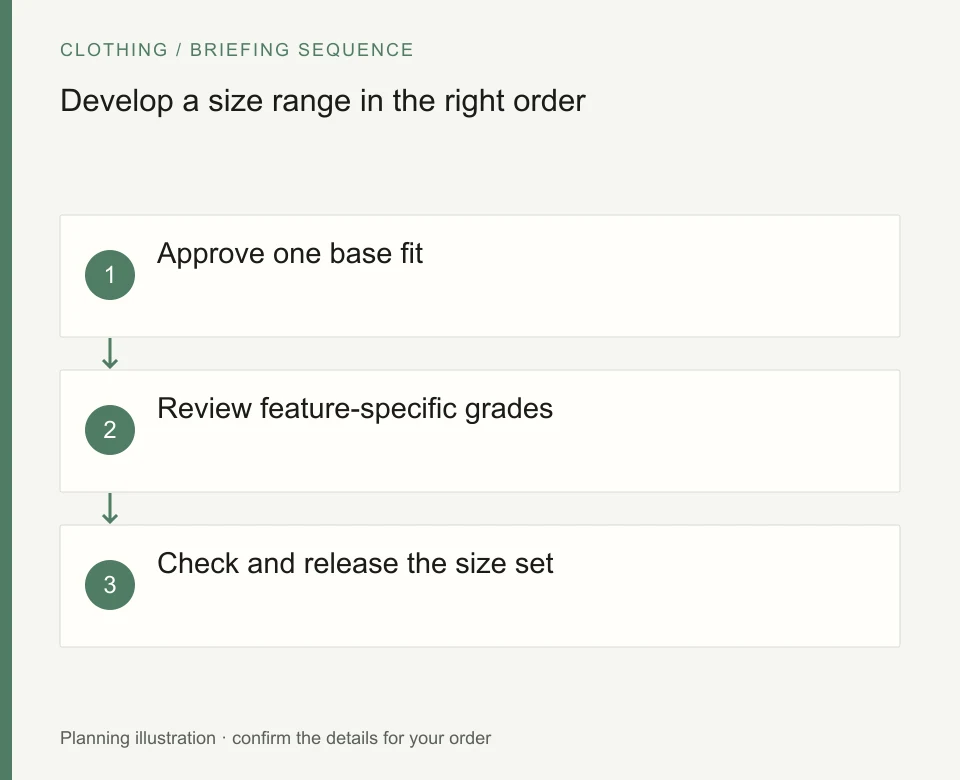
Size grading develops a garment pattern across a size range. It is not simply adding the same amount to every measurement. Begin with a base fit that works, define how key dimensions should change, and check the resulting proportions on more than the middle size before releasing bulk production.
At a glance
Swipe the table sideways to compare both columns →
| Decision | What to specify | What to verify |
|---|---|---|
| Base size | Approved fit and material reference | Do not grade an unresolved fit problem. |
| Grade rules | Dimension-specific changes across the range | Check related measurements and decoration placement. |
| Size set | Physical review against the graded chart | Record proportion issues as well as numeric deviations. |
Keep body measurements and garment measurements distinct
A customer body chart describes the intended wearer; a finished garment chart describes the product. The difference includes design ease and the way a garment is meant to sit. Label each chart clearly. Copying body chest measurements directly into flat garment widths can create both a unit error and a fit problem that later sample comments will not easily untangle.
Choose a base size and document its approved measurement points. For menswear, chest or waist alone cannot establish the fit: shoulder, rise, sleeve, body length and opening dimensions may be equally important. State how each point is measured. If the material or finish changes, confirm that the base fit remains valid before extending the revised pattern to other sizes.
Review grading rules by feature
Ask for the proposed size chart and grade increments, then review related dimensions together. A wider body without a considered sleeve and armhole can feel unbalanced. A larger trouser waist does not automatically tell you the right seat or thigh allowance. Treat grade rules as a development proposal to assess, not a universal formula that works for every silhouette.
Decide whether artwork, pockets and brand labels stay a fixed size or scale with the garment. Their placement references may need to change even when the artwork itself does not. Review shorter and longer proportions especially carefully for cropped tops, oversized tees and coordinated sets. Do not let decorative elements migrate simply because the pattern edge used as a reference moved.
Use the size set to find proportion problems
Agree which sizes need physical samples and why. The ends of a range can expose issues hidden by the base size, while an intermediate size may reveal an unexpected jump. Measure the samples against the graded chart, then evaluate movement and appearance on suitable fit references. A numeric pass alone does not show whether the garment sits as intended.
Record corrections by size and measurement point, and check whether each correction requires a rule change or a local pattern adjustment. Reissue the chart after approval and keep its version linked to the pattern and sample set. For a reorder, use that approved range rather than rebuilding sizes from a retail size label such as large, which is not a technical specification.
Send these details together
- Clearly separated body and garment charts
- Approved base size with point-of-measure diagrams
- Proposed grade increments and size range
- Artwork and pocket scaling or placement rules
- Reviewed size set and final chart version
Use this checklist to prepare your own order brief. Materials, processes, acceptance criteria and any applicable product requirements need order-specific confirmation; this guide is not a test report or availability guarantee.
Prepare a quote briefThe RFQ form prepares a WhatsApp message for you to review. For files, email sales@clothingmanufacturerchina.com.
Questions before sampling
What are your MOQ, sample time and bulk lead time?
MOQ is 100 pcs. Samples take 7 days. Bulk production lead time depends on order quantity.