Clothing Manufacturers China: How to Brief Custom OEM
A buyer brief for clothing manufacturers China sourcing teams approach should turn a menswear range into separate, executable style specifications. Define whether tees, fleece, cargos, and jackets require new development or changes to existing blocks. Connect measurement instructions, fabric references, decoration files, and packaging requirements to a controlled revision. Plan around MOQ 100 pcs per color per design, with material and component minimums checked separately. Samples take approximately 7 days once the brief and materials are confirmed; bulk timing depends on quantity, material readiness, capacity, and approvals. Use explicit sample gates so unresolved choices do not become production assumptions.
At a glance
Swipe the table sideways to compare both columns →
| Brief component | Information to supply | Decision or control |
|---|---|---|
| Service and category scope | Style register, development route, supplied assets, and responsibility matrix | Separate new OEM development from existing-block private label work |
| Measurements and construction | Point-of-measure diagrams, finished dimensions, tolerances, and seam details | Identify the pattern version and measurement condition for each style |
| Fabric and components | Article references, performance priorities, color targets, and trim schedule | Approve substitutions separately from the original specification |
| Decoration readiness | Production artwork, dimensions, placement, color references, and process request | Approve application on the intended substrate before garment release |
| Quantities and sample gates | Style-color-size matrix, material minimums, sample purpose, and approval owner | Confirm feasibility at 100 pcs per color per design and document release |
1. Clothing Manufacturers China: define the brief before development
Start with a range register rather than a folder of disconnected inspiration images. Give every tee, fleece style, cargo, and jacket a unique style code, intended use, target selling market, size range, color list, and development status. State which garments share a fit direction or material, but do not assume that shared styling means shared production instructions. A jersey tee, brushed sweatshirt, woven cargo, and lined jacket need different construction and approval details. Include front and back drawings plus views of pockets, closures, linings, and other features that cannot be understood from the exterior. For buyers entering through /custom-clothing-manufacturer, this register should be the starting attachment to the inquiry. It lets the factory identify missing information by style instead of answering a broad request for custom menswear. Mark unresolved choices openly and assign an owner and response date to each one.
Define the development route for each style before requesting samples. OEM work may involve manufacturing from buyer-supplied patterns, developing a new pattern from measurements, or adapting an agreed reference. Private label work may start from an existing garment or house block with changes to branding, color, fabric, or details. These descriptions can overlap, so list the actual deliverables rather than relying on the service label. Specify who supplies drawings, patterns, graded measurements, fabrics, decoration artwork, labels, and packaging instructions. Record which existing features must remain unchanged and which are open to factory proposals. Agree access, permitted reuse, and delivery terms for buyer-funded patterns and artwork separately; a sample payment does not establish those rights by itself. Ask the supplier to return a written interpretation of the brief, with exclusions and assumptions, before development begins. This is a scope confirmation, not a supplier-ranking exercise.
2. Make fit references and construction instructions measurable
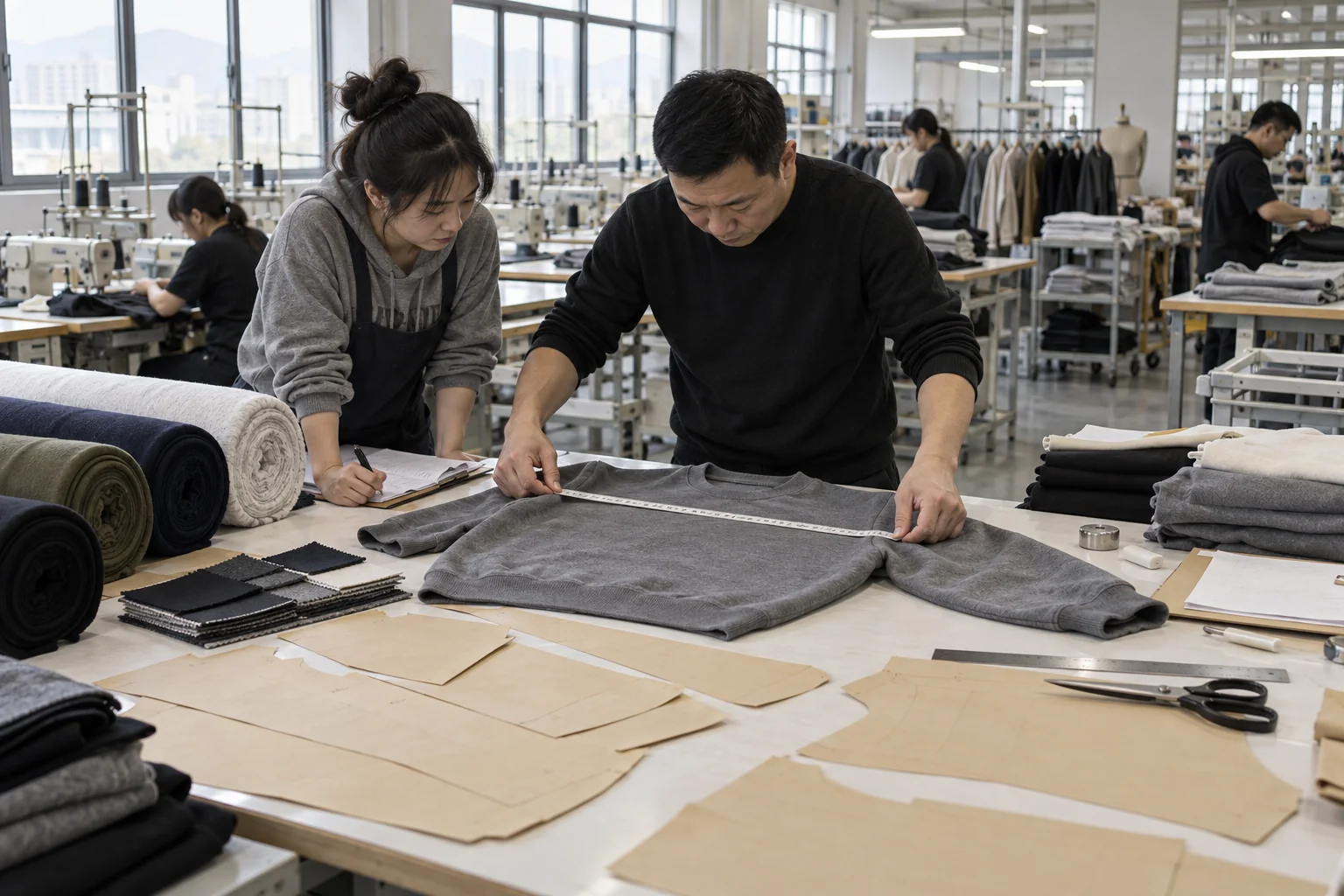
Send a measurement specification that describes the finished garment, not just the body measurements of the intended customer. Identify the base size, units, points of measure, tolerances, and measurement condition. Show whether widths are measured flat, how curved seams are followed, and whether elasticated areas are relaxed or extended. For tees and fleece, define chest, body length, shoulder, sleeve, neckline, and relevant rib dimensions. For cargos, include waist condition, rise, hip, thigh, inseam, and leg opening, with pocket positions referenced to fixed garment points. For jackets, define closure position during measuring, lining considerations, and the intended layering allowance. Do not copy one tolerance across every point without reviewing its effect on fit and assembly. Ask the factory to flag conflicts between the drawings, measurement table, and reference garment before making a pattern. Record the agreed resolution in the specification rather than leaving it in chat.
Treat a physical reference as evidence with specific instructions, not as a complete production standard. Tag the garment with a reference number and describe which features are relevant: shoulder shape, pocket volume, hood depth, sleeve balance, or overall ease. State what must not be copied, including unwanted construction or branding. Add close-up drawings for seam finishes, reinforcement, pocket openings, zipper guards, drawcord exits, and lining attachments where applicable. Identify whether the supplied reference has already been washed or worn, since its current dimensions may not represent an original production size. Request a base-size sample report showing actual measurements and deviations against the current specification. Then review an agreed size selection before accepting grading. Pattern corrections, grading changes, and shrinkage allowances should remain distinguishable in the revision record. A satisfactory base-size fitting does not establish that the smallest and largest sizes will preserve the intended proportions.
3. Connect fabric references to category-specific requirements
Describe fabric through an identified article or a structured sourcing request. Include composition, knit or weave construction, weight and measurement condition, usable width where known, surface finish, stretch direction, color target, and intended garment treatment. A swatch labeled soft black cotton leaves important decisions unresolved. For tees, clarify opacity, drape, neckline recovery expectations, and whether the surface will carry decoration. For fleece, distinguish brushed or unbrushed interiors and specify how body fabric and rib should coordinate. For cargos, describe the balance of structure, mobility, and pocket support. For jackets, identify shell, lining, and any insulation as separate materials with separate references. State performance priorities and request proposed evaluation methods and acceptance criteria rather than assuming that a fabric name proves suitability. If the article is not selected, label the specification as a sourcing target and keep material approval open until the actual proposal is reviewed.
Build a component schedule alongside the fabric specification so trims are not chosen after the garment has been sampled. List rib, pocketing, interlining, zippers, buttons, snaps, elastic, cords, labels, and packaging where used. Record dimensions, color references, attachment details, approval status, and whether each component is buyer-supplied or factory-sourced. Check compatibility with the intended washing, pressing, and decoration sequence; a trim that looks correct before processing may behave differently afterward. Ask whether materials are reserved stock, available shared stock, or made to order, and identify any separate purchasing minimums. Specify how substitutions must be submitted, including a comparison sample and the effects on cost, schedule, appearance, and measurements. Similar composition or weight alone is not approval for replacement. Keep an approved swatch set linked to article and color references, and require incoming material records that allow the sampled material to be connected to bulk cutting.
4. Separate decoration intent from production-ready instructions
Create a decoration schedule for every printed, embroidered, patched, or otherwise branded area. Assign an artwork identifier and revision, then state finished dimensions, color references, process preference, and placement measured from defined seams or garment points. Indicate whether placement stays constant across sizes or follows a size-specific rule. A centered graphic in a presentation mockup is not a measurable placement instruction. Supply editable production artwork where appropriate, with fonts converted or otherwise provided under permitted use, and identify any image files that are only visual references. Explain whether the design requires a particular texture, coverage, handfeel, or relationship to seams and pockets. Ask the factory to identify technical constraints before changing artwork. Simplifying embroidery detail, altering print dimensions, or moving a graphic away from a seam should be a submitted proposal, not an undocumented production adjustment made because the original file was difficult to execute.
Approve decoration on the intended fabric and color whenever substrate behavior matters. A print on white jersey does not establish its appearance or handfeel on dark fleece, and a loose embroidery swatch does not show distortion on an assembled pocket. Request strike-offs or stitch-outs that identify the artwork revision, substrate, application method, and relevant backing or preparation. Review color, edge definition, coverage, surface feel, puckering, and placement feasibility, then agree any necessary care or durability evaluation. State whether decoration occurs before assembly, after assembly, or around a garment finishing process, because sequence can affect access and appearance. Keep decoration approval separate from fit approval, while requiring the final preproduction garment to demonstrate both together. Include label text and placement in the same controlled file system, but review destination-market fiber, care, origin, and other required information separately. Approval of visual branding does not establish labeling compliance.
5. Reconcile the quantity matrix with material and schedule limits
Use MOQ 100 pcs per color per design as the garment planning basis and submit quantities in a style-color-size matrix. Do not combine tees, fleece, cargos, and jackets into one total and expect that total to establish feasibility for every line. Identify distinct decoration versions, fabric changes, and finish variants, then ask how the supplier classifies them for minimums. Show the size allocation rather than assuming it can be settled after cutting plans are prepared. Keep fabric, dyeing, trims, decoration setup, and packaging commitments separate from garment quantities. A small garment order may still require excess purchased material or branded components. Ask for the proposed handling of surplus, including ownership, storage, permitted use, and disposal. If available stock is proposed to support the opening order, approve its exact identity and discuss replenishment limitations. Do not let a minimum-order compromise silently change the product specification.
Request a schedule tied to decision points and material readiness rather than a single delivery promise. Samples take approximately 7 days once the brief and materials are confirmed, but this is not an allowance for an entire development cycle. Custom fabric, unavailable trims, decoration trials, shipping, buyer review, and revisions need separate planning. Bulk timing depends on quantity as well as material availability, production capacity, construction complexity, and approvals. For a mixed-category range, ask which styles can progress independently and which depend on shared fabrics, components, or decoration resources. Name the buyer contact authorized to resolve questions and define a response window that the schedule can accommodate. Record the effect of late changes before accepting them. If a jacket remains unresolved while tees are approved, document whether partial production or split shipment is permitted, including packing, storage, and commercial responsibilities. Keep target dates distinct from confirmed production bookings.
6. Use narrow sample approvals and a controlled bulk release
Define what each submission is intended to prove before it is made. A development sample may test silhouette and assembly; a fit sample may establish measurements; a decoration trial may resolve application; and a preproduction garment should connect the approved elements. These purposes can share one submission only when the relevant materials and processes are present. Identify substitute fabrics or temporary trims on the sample tag and in the review report. Do not approve final shrinkage, handfeel, decoration behavior, or finished appearance from a sample that cannot demonstrate them. Review each submission against a numbered specification revision, record actual measurements, and consolidate comments into one response. Separate required corrections from optional suggestions. State which decisions are accepted, rejected, or pending, with a named owner for each unresolved item. Approval of sleeve length must not be interpreted as approval of fabric color, pocket construction, or label wording.
Release bulk through a written record that identifies the style, quantity matrix, bill of materials, pattern revision, measurements, decoration files, color references, and packing instructions. Approve an actual-material preproduction garment through the intended assembly and finishing route, with any exceptions explicitly listed. Decide what work, if any, may proceed while an exception remains open; permission to reserve fabric is not permission to cut. Keep matching retained references with the buyer and factory, and make the current approved files accessible to the production team. Withdraw superseded versions rather than relying on email chronology. Attach inspection expectations covering category-specific construction, measurements, decoration, labeling, and packing, with agreed acceptance criteria and corrective-action responsibilities. Require renewed review when substitutions or process changes affect the approved result. The completed brief should allow production staff to distinguish a deliberate requirement from an unresolved preference without reconstructing the buyer's earlier conversations.
Send these details together
- Create a style register for tees, fleece, cargos, and jackets, with development routes, responsibilities, and unresolved decisions.
- Issue finished-garment measurements, point-of-measure diagrams, tolerances, construction details, and reference garment instructions.
- Identify fabrics and components, sourcing status, performance priorities, substitution rules, and separate purchasing minimums.
- Supply controlled decoration artwork, measurable placement, application requirements, and actual-substrate approval requests.
- Confirm MOQ 100 pcs per color per design, size allocations, surplus ownership, and a schedule tied to material and approval readiness.
- Define sample purposes, approximately 7-day starting assumptions, revision control, retained references, and written bulk release.
This guide covers preparation of a buyer brief for custom menswear production in China, including tees, fleece, cargos, and jackets. It addresses OEM and private label service boundaries, technical references, decoration readiness, quantities, and approval records rather than supplier vetting or shortlisting. MOQ 100 pcs per color per design is the garment planning basis; confirm size allocation and separate fabric, trim, and packaging minimums. Samples take approximately 7 days once the brief and materials are confirmed; bulk timing depends on quantity, material readiness, capacity, and approvals. Pattern rights, contractual responsibilities, and destination-market compliance require separate review. Reprint attribution: clothingmanufacturerchina.com.
Prepare a quote briefThe RFQ form prepares a WhatsApp message for you to review. For files, email sales@clothingmanufacturerchina.com.
Questions before sampling
Can I brief a custom clothing manufacturer with only reference photos?
Photos can communicate direction, but they usually leave measurements, fabric identity, internal construction, and finishing unresolved. Mark the features to retain or change, then add a style code, finished-garment measurement table, material request, and decoration instructions. Ask the factory to list remaining assumptions before sampling. If technical development is part of the service, define its deliverables and approval responsibilities explicitly.
Can tees, fleece, cargos, and jackets share one technical brief?
They can share a range register, branding rules, and file-control system, but each style needs its own executable specification. Category-specific measurements, fabrics, construction, and processing should remain identifiable. Shared components should reference the same approved article rather than separate informal descriptions. Use a style-color-size matrix to connect the range, while keeping sample decisions and bulk release status separate for each design.
Does MOQ 100 pcs apply to the whole menswear order?
Plan on MOQ 100 pcs per color per design, not one combined quantity across the range. Ask the supplier how decoration changes, fabric variants, and finishes affect that classification. Fabric, trim, and packaging minimums may create additional purchasing commitments even when garment quantities qualify. Confirm the size allocation and responsibility for surplus materials before treating the quantity matrix as accepted.
Does an approximately 7-day sample mean bulk can start immediately afterward?
No. Samples take approximately 7 days once the brief and materials are confirmed, and the submission may address only one development question. Buyer review, revisions, actual-material trials, grading checks, and preproduction approval can require additional time. Bulk should start only after the agreed release conditions are met. Bulk timing depends on quantity, material readiness, production capacity, and the remaining approval workload.
What are your MOQ, sample time and bulk lead time?
MOQ is 100 pcs. Samples take 7 days. Bulk production lead time depends on order quantity.