Custom Jacket Tech Pack: Panels, Lining and Closures
A jacket tech pack needs to explain what happens inside the garment as clearly as what appears outside. Lining, pocket bags, closure supports and internal finishing can affect fit and usability. A front-and-back sketch is the starting point, not the complete instruction for a custom jacket sample.
At a glance
Swipe the table sideways to compare both columns →
| Decision | What to specify | What to verify |
|---|---|---|
| Layers | Shell, lining, facing and any proposed internal structure | Draw the inside and identify each panel. |
| Function | Closures, pockets and adjusters | Check access and interference on the sample. |
| Fit | Measurements and intended underneath layer | Review movement with representative construction. |
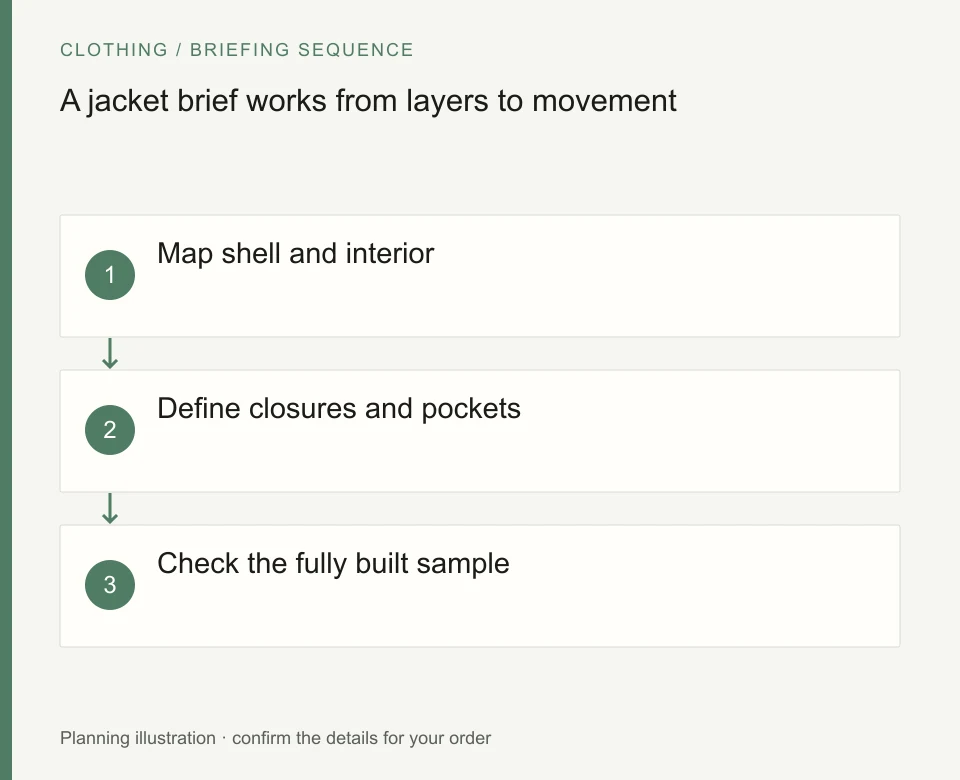
Map the layers and panels
Provide front, back and open-interior drawings with matching panel codes. State which areas use shell, lining, facing or another material. If the jacket includes padding or interlining, describe the intended structure and ask for the proposed construction to be confirmed. Do not infer weather protection, insulation performance or certification from the name of a fabric or layer.
Add seam and edge details where the finish matters: collar, hem, cuffs, pocket openings and any exposed inside seams. Explain whether the desired look is clean, bulky, topstitched or deliberately raw. Different construction choices can change the outline and hand feel. Use close-up references to resolve those details without asking the supplier to copy an entire unrelated jacket.
Specify closures and storage as working components
List zipper or button requirements, opening direction, finished length and visible finish. Identify any placket, guard or backing needed around the closure. For pockets, state position, opening size, bag depth and intended use. A pocket outline on a drawing does not establish whether a hand can enter comfortably or whether the pocket bag interferes with the lining.
Review the interaction between nearby components. A chest pocket may compete with an internal pocket, while a hem adjuster can create bulk near the main closure. Show these relationships in the drawing and request a functional sample review. If branded hardware is proposed, confirm artwork, dimensions and feasibility separately rather than assuming the stock trim in a reference can be reproduced.
Approve fit with the intended layers
State what the jacket is intended to be worn over and provide the base-size measurement method. Assess shoulder, armhole, sleeve, chest and length together while the jacket is fastened and open. A shell-only sample may help an early pattern discussion but cannot fully demonstrate the effect of the final lining or other internal layers on movement and drape.
Document the sample's materials and exceptions, then check the finished garment after any planned wash or treatment. Review closure operation, pocket access and the way the lining sits at the hem and cuffs. Consolidate comments into the next tech-pack version. Release bulk against the complete approved construction, not an outside photograph that leaves the internal specification unresolved.
Send these details together
- Outside and open-interior technical drawings
- Coded layer and panel material list
- Closure, pocket and adjuster specifications
- Base-size chart and intended layering reference
- Finished sample review with all exceptions resolved
Use this checklist to prepare your own order brief. Materials, processes, acceptance criteria and any applicable product requirements need order-specific confirmation; this guide is not a test report or availability guarantee.
Prepare a quote briefThe RFQ form prepares a WhatsApp message for you to review. For files, email sales@clothingmanufacturerchina.com.
Questions before sampling
What are your MOQ, sample time and bulk lead time?
MOQ is 100 pcs. Samples take 7 days. Bulk production lead time depends on order quantity.