How to Brief Apparel Suppliers China Programs
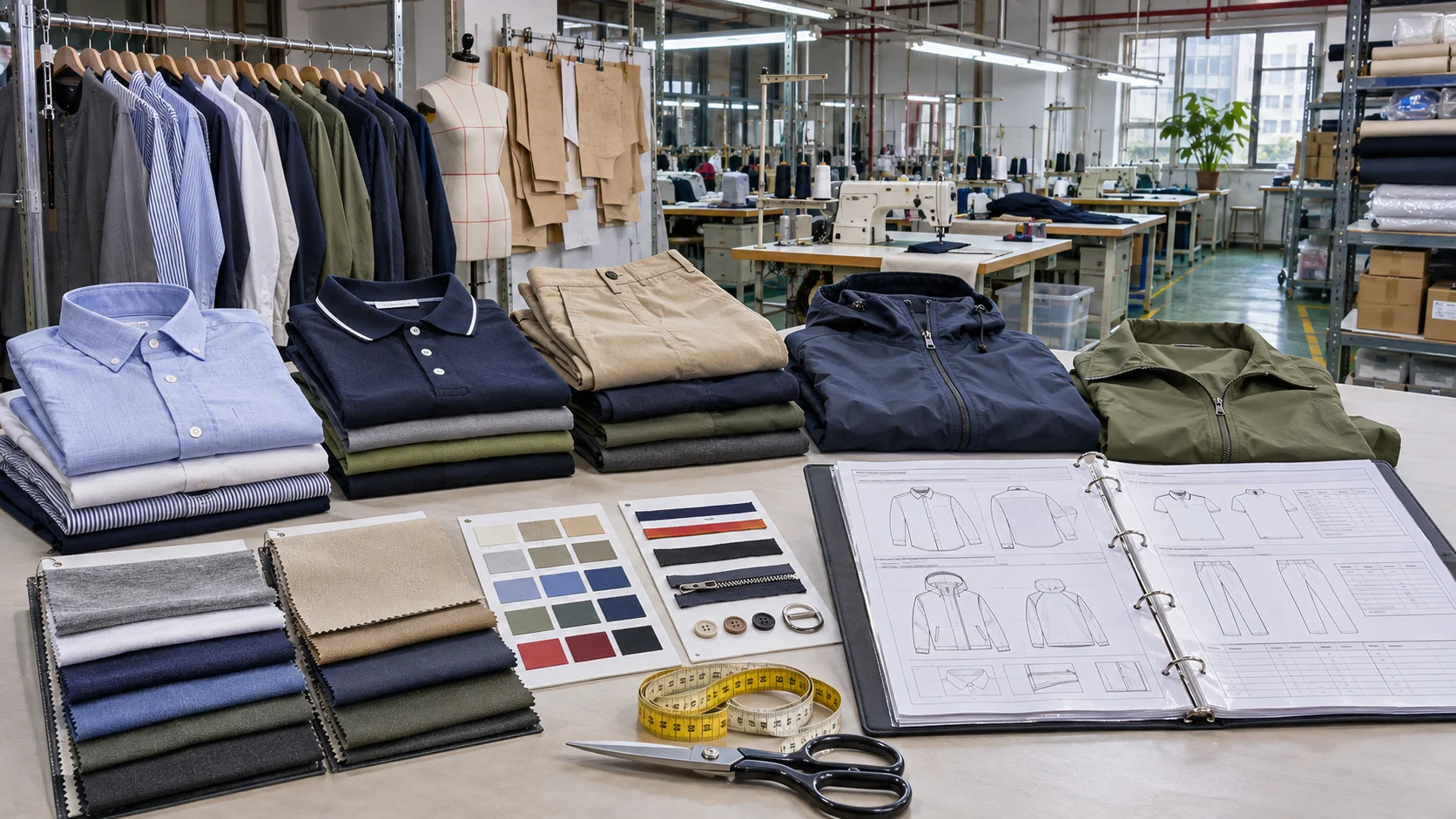
A buyer brief for apparel suppliers China programs should turn a mixed menswear assortment into defined sourcing routes, comparable quotations, and controlled approvals. Separate OEM manufacturing from merchant-supplied finished goods, then identify category capability, technical documents, material responsibilities, and quantities by design, color, and size. Plan around MOQ 100 pcs per color per design, with fabric and component minimums checked separately. Samples take approximately 7 days once the brief and materials are confirmed; bulk timing depends on quantity, material readiness, capacity, and approvals. Use purpose-specific sample gates and a written QC release process rather than treating a complete quotation as production authorization.
At a glance
Swipe the table sideways to compare both columns →
| Briefing decision | Evidence to include or request | Buyer control |
|---|---|---|
| Category and supply route | Assortment matrix, proposed sites, and OEM or merchant classification | Confirm what each supplier makes, sources, or holds as finished stock |
| Technical baseline | Versioned tech packs, material references, measurements, and open questions | Separate confirmed requirements from assumptions and proposed alternatives |
| Color and size allocation | Quantities by design, color, and size with separate component minimums | Check feasibility at MOQ 100 pcs per color per design |
| Sample approval | Sample purpose, actual or substitute materials, reports, and decision owner | Limit each approval to the features the sample can demonstrate |
| QC and shipment release | Inspection criteria, batch coverage, corrective actions, and release authority | Keep bulk authorization and shipment acceptance as separate decisions |
1. Structure the apparel suppliers China brief by category
Begin with an assortment matrix rather than a folder of garment photographs. List the menswear categories you intend to purchase, the number of designs in each category, intended selling season, target delivery window, and expected replenishment pattern. Separate jersey tops, woven shirts, trousers, and outerwear where their materials or manufacturing routes differ. A supplier that handles one category should not be assumed to control all adjacent categories equally well. Ask it to mark each line as internally manufactured, subcontracted, purchased as finished goods, or outside its proposed scope. Request the production location and accountable contact for each accepted category. This makes category coverage an operational commitment instead of a broad catalog claim. It also exposes programs that need separate sampling calendars, material approvals, or inspection arrangements before the buyer tries to combine everything into one order.
Keep this brief distinct from supplier discovery and detailed garment engineering. The /china-clothing-manufacturer page can serve as the starting point for manufacturing scope, while a shortlist exercise compares which candidates merit qualification. This resource addresses the next question: what information must every candidate receive so its offer can be compared fairly? An individual custom OEM brief then develops each selected design in greater technical depth. In the assortment brief, state which categories may be split between suppliers and which must share coordinated colors, trims, or packaging. Identify the commercial contact who consolidates responses without implying that consolidation means common production control. Require unanswered questions and exclusions to be returned in a structured schedule. A proposal that silently omits a difficult category should not appear more competitive than one that prices the complete requested program.
2. Separate OEM manufacture from merchant supply
Ask the supplier to classify the supply route for every design before discussing customization. OEM manufacture should identify the specification being produced, the operations included, and the party controlling production changes. Merchant supply may involve purchasing existing garments, allocating warehouse stock, or arranging goods from another producer. Either route can fit a buying strategy, but they support different assumptions about fit consistency, branding changes, replenishment, and material traceability. For merchant goods, request the stock reference, available quantities by size and color, reservation period, and evidence that the reviewed sample represents the allocated inventory. For OEM goods, request the proposed manufacturing site, material sourcing responsibilities, and development deliverables. Do not use the seller's business description as a substitute for this line-level classification. A single company may legitimately use different routes for different items within the same quotation.
Define accountability separately from the physical location of each operation. The brief should name who purchases fabric, develops patterns, approves substitutions, arranges decoration, checks labeling, performs inspection, and handles claims. If an intermediary is the contractual seller, ask how it obtains production records and enforces corrections at the manufacturing site. Outsourcing is not itself a reason to reject an offer, but undisclosed changes in production route should require buyer review. Establish ownership and permitted reuse of artwork, commissioned patterns, tooling, and unused branded components without assuming that a sample fee transfers all rights. For existing garments, confirm whether relabeling is physically feasible and whether required product information remains accurate after modification. Require written disclosure when a proposed alternative changes the underlying garment rather than merely changing its label. Keep those alternatives separate from the compliant quotation so purchasing decisions remain explicit.
3. Set a technical baseline with visible open questions
Issue a document register that assigns each design a stable code, revision date, and current approval status. The minimum technical baseline should include garment drawings, construction notes, a bill of materials, points of measurement, size information, decoration requirements, and label and packing instructions. Specify measurement methods and tolerances rather than sending dimensions without reference points. Describe fabrics by composition, construction, weight and measurement condition, finish, and relevant performance expectations; a category name such as cotton twill is not a complete purchasing specification. Identify which references are mandatory and which are visual direction only. If a physical garment is supplied, record whether it controls fit, workmanship, material appearance, or another limited feature. Otherwise, a supplier may copy an incidental detail that the buyer never intended to approve. Link each quotation to the exact revision used for costing.
Match technical depth to the risks of each category while preserving a common response format. A jersey top may require close attention to relaxation, neckline behavior, and print appearance, while a woven shirt may need collar construction, seam appearance, and interlining compatibility defined. Trousers need clear rise and leg measurement methods; lined outerwear needs an explicit component and assembly sequence. These are briefing prompts, not substitutes for product-specific engineering. Ask suppliers to return a feasibility review that lists missing dimensions, material assumptions, difficult operations, and proposed changes. Distinguish a cost-saving option from a correction needed to make the design manufacturable. Assign an owner and due date to each open question, and prevent unresolved issues from disappearing into a revised price. Destination-market labeling and product requirements should receive separate review by the buyer or its designated adviser before final artwork is released.
4. Reconcile colors, size runs, and separate minimums
Build the quantity matrix around MOQ 100 pcs per color per design, then show the size allocation within each commitment. Do not present a total assortment quantity as though it establishes feasibility for every line. For example, two colors of one design need separate quantity review even when they share the same pattern and fabric construction. Ask the supplier to define what counts as a new design or color when decoration, garment dyeing, or trim changes create different production requirements. Include the complete intended size range and flag any sizes with special fit, grading, or component needs. Confirm whether the proposed size distribution can be cut and assembled without changing the quoted basis. Do not assume that the garment minimum applies separately to each size, or that all size distributions are automatically accepted. Obtain written acceptance of the actual matrix.
Reconcile the garment plan with fabric, dyeing, decoration, label, and packaging commitments. A sewing quantity that meets the stated minimum may still depend on stock cloth, shared trim inventory, or surplus purchases. Ask for each constrained component's purchasing basis, usable quantity, development consumption, and expected remainder, with responsibility for storage or disposal identified. If several designs share a material, confirm that the proposed consolidation is technically valid and that allocation records preserve traceability. Similar color names do not establish a shared dye lot or a common appearance across different fabric constructions. Request physical color approvals and define how coordinated categories will be assessed together. For replenishment, distinguish reserved material from an expectation that similar stock will remain available. Make the quotation state what happens if a later order requires a replacement article, a new dye lot, or a different component minimum.
5. Define sample purposes and conditional timing
State what each sample must prove before asking when it will arrive. Samples take approximately 7 days once the brief and materials are confirmed, but that allowance does not cover every development round, transit period, or material procurement delay. Ask the supplier to confirm the starting conditions and list anything that prevents the sample clock from starting. A substitute-fabric fit sample can support a limited silhouette review, but it cannot establish final shrinkage, handfeel, or decoration behavior. A material swatch can approve a surface or color without approving garment construction. Specify the sample size, material status, required labels, accompanying measurement report, and decision owner for each submission. Record comments against the design and document revision rather than relying on an unstructured message thread. Where categories use different manufacturing routes, give them separate sample gates instead of forcing one misleading completion date.
Before bulk authorization, require a preproduction reference that represents the intended materials, construction, finishing, and branding. Define any additional size review needed to assess grading rather than assuming the base size proves the whole range. List unresolved components and state exactly which activities remain blocked; approval to purchase fabric is not automatically approval to cut or ship. Bulk timing depends on quantity, material readiness, production capacity, and the speed of buyer decisions. Request a dependency-based schedule covering purchasing, cutting, assembly, decoration or finishing, inspection, and packing, with transport treated separately. Identify the consequences of a delayed approval across coordinated categories and decide whether split deliveries are acceptable. Retain matching approved references with the buyer and production team. Require renewed review for substitutions or changes that affect appearance, fit, labeling, or performance, even when the supplier expects the revised route to save time.
Send these details together
- Map every category and design to an OEM, subcontracted, or merchant supply route with an identified accountable party.
- Issue versioned technical documents and require a written list of assumptions, exclusions, alternatives, and open questions.
- Confirm MOQ 100 pcs per color per design against the actual size matrix and separate material and component commitments.
- Assign sample purposes, material status, approval owners, and approximately 7-day starting conditions without treating them as a full development schedule.
- Approve the intended production reference and a dependency-based bulk schedule before authorizing the relevant work.
- Agree inspection coverage, corrective-action responsibilities, shipment release authority, and records needed for replenishment.
This guide covers buyer-side assortment briefs for China menswear suppliers across OEM manufacturing and merchant supply routes. It focuses on category coverage, comparable supplier responses, technical readiness, quantity planning, sample gates, and QC release rather than supplier ranking or complete garment engineering. MOQ 100 pcs per color per design is the garment planning basis; confirm accepted size allocations and separate material and component minimums. Samples take approximately 7 days once the brief and materials are confirmed; bulk timing depends on quantity, material readiness, capacity, and approvals. Contract rights and destination-market product and labeling requirements require separate review. Reprint attribution: clothingmanufacturerchina.com.
Prepare a quote briefThe RFQ form prepares a WhatsApp message for you to review. For files, email sales@clothingmanufacturerchina.com.
Questions before sampling
How does an assortment brief differ from a custom clothing OEM tech pack?
An assortment brief defines the categories, supply routes, quantities, shared requirements, responsibilities, and delivery dependencies across a purchasing program. A custom OEM tech pack specifies how an individual design should be made and measured. Use both when commissioning new garments. The assortment brief makes supplier offers comparable, while the tech pack provides the controlled technical reference for development and production.
Can one supplier combine OEM garments and merchant stock in the same order?
Yes, if the route for each line is disclosed and the approval requirements remain separate. Merchant stock needs identified inventory, size and color availability, reservation terms, and a representative sample. OEM garments need a controlled specification and production approvals. Confirm how labeling, inspection, claims, and replenishment work for each route rather than assuming one seller means one manufacturing process.
Does MOQ 100 pcs per color per design mean 100 pieces in every size?
The planning basis is 100 pieces for each color of each design, with sizes allocated within that quantity. It does not by itself establish a minimum of 100 pieces per size. Submit the actual size matrix for acceptance, since grading, cutting, or component constraints may affect feasibility. Fabric, decoration, branded trims, and packaging can also carry separate purchasing commitments.
Does a sample taking approximately 7 days mean bulk can start immediately afterward?
No. Approximately 7 days applies once the brief and materials are confirmed and should be tied to a defined sample purpose. Review time, revisions, actual-material confirmation, and additional size checks may still be needed. Authorize bulk only after the relevant approval gates are closed. Bulk timing depends on quantity, material readiness, capacity, and approvals, not simply the arrival of the first sample.
What are your MOQ, sample time and bulk lead time?
MOQ is 100 pcs. Samples take 7 days. Bulk production lead time depends on order quantity.