Plan a Streetwear Capsule Before Requesting Quotes
A streetwear capsule is easier to develop when each style has a clear role and the shared details are intentional. A tee, hoodie and trouser can belong to one collection without sharing the same material or fit rules. Build a small style matrix before asking a factory to quote the whole range.
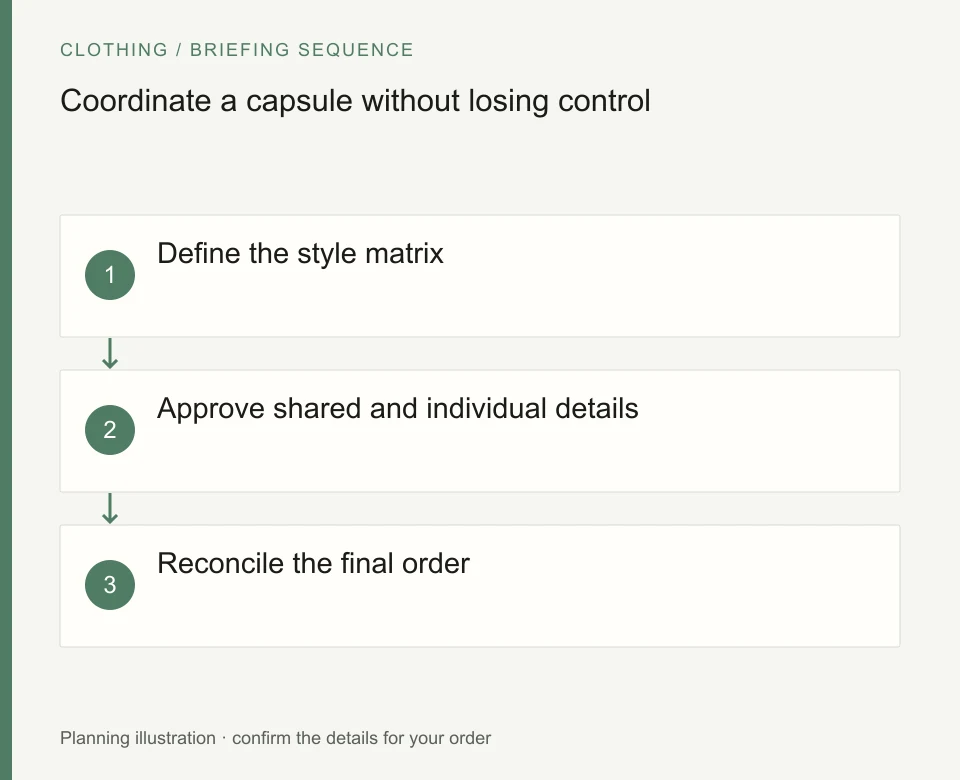
At a glance
Swipe the table sideways to compare both columns →
| Decision | What to specify | What to verify |
|---|---|---|
| Collection | Shared logo, color relationship and label language | Maintain a master reference and change history. |
| Style | Individual fit, material and construction | Approve each garment, even within a set. |
| Order | Quantity and size plan for each variant | Confirm feasibility before committing the full range. |
Give every style a job
Identify the lead garment and the supporting pieces. Record what makes each worth developing: an oversized proportion, a distinctive pocket, a washed finish or a graphic placement. If two styles serve the same purpose with only a minor detail change, decide whether both are needed for the first release. More variants create more approvals and more inventory decisions.
Create one row per style with its code, silhouette, material direction, color options, decoration and size range. Keep proposed quantities in the same matrix so the development scope can be compared with the buying plan. Do not assume that a collection total satisfies every material or process condition; ask the supplier to review the proposed breakdown explicitly.
Define what is shared and what is not
Choose the elements that connect the capsule: logo treatment, label system, color relationship or a repeated seam detail. Maintain a master reference for each shared feature and link it from the individual tech packs. This avoids one garment using an old logo while another uses a revised file, without forcing all garments to have identical construction or dimensions.
When coordinating colors across jersey, fleece, rib and woven fabric, review physical submissions together. Different surfaces can look different under the same light even when the nominal color target is identical. Decide whether the aim is close matching or deliberate tonal contrast. Keep that decision visible on the collection board and approve the complete outfit where coordination matters.
Sequence development around dependencies
Begin with unresolved features that affect several pieces, such as a shared graphic or color direction. At the same time, track garment-specific fit and material approvals separately. A hoodie sample cannot approve the waistband of a matching trouser. Record dependencies so a change to one shared reference triggers review only where it actually affects another style.
Before releasing bulk, reconcile the style matrix with final quantities, sample versions and packing instructions. Decide how sets are identified if tops and bottoms are sold together, and whether customers can select different sizes. Keep launch planning separate from unconfirmed production timing. Bulk lead time depends on order quantity and should be confirmed against the actual collection and approval state.
Send these details together
- Style matrix with each garment's purpose
- Individual material and silhouette references
- Shared logo, label and color master files
- Dependencies and separate sample approval status
- Final size breakdown and set-packing instructions
Use this checklist to prepare your own order brief. Materials, processes, acceptance criteria and any applicable product requirements need order-specific confirmation; this guide is not a test report or availability guarantee.
Prepare a quote briefThe RFQ form prepares a WhatsApp message for you to review. For files, email sales@clothingmanufacturerchina.com.
Questions before sampling
What are your MOQ, sample time and bulk lead time?
MOQ is 100 pcs. Samples take 7 days. Bulk production lead time depends on order quantity.