How to Set Private Label Clothing QC Standards
Learning how to set private label clothing QC standards starts with translating product expectations into measurable acceptance criteria, not asking inspectors to judge general quality. Define measurement methods, workmanship limits, label content, packing rules, defect classes, and inspection responsibilities before production. Use MOQ 100 pcs per color per design as the garment planning basis, with separate material and component minimums checked. Samples take approximately 7 days once the brief and materials are confirmed; bulk timing depends on quantity, material readiness, capacity, and approvals. Connect every inspection result to a controlled specification and a written hold, correction, or release decision.
At a glance
Swipe the table sideways to compare both columns →
| Control area | Acceptance criteria to write | Evidence and release action |
|---|---|---|
| Measurements and fit | Point definitions, garment condition, size targets, tolerances, and size-specific exceptions | Record actual readings by size and hold affected groups when results fail the agreed criteria |
| Workmanship and appearance | Construction requirements, defect descriptions, severity, location, and visual limits | Compare findings with labeled references and document correction before reinspection |
| Labels and branded components | Approved content, version, placement, orientation, attachment, and item matching | Verify components against the approved bill of materials and isolate incorrect versions |
| Packing and assortment | Folding, protection, SKU identification, size ratios, quantities, and carton markings | Reconcile packed units with the order matrix and correct mismatches before dispatch |
| Sampling and disposition | Lot definition, sampling scheme, defect counting, acceptance rules, and release authority | Issue a traceable report and require written disposition for failed or unresolved lots |
1. Define how to set private label clothing QC standards
Start with a QC specification that describes the product you are buying and the decisions an inspector must make. Separate measurable requirements from descriptive preferences: a shirt can be called cleanly finished while the buyer and sewing supervisor disagree about acceptable collar asymmetry. Identify each style, color, size range, fabric article, construction version, and finishing route covered by the document. Assign a revision number and effective date, then name the buyer representative who approves changes. State which document controls if the purchase order, technical pack, approved sample, and inspection instructions conflict. Require clarification before production when those references disagree rather than allowing the factory to select the easiest interpretation. The purpose is not to write every possible defect into a contract. It is to make the important acceptance decisions repeatable and to establish how an unfamiliar or disputed condition will be resolved.
Build the requirements around how each garment will be used, sold, and replenished. A woven overshirt, knitted polo, and lined trouser need different attention even when they belong to one private label clothing program. Identify features that affect safety, function, fit, appearance, and retail identification, then define the evidence needed for each. Use the [factory evaluation guide](/resources/how-to-evaluate-private-label-clothing-factories) to assess whether a supplier can operate these controls; supplier capability is a separate decision from what your order must pass. Put product definitions in the [technical pack](/resources/private-label-clothing-tech-pack-checklist) and reference them from the QC document instead of maintaining conflicting copies. Assign responsibility for measurements, laboratory testing where required, label review, inspection, and final disposition. Confirm that the legal seller accepts the standard and communicates it to subcontractors. An inspector should not become the default product designer because the purchasing documents leave limits unresolved.
2. Write measurement criteria that inspectors can reproduce
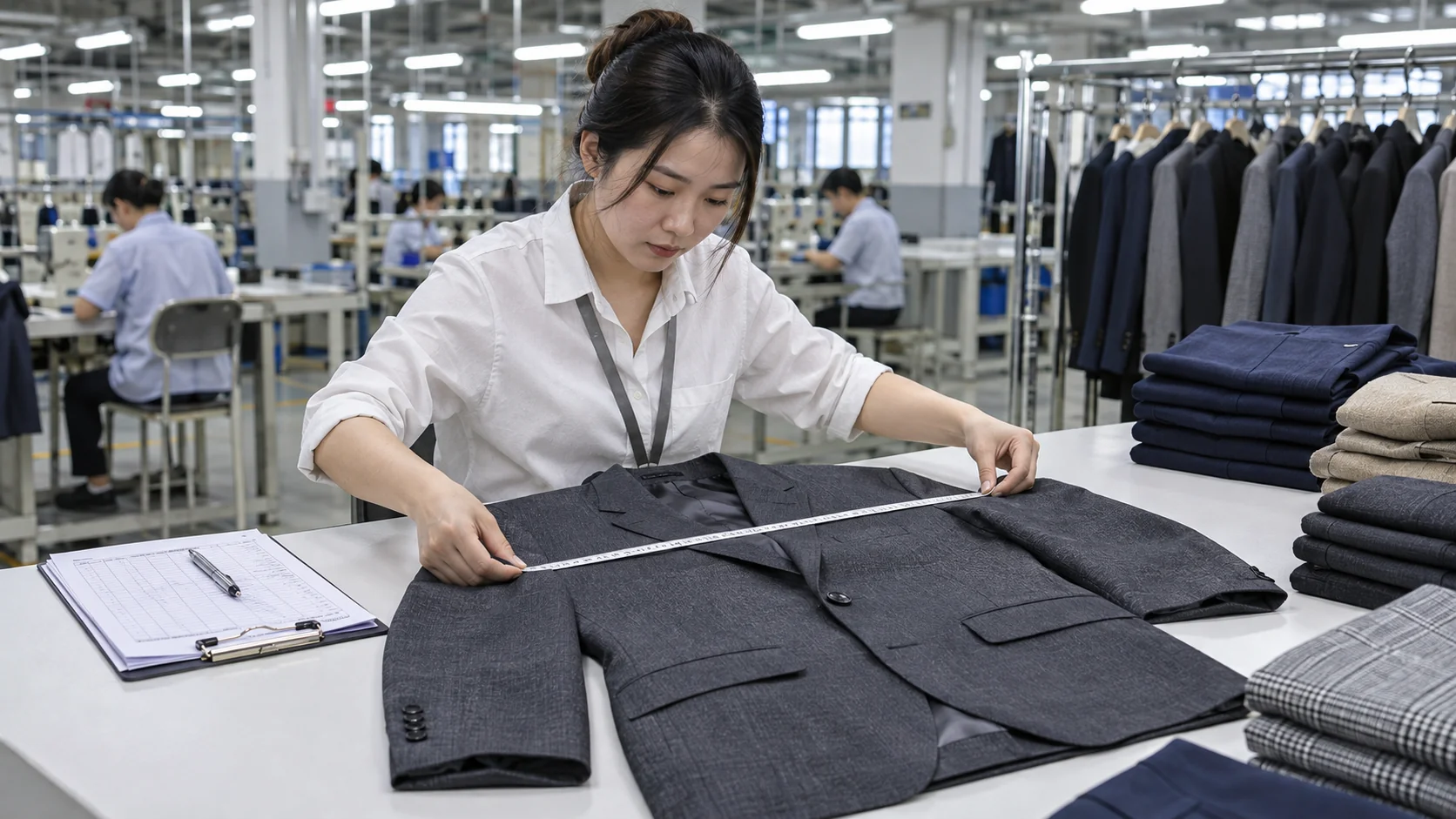
For every controlled measurement, provide a point name, diagram, target by size, tolerance, and measuring method. Explain whether the garment is laid flat, fastened, relaxed, or extended, and whether a reported width is a flat measurement or a circumference. Define reference points for shoulder, chest, sleeve, waist, rise, inseam, and other relevant dimensions rather than relying on familiar names alone. Specify the garment condition: after the intended finishing process, after any agreed conditioning period, and before or after a defined care trial where applicable. Do not apply one convenient tolerance to every point. Consider the construction, material behavior, intended fit, and ability to measure consistently. An elastic waistband needs a defined relaxed state and, if extension is assessed, an agreed extension method. Have both parties measure the same sample and compare readings before using the method to judge bulk production.
Keep production measurement acceptance separate from evaluating whether the approved silhouette suits your customer. Bulk inspectors can verify the agreed specification, but they cannot repair a fit decision that was never settled. Use the [sample approval checklist](/resources/private-label-clothing-sample-approval-checklist) to record fit decisions, then transfer the resulting targets and exceptions into the controlled QC document. State how many garments and which sizes will be measured under the inspection plan, including coverage of size extremes where relevant. Record individual readings rather than only averages, since an average can conceal opposing deviations. Define how an out-of-tolerance result is classified and whether it triggers expanded checks, segregation, or a lot hold. If dimensional change after care matters, specify the care procedure, comparison method, acceptance limits, and testing responsibility separately. Do not assume that an initial measurement pass establishes acceptable shrinkage or shape retention after washing.
3. Classify workmanship and appearance defects
Write workmanship requirements around observable conditions and their consequences. For seams, identify the required construction, stitch appearance, seam allowance where controlled, and unacceptable conditions such as open seams, skipped stitches, broken threads, or seam puckering beyond the approved visual limit. For functional components, define checks for button attachment, zipper operation, pocket access, closures, and elastic insertion using agreed methods. State which features need measurements, which need functional trials, and which are judged against retained examples. Avoid instructions such as perfect stitching or export quality because they do not establish a consistent threshold. Use annotated photographs and physical defect examples where words are insufficient, especially for puckering, pressing marks, surface damage, and uneven topstitching. Identify viewing distance, lighting, garment presentation, and affected locations for appearance checks. A prominent front-panel defect may have a different commercial effect from a similar condition inside a concealed seam.
Create a defect classification table with agreed critical, major, and minor categories, but do not assume the category names settle every case. Describe the actual defect, relevant location, extent, functional consequence, and classification. A wrong size label, for example, needs an explicit rule because it can misidentify the garment even when sewing is acceptable. Safety-related findings need defined stop and escalation instructions rather than treatment as ordinary cosmetic variation. For shade, approve a target and acceptable limits under stated viewing conditions; distinguish variation between garments from mismatched panels within one garment. Specify how repeated defects on one unit are counted under the selected inspection system. Keep private label garments with unresolved classification disputes on hold while the designated buyer representative decides. Record that decision as a controlled clarification for the affected order, and determine whether future orders need a revised standard.
4. Make labeling and packing part of acceptance
Treat labels as controlled product components, not finishing details that can be checked only for neat attachment. List each brand label, size label, care label, composition statement, origin marking, hangtag, and other required identification by approved version. Specify content, dimensions, material where relevant, position, orientation, attachment method, and readability. Match size and SKU information to the garment and order matrix. The buyer should arrange destination-market review of required wording and instructions; factory artwork approval alone does not establish legal compliance. Require production to use the approved files and physical components, with obsolete versions segregated or removed. Include checks for labels trapped in seams, distorted printing, incorrect orientation, and attachments that damage the garment. If branded trims undergo washing, pressing, or another finishing treatment, assess their condition after that process rather than accepting an unused component as evidence of finished-product suitability.
Write packing requirements at garment, assortment, and carton levels. Define folding, protective materials, required inserts, bag identification, barcode data where used, and any market-specific packaging warnings subject to review. State the quantity and size ratio for each pack, the permitted carton assortment, carton markings, and how packed goods remain linked to production lots. Specify barcode readability checks separately from checking that encoded information matches the intended item. A readable code can still identify the wrong size or color. Set rules for garment cleanliness, moisture or odor concerns, exposed hardware, and packing damage using appropriate inspection or testing methods rather than vague assurances. Reconcile packing lists to physical counts before shipment and define how shortages, overages, and mixed assortments are handled. Keep any agreed quantity allowance separate from defect acceptance; permission to ship a different quantity is not permission to ship incorrect or damaged units.
5. Specify sampling language and inspection points
If you use acceptance quality limit, or AQL, sampling, name the agreed sampling standard and applicable edition in the purchasing documents. Then specify the inspection level, sampling type, severity, lot definition, lot size, defect classes, and selected AQL values where applicable. The resulting sample size and acceptance and rejection numbers must come from that chosen plan, not from an inspector's customary practice. Explain whether counting is based on nonconforming units or individual nonconformities and how multiple findings on one garment are treated. Do not describe AQL as a guaranteed maximum percentage of defects in every shipment. Sampling supports a lot acceptance decision under stated rules; it does not establish that every uninspected unit conforms. For critical findings, write the immediate hold and escalation rule explicitly, and assess whether additional prevention, testing, or full checks are needed rather than relying on sampling alone.
Define inspection points around opportunities to prevent or contain defects. Incoming checks can confirm material identity, shade grouping, visible damage, and approved trims before cutting. Early production checks should assess the first completed work from the intended line and finishing route, while in-process checks monitor recurring construction and measurement issues. Final inspection should occur at an agreed completion and packing status that permits representative selection and packing verification. Use MOQ 100 pcs per color per design as the planning context, not as an automatic inspection lot or sample size. State whether colors, designs, sizes, and production batches form separate lots or agreed strata, and explain the coverage required. Buyers may choose full checks for selected attributes on small runs, but should define the scope and limitations. Factory routine checks and independent inspection serve different purposes; neither should silently replace the other.
6. Document hold, correction, and release authority
Create a disposition procedure before the first inspection. Name who may stop work, isolate inventory, approve repairs, authorize reinspection, accept a documented concession, and release shipment. A failed lot should have an identifiable hold status in both records and storage so it cannot be mixed back into accepted goods. Require a report showing the inspected population, sampling method, specification revision, measurements, defect counts, photographs, and affected quantities or groups. The factory should propose containment and corrective action, including checks for the same issue elsewhere in production. After sorting or repair, define how the lot will be presented again and how reinspection will verify the correction without overlooking unrelated defects. Do not treat replacement of a few failed sample units as correction of the lot. Agree responsibility for repair, inspection, storage, and transport costs contractually, without assuming every finding has the same cause.
Tie QC release to the production schedule and purchase order rather than treating it as an informal approval near dispatch. Samples take approximately 7 days once the brief and materials are confirmed, but revisions, testing, transport, and buyer review need separate allowances. Bulk timing depends on quantity, material readiness, capacity, and approvals, including time to investigate failures. Specify which unresolved issues prevent cutting, finishing, packing, or shipment, and do not let silence count as acceptance. For remaining commercial questions, use the [questions-to-ask guide](/resources/questions-to-ask-private-label-clothing-manufacturers) to establish reporting access, subcontractor controls, and claims procedures. When requesting an OEM quotation through the [private label clothing manufacturer page]([private label clothing manufacturer](/private-label-clothing-manufacturer)), submit the QC standard alongside the technical pack and quantity matrix. Ask the supplier to identify exceptions before order confirmation. Keep each approved concession limited to its stated quantity and delivery; it should not quietly become the standard for replenishment.
Send these details together
- Issue a revision-controlled QC specification with document precedence, approval owners, and rules for resolving conflicting references.
- Define measurement points, garment condition, methods, targets, tolerances, size coverage, and out-of-tolerance actions.
- Classify workmanship, appearance, functional, and safety-related findings with observable limits and labeled examples.
- Approve label content and versions, component placement, SKU matching, packing ratios, carton markings, and count reconciliation.
- Specify the sampling system, lot boundaries, counting method, acceptance rules, inspection stages, and any full-check requirements.
- Agree hold status, containment, corrective action, reinspection, concessions, release authority, and cost responsibility before production.
This guide covers buyer-side acceptance criteria for China private label clothing OEM orders, including measurements, workmanship, labeling, packing, sampling, and bulk disposition. It does not replace product-specific risk assessment, destination-market compliance review, or laboratory test planning. MOQ 100 pcs per color per design is the garment planning basis; confirm size allocation and separate material and component minimums. Samples take approximately 7 days once the brief and materials are confirmed; bulk timing depends on quantity, material readiness, capacity, and approvals. Agree sampling details and contractual remedies for each order rather than assuming a universal QC threshold. Reprint attribution: clothingmanufacturerchina.com.
Prepare a quote briefThe RFQ form prepares a WhatsApp message for you to review. For files, email sales@clothingmanufacturerchina.com.
Questions before sampling
Is an approved sample enough to define clothing QC standards?
No. A sample provides a physical reference, but it rarely defines every measurement tolerance, label requirement, defect class, or packing rule. Connect the sample to a controlled specification with measurement methods and written acceptance criteria. Identify which reference governs if documents conflict. Use photographs or limit samples for visual judgments, and record any accepted deviations without turning them into unrestricted permission for future orders.
What AQL should a buyer specify for private label garments?
There is no single AQL suitable for every garment and risk profile. Agree the sampling standard, inspection level, lot definition, counting method, defect classes, and selected values before inspection. Use the chosen plan to determine sample sizes and acceptance numbers. AQL is not a shipment-wide defect guarantee. Safety-related concerns may require additional preventive controls, testing, or full checks beyond routine acceptance sampling.
Should a 100-piece clothing order receive a full inspection?
A small order can make full checks practical for selected attributes, but quantity alone does not determine the inspection method. Plan around MOQ 100 pcs per color per design, then define actual lot boundaries and risks. Distinguish full visual checks from measurements, functional checks, and destructive testing. If using sampling, obtain the sample size from the agreed plan rather than choosing an arbitrary percentage.
What should happen when a final clothing inspection fails?
Place the affected lot on a documented hold and identify the reason for failure. Require containment, investigation, and a corrective-action proposal covering potentially affected units, not just the inspected failures. Agree sorting or repair scope and reinspection conditions. Shipment should proceed only after the named authority records release or a limited concession. Resolve associated costs according to the purchasing agreement and documented responsibility.
What are your MOQ, sample time and bulk lead time?
MOQ is 100 pcs. Samples take 7 days. Bulk production lead time depends on order quantity.